Press Enter / Return to begin your search.

How To Plant An Urban Garden: A Step-By-Step Tutorial

As winter recedes and we dig our slightly lighter clothes out from the back of our closets, our thoughts turn to vegetables and flowers—even if, for city dwellers, our growing spaces are limited to balconies, rooftops, fire escapes, sunny windowsills, and tiny backyards. But these meager spaces shouldn’t deter us; it’s surprisingly easy (and fun!) to grow all kinds of pretty and delicious plants even without a lush suburban yard.

Maureen O’Brien, a community field manager at the Brooklyn Botanic Garden, walked us through some of the many easy ways to plant a garden, even in a small space. The key limiting factor in what you can plant, says O’Brien, is sun. She divides the possibilities for small-space gardens into three categories: shady, part-sun, and sunny. Full sun is going to be unusual in an urban environment: trees, other buildings, fences, and all kinds of other obstacles are likely to block sunlight for at least part of the day. Partial sun, generally, is what we urbanites might think of as “extremely sunny,” consisting of unblocked sun for around four to six hours per day. Anything under four hours is considered shady—if you’re looking at under two hours a day, you’ll be restricted to plants that need basically no sun at all.

Photo: Unsplash user Thomas Verbruggen

Steal My Sunshine

If your growing space has a mere few hours of sun per day—this might include something like a sunny window—you still have options.

First, you’ll need a container. You might be surprised that those expensive glazed or terracotta pots, while beautiful, offer absolutely no advantage to growing plants besides looking nicer than, say, a plastic bucket. “Plastic quart takeout containers would work fine for herbs; or you can get an expensive glazed pot, and that works fine, too,” says O’Brien. We love Home Depot’s five-gallon “Homer” bucket ($3.42 each) for big stuff, and its “Norcal” terracotta pots ($1.32 each) for little stuff. If you want something a bit more stylish, Crate & Barrel make really beautiful two-tone planters ($6.95-$49.95). There’s always Ikea, which typically has a solid selection of inexpensive planters, or you can buy plain boards ($7.98) and make them yourself:

[youtube https://www.youtube.com/watch?v=UUOsUNtXK7k?rel=1&autoplay=0]

The key is to make sure the container has a hole in it, preferably around the sides, about an inch up from the bottom, to provide proper drainage. You’re a garden noob and may accidentally overwater, so drain holes let any excess water escape without rotting the roots. You could insert a little piece of screen or a bit of fabric to block soil from coming out of the bottom, but you’ll still want to place a container like this on a catch saucer in case excess water comes out. If you’re doing a lot of gardening, you could opt for some weed-blocker fabric, which is effective and cheap at scale ($18 for 50 yards). An old T-shirt, honestly, will work as well. (I’ve typically just done without and accepted that a little soil will come out of the bottom with excess water.)

Be careful of window boxes that hang from a window ledge: for one thing, they can be dangerous if not properly attached, and for another, it’s trickier to plant a bunch of different plants in a single container. They can fight with each other for water or nutrients, and if they have different water needs, you’ll end up over- or underwatering something. If you do go for a window box, this one from WindowBox.com ($76.97) allows you to place individual pots in the window box holder.

You’ll need soil, too; in most urban environments, soil can be polluted and generally rocky, sandy, and depleted of nutrients. Better to buy some potting soil. For beginners, Miracle Gro or other boosted-nutrient soils work just fine, but for intermediate gardeners, O’Brien recommends going organic. “When you use Miracle Gro or things like that, it’s a big shock of nitrogen all at once, and it doesn’t stay in the soil,” she says. The nitrogen can soak into groundwater, which isn’t good, but it also has weird effects on the plant: O’Brien says she’s noticed that too much nitrogen can result in more succulent leaves, which can attract pests, as well as fewer fruits. Black Gold ($16.00 for four quarts) makes some good organic soil, or if you want to go the non-organic route, just snag some Miracle Gro. It’s available on Amazon ($7.49 for 1 cubic foot), but you’ll find more options if you go to a hardware store or a Home Depot or Lowe’s. (I’ve had good luck with Miracle Gro’s organic line, Nature’s Care. But don’t overthink it. Just buy some potting soil.)

You’ll want to grab some fertilizer, too. O’Brien recommends either a liquid fish emulsion or the granular version. Jobe’s is the go-to brand for organic fertilizers, and is very cheap ($8.24 for four pounds, easily enough for a couple of seasons). I’ve used a liquid fish-based fertilizer called “Neptune’s Harvest” for years, primarily because it has an amusing label. Exactly what sort of fertilizer you should use actually varies by plant, soil type, and pH levels, but for starting out, just follow the directions and err on the side of underfertilizing.

So what can you grow in a difficult, shady spot? Edibles can be tricky, but a few herbs will grow happily without much sun. Mint is a great option, as are chives. They grow without much effort on your part and are hearty enough to withstand your mistakes. For non-edible options, O’Brien recommends “amaryllis or other bulbs, something where the energy’s already in the bulb.” Amaryllis bulbs (various prices, but don’t spend more than about $12)—produce absolutely stunning gigantic pink-and-white flowers with minimal effort. Ferns and many other houseplants are also pretty shade tolerant. You can buy some of these online easily; Amazon sells a rubber tree ($18-ish) that’ll arrive already planted and will eventually grow to six feet or taller. There are also lots of plant starters available inexpensively on eBay.

Beginners will want to go with seedlings instead of seeds. “Most seed packets have enough seeds to grow a 100-foot row of plants,” says O’Brien, and you certainly don’t need that. And some plants are tricky to grow from seed: “Parsley takes, like, three weeks to germinate,” she says. Don’t bother: Grab some seedlings from a local garden store or farmer’s market.

Photo: Unsplash user Jeff Sheldon

I’ve Got A Pocketful Of Sunshine (And Literally No More)

So you’ve got a little more sunshine than just a window—perhaps a deck or a south-facing window. Now you’ve got some options. First of all, go bigger: The size of your container will heavily affect the size of your final plant. Always go bigger than you think you need, and never overcrowd plants. Those gigantic five-gallon containers from Home Depot are good for, believe it or not, a single tomato plant or chili pepper plant. Don’t try to put in more; the plants will fight each other rather than grow tall and strong.

For intermediate gardeners, you can make a pretty amazing drainage system out of those buckets. Fill them with gravel ($11.69 on Amazon) up to a couple inches from the bottom of the bucket, then lay a layer of fabric (weed blocker is good, but honestly cotton will work fine) over top of that, then fill up the bucket the rest of the way with soil. This strategy gives you a much more regulated drainage system and will help your soil resist mold and sitting water.

Be careful if you’re planting multiple plants together; look at the tags to make sure they have the same requirements in terms of sunlight and water. Some plants naturally work together; “If it was an herb box, and you had parsley, basil, mint, and cilantro? Those are all kind of similar, they like a lot of water and would do best under full sun,” says O’Brien. But others, like sage, thyme, and oregano, need less water and less sun, and wouldn’t do as well under the same conditions.

Part-sun environments really open up what you can grow. Greens are incredibly easy, and for intermediate gardeners are a great way to play around with seeds. Lettuces, arugula, and chard are all super simple to grow, and germinate quickly.

Beginners and intermediates alike can opt, finally, for some non-leaf edibles as well. Tomatoes are easy to grow, but be careful about what kind you choose: O’Brien recommends cherry or grape tomatoes, which give harvests throughout the summer and can handle less sunlight and less space a lot more readily than, say, a beefsteak. Chili peppers are also incredibly easy to grow. If you’re starting from seed, O’Brien recommends seeds from Renee’s Garden, which you can find for about $3.00 per packet. From seedlings? Just head to your farmers’ market or hardware store.

With part sun, you’ll also probably encounter pests. Even in an urban environment, there are plenty of bugs (and even squirrels and pigeons) that are just as eager as you are to chomp down on some fresh local produce. Addressing bugs doesn’t have to be complicated: A simple solution of a tablespoon or two of dish soap to a quart of water in a spray bottle and squirted onto leaves and stems will discourage most bugs.

As for watering, again you can go as simple or as complicated as you want. The only real rule is to not over- or underwater, and to water directly into the soil where the stem emerges. Don’t ever water the leaves—they can get moldy and die—although certain plants can enjoy a nice misting of water on their leaves. (Again, refer to the seed packet or tag.)

Black Whole Sun

You’ve got rooftop access or a sunny backyard, so the sky’s the limit now—or, rather, your available space is the limit. A key mistake that many early gardeners make is picking the wrong kind of crop for a small space. Root vegetables are fun—”It’s really something to pull a carrot out of the ground,” says O’Brien—but because you’re eating the root of the plant, you only get one harvest per year, which makes it not a good use of space.

Ditto to gigantic plants like pumpkin, butternut squash, and watermelon. They’ll grow, but not all that well; these plants tend to want to cover the entire ground, and don’t play nice with other crops. And forget corn: Like carrots, it’s really fun, but the amount of space you need to grow even a meal’s worth of corn is probably more than you have in total.

Instead, opt for smaller fruits and vegetables: tomatoes and chili peppers, sure, but also zucchini, eggplant, cucumbers, and beans. Follow the directions on the package for these: Some, like cucumbers and beans, are climbers. Intermediate urban farmers can use an extremely old Native American technique for planting multiple items at once: You can stake or trellis your climbers, then grow ground-covering plants underneath them, like greens or herbs. You get double the crop in the same amount of space. You can get a cheapie wooden trellis for about $18.00, or you can go for beautiful elaborate wrought-iron trellises like this one ($387, which would be, frankly, insane), but they’ll work about the same. (Trellises are a great opportunity for a DIY project.)

With full sun, you might want to investigate a raised planter instead of using containers. This is a bit more effort, but could be worth it: You give your plants a little more room to stretch their roots and grow bigger and stronger. O’Brien recommends the “square foot gardening” system, which blocks off a raised bed into individual sectors to ensure plants grow unimpeded by others in a raised bed. And you can buy the boxes or other setups for that system already put together, or you can opt for a simpler wooden one ($69.99).

If you have a more elaborate raised bed garden, it’s worth it to figure out some kind of automatic watering system. That’ll allow you to leave for a day or a week and not worry about all your hard work going to waste, and will make sure your plants are happy. There are plenty of options, ranging from low-tech drip systems to smartphone-controlled Wi-Fi-enabled gadgets; this is a good guide to get you started.

Photo: Unsplash user Sergee Bee

The Best Gardening Gadgets

It’s likely you’ve read our dead-simple advice above and thought one of two things: Doesn’t everyone know this already? or Isn’t there an Uber for plants? To your first thought I’d reply (in this scenario, I’m a telepath): You’d be surprised. I’ve helped several of my New York City-based friends learn to grow plants over the years, and sometimes even just the basics of watering and draining have been shockingly novel to them. Not everyone actually knows how trees grow in Brooklyn.

As for automation, there is no shortage of off-the-shelf solutions to help you grow herbs and flowers. Some of them are even pretty good! But they’re certainly not as inexpensive as a DIY solution, and many of them won’t present you with the opportunity to learn the basics of gardening that will let you advance to trickier varieties of plants. Still, any method that gets you into the joys of having fresh greens at hand is a win.

Gardening gadgets can be roughly split into two categories: Monitoring solutions that keep track of soil dryness or nutrient balance, and all-in-one growing systems that typically forgo soil for hydroponic, water-based gardening.

Out of all of the monitoring gadgets—the Parrot Flower Power ($55); the Oso PlantLink ($45); the Spruce Irrigation system ($250+)—there are only a couple I’d actually recommend to the casual apartment gardener: the Chirp! water sensor from Adafruit ($16, with battery), which is a simple stick that sits in a pot and makes a little buzzing noise when things get too dry; or the Dr. Meter hydrometer ($16 for two), a clever little analog device that doesn’t even need batteries to operate. Both are highly rated (and regarded) and do the only thing you really need, which is to give you a second opinion about when it’s time to water. And since it’s likely that you’ll be watering all your plants at once, using one monitor in a single pot should be reminder enough that your plants need a little sip. (Bigger pots and bigger plants will go through water at different rates, but you can always just move the monitors to double-check what your finger in the soil tells you.)

Another simple tool? A reminder in your favorite calendar or to-do app that reminds you every two to three days to give your plants a drink.

[youtube https://www.youtube.com/watch?v=fY01M-_xBwI?rel=1&autoplay=0]

If you want to skip the pots and soil entirely, there are several all-in-one hydroponics kits around these days, including the category pioneering AeroGrow/AeroGarden ($87-$112, depending on add-ons), now a division of MiracleGro. These units are about as basic as they come: A water tub at the bottom, some dangling, foam-filled seed pods in the middle, and some sort of grow light on top. I used the first Aerogrow almost a decade ago and found it to be pretty satisfying, albeit without the joy of playing with dirt. These sorts of systems come with their own drawbacks: you can’t really grow root vegetables, and you’ll have to tear them apart every month or two to clean out the insides to keep them from getting scummy with algae. That said, they couldn’t be any easier to use, and even though the prepackaged seed pods are hilariously expensive compared to buying seeds in packets, I have ripped out the old root systems and planted new seeds without any issue. There are a few new contenders in the space, like the Click & Grow ($60) which has an ever-so-slightly classier design, or the Modern Sprout hydroponic system ($150+) which is clad in real wood and downright attractive. They all work in essentially the same way, so if you’re just trying to get bunches of fresh herbs on your shelf—and the units with grow lights make it possible, say, even in non-windowed kitchens—you can’t really make a bad choice.

There are a couple of other categories of gardening gadgets that can be safely ignored for now: super “smart” planters, with Internet-Of-Things integration and other whiz-bang features, like the AliGro or the nthing Planty pot, which are intriguing but far too expensive and unproven for the starting gardener; and grow lights. If you absolutely feel that grow lights are a solution for your black thumb—and as an owner of a few in my apartment garden, I can assure you they are not—take a look at some of the newer, LED-based versions that use a little less electricity than incandescent models. Be ready for an apartment filled with purplish-blue light, though, and for neighbors who knock on your door asking about your stash.

Photo: Unsplash user SnapbyThree MY

Fine, I’ll Grow Something!

The real takeaway here is that gardening is incredibly easy, calming, and rewarding. A takeout container that used to hold wonton soup, plus some soil from Amazon and a nice little seedling from your farmers market, can produce herbs, fruits, vegetables, or flowers. Don’t overthink it: You’ll make mistakes, you’ll lose a few plants to inexperience, but growing plants is a way to liven up your living space and help you quiet—if it’s just for a few minutes a day—the insane bustle of city living.


Read More

“Twisted And Mischaracterized”: How FanDuel’s CEO Is Fighting Back Against Detractors

LeBron James hammers down a thunderous dunk, and 18,000 fans at the 2016 NBA All-Star Game erupt in a reverberating “Ooohhh!”

It’s Valentine’s Day at Toronto’s Air Canada Centre, where James, Stephen Curry, Kobe Bryant, and other stars are dazzling the crowd. A-list entertainers, from Drake to Kevin Hart to Jon Stewart, fill the courtside seats, while NBA commissioner Adam Silver monitors the action at half-court a few rows back. But one of the most significant people attending tonight’s game is someone most fans probably don’t recognize, an inconspicuous Irish math geek seated in row nine: Nigel Eccles, the 41-year-old CEO of FanDuel.

Over the past year, Eccles has turned FanDuel into the most controversial player in the world of sports entertainment. The company’s web and mobile apps let fans bet real money on rosters of athletes like LeBron and Kobe, from $1 to as much as $10,000 or more. Known as daily fantasy sports (DFS), FanDuel’s approach has exploded in popularity: More than 6 million people have registered to play, and last year, the company doled out $1 billion in winnings. FanDuel has raised more than $360 million in financing, has been valued at more than $1 billion, and has locked in deals with 32 NBA and NFL teams.

But as daily fantasy sports has grown, so has scrutiny. Critics argue that FanDuel, the industry leader, is essentially an illegal gambling ring operating at Silicon Valley scale. The service, they say, has streamlined the process and coated a criminal industry in a sheen of legitimacy, thanks to backing from the likes of Google Capital, Comcast, and the NBA. Eight states already prohibit DFS, and dozens more are currently weighing how to handle the phenomenon. With a host of investigations and lawsuits ongoing, FanDuel’s future remains a question mark.

Eccles shows no doubt that FanDuel will survive the regulatory pressure and government skepticism. Looking at him at the All-Star Game, as he munches on a pulled-pork sandwich and claps softly after each swish, you’d never know he’s at the center of so much controversy. “When you’re this close to the action, it’s so good,” says the CEO, who’s grown accustomed to plum seats at major events. Eccles has spent the past two days here in Toronto conducting three closed-door sessions at the upscale Fairmont Royal York hotel, during which he pressed NBA executives not to worry (the league has an equity stake in the company). The previous weekend, he made a similar pitch to NFL team officials attending the Super Bowl. Despite all the negative attention, he wanted them to know, FanDuel’s revenue has actually quintupled over the past 18 months. The company has made significant strides toward legalizing DFS in more than 20 states (a few weeks later, Virginia would become the first to officially sanction it). Among the benefits FanDuel offers to pro sports organizations: The more games that players engage in on FanDuel, Eccles says, the more sports they consume overall. “We’re very bullish on FanDuel,” says Orlando Magic CEO Alex Martins, who attended one of Eccles’s Toronto sessions. “It’s a breakthrough in fan engagement.”

In today’s startup climate—where innovating at speed often outpaces regulation—entrepreneurs like Eccles are convinced that they can’t wait for the government to catch up; they move fast and break things, as the saying goes. Airbnb, Uber, 23andMe—startups hurtle forward on the edges of legality, hoping that consumer demand and the undeniability of their innovations offer strong-enough moral justification. FanDuel, which is both hugely popular and legislatively uncertain, could now be the ultimate test of that philosophy.


FanDuel recently moved into an airy new office near New York’s Madison Square Park, having rapidly outgrown its former home seven blocks south. When I meet up with Eccles there on a February afternoon five days before the All-Star Game, the CEO has so far spent only a few hours in the new space, due to his draining travel schedule and the fact that he lives with his family in Edinburgh, Scotland, where FanDuel’s engineering team is based. Eccles commutes to New York regularly, splitting his time between the two offices.

I arrive just as Eccles is finishing his weekly “Ask Nigel” session, during which he answers queries on a company-wide videoconference call that includes employees of FanDuel’s five satellite offices. Nothing is off-limits during these sessions, with Eccles addressing financial numbers, negative media attention, and even legal issues. “I’ve been at a startup that ran into challenges, and people really weren’t being told what was happening,” the CEO says right after the session ends. “That made it much harder, because it really didn’t feel like we were all in it together.” At FanDuel, Eccles wants everyone to know where things stand. “It has certainly been a period of real uncertainty,” he says. “[Employees are] like, ‘What’s going to happen next?’ ”

It’s a good question. When Eccles cofounded the startup in 2009, long before all the controversy started, no one had heard of daily fantasy sports, and at first, his business grew quietly. FanDuel evolved out of another website, a “news predictor” called HubDub that Eccles launched in 2007 with his wife, Lesley, and three engineers. Though that project didn’t pan out, the quintet decided to continue working together, brainstorming other concepts on Post-its. They eventually hit on an idea to disrupt the fantasy-sports industry. Eccles, a native of Northern Ireland who studied econometrics at St. Andrews and later became a McKinsey consultant, wasn’t much of a pro sports fan, but he and his cofounders were enamored of data, and fantasy sports seemed promising. It was, after all, a game of number crunching.

Fantasy sports dates back decades, but over the past 15 years it has blown up in the United States into a multibillion-dollar Internet business. CBS, ESPN, and Yahoo, the dominant players for season-length fantasy sports, let users set up leagues with friends or enter an open tournament for larger cash prizes. Looking at the industry, Eccles saw an opportunity. “Fantasy sports in 2009 was the same as it was in 1999,” he says. “Maybe the interface was better, but it was the same basic game.” Pain points were rife: Users hated corralling friends to sign up each season; the game was slow; and interest often waned midseason, especially if your team got stuck with an injured player.

Eccles and his cofounders came up with the idea for a daily version, which solved most of these issues and made the experience far more fast-paced. DFS lets fans act as managers of their own virtual teams, assembling rosters of players chosen from the ranks of all current pro athletes, like “Dungeons & Dragons for jocks,” Eccles likes to joke. Your team then competes against those of your friends or other online competitors, and the roster with the best stats wins. DFS compresses the slow burn of a conventional season-long experience into a series of daily mini events, making the action much more intense—and betting much more practical. With FanDuel, competitors can enter a variety of contest styles, from a low-stakes group tournament, where teams finishing in the top half split the prize money, to a $10,600 head-to-head match, where the winner takes all. FanDuel keeps a 10% cut of all entry fees.

The genius of this model was that it worked within the bounds of the U.S. Federal Unlawful Internet Gambling Enforcement Act—or so Eccles argued. Eccles pored over a printed copy of the 2006 law, known as UIGEA (you-EEJ-ah), which barred gambling operators from accepting bets via the Internet. The bill killed the online poker industry, but it made an exemption for fantasy sports, which it branded a game of skill, not chance (essentially leaving it up to individual states to decide whether to allow it). Since the bill didn’t define fantasy sports as a season-long contest, as long as FanDuel satisfied certain UIGEA conditions (such as establishing kitty size before each contest), Eccles concluded that this new daily style of play was perfectly legal.

Leading into the summer of 2009, the team developed the first incarnation of FanDuel in a Google Docs spreadsheet, says cofounder and chief product officer Tom Griffiths, who recalls recruiting test players on Craigslist and accepting their entry fees via PayPal. “We were like, ‘Holy crap! People are doing it!’ ” FanDuel launched a more fully featured website in July, and by November, the company was ecstatic when it pocketed $5,000. Growth was bumpy, partly due to the “extreme seasonality” of sports, Eccles says. Engagement soared during the 2010 NFL or NBA seasons—”I remember thinking, We’re geniuses!” he laughs—but once they ended, it was “tumbleweeds.”

At first, Eccles struggled to attract funding. Paul Martino, an early investor, recalls meeting the “very buttoned-up, straight-arrow” entrepreneur. “Nigel needed to learn how to boast,” he says of Eccles’s pitch. “Most people [who] come into my office you’ve got to tone down, but Nigel we had to tone up. [He potentially] had one of the breakout businesses of the decade.” FanDuel managed to raise $4 million the following September from European investors. With an assist from advertising dollars, daily fantasy finally started to click, and soon the business was booming. In 2013, FanDuel awarded more than $150 million in cash prizes; by the end of 2014, that total jumped to $560 million for the year.

This growth was further bolstered by Fan­Duel’s marketing partnerships with sports leagues and team franchises, which have been essential in legitimizing daily fantasy and bringing it to the mainstream. The Orlando Magic was the first to sign on, in August 2014. Since then, FanDuel has made deals with dozens of NBA and NFL teams, including the Miami Heat and the Green Bay Packers. The company’s pitch was straightforward: DFS increases fan engagement. An NBA playoff game has no trouble selling tickets and ads, but what about that midweek snoozefest between two bottom-rung teams? The more wagers fans place on DFS sites, the more likely they are to tune in to a random matchup that happens to feature players in their lineups, even if the game itself is unexciting. “That’s our bread and butter; we want to make those games nobody cares about as exciting as the Super Bowl,” Eccles says.

In turn, the leagues and teams offer advertising, a social media push, and in-arena promotions. (FanDuel’s deal with the Jacksonville Jaguars, for example, led to “FanDuelVille,” a 3,000-person-capacity section of its stadium that offers multiple cocktail bars, live music, and, of course, a digital lounge experience to feed all your daily fantasy football needs.) These arrangements aren’t cheap: FanDuel pays anywhere from $500,000 to $1.5 million per year to each team it partners with.

In July 2015, with cash prizes headed to $1 billion by the year’s end, the company raised a $275 million round of funding from Google Capital and Comcast Ventures, among others. Much of this money has gone toward marketing, which has become especially significant with the growth of upstart DFS rival Draft­Kings. Launched in 2012, DraftKings itself raised $300 million last summer, led by 21st Century Fox, and the result of all this investment has been an onslaught of advertising. In September alone, when the NFL season kicked off, FanDuel and DraftKings collectively aired more than 200 hours’ worth of 30-second spots, the equivalent of nearly nine straight days of round-the-clock national ads.

FanDuel and DraftKings’ efforts to compete with each other have led to some questionable business practices. For one thing, some of their ads have been shamelessly misleading. Both companies have promised new players that they’d double their deposit, but the fine print hid a huge catch: To unlock, say, a matching $250 bonus, players first had to spend $6,250 betting on the sites. Worse, these ads implied that average fans were regularly winning big money; in truth, 91% of the sites’ payouts were going to an elite 1.3% of DFS players, according to a McKinsey report that studied three months during the 2015 baseball season (a FanDuel spokesperson says that the payout percentage is different at other times of the year). In other words, if you spend money playing games on FanDuel or DraftKings, you are extremely likely to lose it.


When New York attorney general Eric Schneiderman announced that his office would go after DFS, FanDuel executives were shocked by his hostility. “Daily fantasy sports is neither victimless nor harmless,” Schneiderman said in a November 2015 press release, “and it is clear that DraftKings and FanDuel are the leaders of a massive, multibillion-dollar scheme intended to evade the law and fleece sports fans across the country.”

New York attorney general Eric Schneiderman

Things had started to go wrong for the DFS sites that October, when The New York Times published a story about a Draft­Kings employee who allegedly used insider information to win $350,000 in a FanDuel tournament. Both companies denied wrongdoing (although they have since forbidden employees from playing any DFS games), but the revelation led to intense negative media coverage. Fans started to learn about how some of the sites’ most active users gamed the system by entering hundreds of matches (or more) per day with the help of software scripts to automate the betting process.

Cries for regulation were swift, and soon Schneiderman and other state attorneys general opened investigations into DFS. In November, Schneiderman essentially ordered FanDuel and DraftKings to shut down. (An appellate court later ruled that they could continue operating temporarily.) In the wake of the controversy, several major payments processors, including Citigroup and Bank of America, stopped accepting DFS–related transactions in New York state, and the industry now faces around 80 class-action lawsuits, ranging from claims of fraud to false advertising.

Eccles insists that FanDuel has been “twisted and mischaracterized” and that his company operates with integrity. FanDuel has a “good moral compass,” he says—nothing like the unscrupulous gambling ring you’ve read about in the news. “The game is an evolution of seasonal fantasy sports, which has been considered legal for 50 years,” he says. At the same time, he adds, “It shouldn’t be a nonregulated free-for-all. There is no multibillion-dollar unregulated industry; we needed to become regulated.”

Spending time with Eccles, it’s clear that he’s determined to remain disciplined and focused, whatever obstacles arise. “Nigel is not someone who panics,” says Owen O’Donnell, who worked closely with Eccles in the early days of HubDub and FanDuel. “A lot of entrepreneurs have emotional reactions, whereas Nigel has always been pragmatic, measured, and nonconfrontational. You’d never hear his team swearing or shouting.” Still, the company’s efforts to spin opinion can feel a tad contrived, especially when I’m scolded several times for using what CFO Matt King refers to as “the B-word”: betting. (In FanDuel’s world, users don’t bet; they “play.”)

Ultimately, FanDuel’s fate will be determined less by its internal culture than by the vagaries of state-level politics, as legislatures around the country begin to hash out what to allow. The challenges ahead are overwhelming, and they could end up crippling FanDuel. For Eccles, the strategy right now is just to keep going. King compares it to Matt Damon’s character in The Martian, an astronaut trying to make it home from Mars. “How do you survive?” King asks. “He’s like, ‘You solve one problem, and then you solve the next one, and then the next.’ That’s our approach. Because if you take a step back and look at the totality of all of your problems, you’re screwed.”


Since Schneiderman “declared war” on FanDuel, as Eccles puts it, the company has been racing to gain support in state capitols. The CEO says that it was “frightening” how Schneiderman could “wake up and reinterpret the law and decide [DFS is] illegal.” But the reality is murkier. UIGEA, written before the concept of DFS existed, did carve out an opening for fantasy sports at a federal level, but it doesn’t explicitly declare DFS to be legal—and it doesn’t trump state gambling laws.

In many states, the definition of gambling depends on whether a game is predominantly skill- or luck-based. This standard is vague. Is DFS a game of skill because players analyze stats to build the best lineups? Or a game of chance because the outcome of a tournament often depends on unpredictable events, such as wind blowing a field-goal kick wide of the goalposts or a starting quarterback getting injured? “Our laws make it explicitly clear that if there’s a material element of chance, even if skill is involved, it’s still gambling,” Schneiderman has said. The attorney general of Rhode Island, meanwhile, has said he believes that DFS is a mix of both chance and skill and is likely legal under state law.

FanDuel and DraftKings have enlisted armies of high-profile lawyers and lobbyists to push this latter view. The Fantasy Sports Trade Association, which is funded in part by the two DFS leaders, has hired at least 65 lobbying firms in 44 states and will reportedly spend around $10 million on the fight in 2016. NBA commissioner Adam Silver has thrown in his support, as has Dallas Mavericks owner Mark Cuban. (“It’s not a lottery. It’s not a card game. It’s a game of investigation, preparation, and intellect,” Cuban told me in an email.) “Over a three-year horizon, I’m confident that we will get to 45 states with laws that clarify the legality of fantasy sports,” Eccles says.

Currently, there are just two states that specifically legalize daily fantasy sports: Virginia and Indiana (Kansas has a law that legalizes fantasy sports more broadly). But FanDuel says it’s optimistic about regulation in more than 20 state legislatures, including California. Many bills include a set of baseline standards, such as prohibiting DFS company employees and their relatives from playing and upping the minimum age to 21 from 18 (Eccles supports these regulations). To lawmakers such as Indiana state senator Karen Tallian, though, the rapid push to legalize this new industry is distressing. She couldn’t believe that a DFS bill, authored by two novice lawmakers, rushed through the senate chamber without much resistance. “Half my colleagues were going, ‘Fantasy gaming? What’s that?’ ” Tallian recalls. “These companies are pushing legislation all over the country to say [DFS] is not gambling so they can automatically get rid of that hurdle. This is just wrong. We need to slow down and look at this harder.”

In many ways, this legislative approach resembles that of Airbnb and Uber, which continue to fight regulatory battles as they seek broader acceptance of their disruptive services. FanDuel has even tapped consultant Tusk Strategies, which previously advised Uber, to help raise awareness of the situation among consumers. But there’s a difference: Resistance to those companies is primarily coming from the industries being disrupted, whether it’s the entrenched taxi industry or the multibillion-dollar hotel business. With FanDuel, the sports industry is an enthusiastic supporter. Eccles says his plan is to work with legislators to “educate” them about his company, rather than “trying to steamroll into places like Uber.” But he does push back against some tougher regulation. For example, Eccles recoils at a proposal by the Massachusetts attorney general that would institute a $1,000 limit on deposits per month unless customers can verify to DFS operators that they can sustain higher losses. “You would never treat Amazon like that,” Eccles says. “People overspend on shopping, right? Amazon never has to prove that somebody can afford what they’re buying. It feels a bit overly paternalistic.”

Some critics have also called on the DFS sites to crack down on the high-volume players who enter hundreds of tournaments per day to win big payouts from less-savvy players. Banning this type of play sounds like common sense, but as Tom Griffiths, FanDuel’s chief product officer, explains, restricting these players would “reduce the size of the prize pools, which is something that people really like. It would also make us smaller as a business.” The company has tried to alleviate the situation with features such as “rookie contests,” which are only open to players who have entered fewer than 50 games. But ultimately, Eccles believes players should just be allowed to play. It all comes down to your “personal liberty,” a phrase he repeats three times in the course of 10 minutes during one of our interviews.


With 2.6 seconds left on the clock at the NBA All-Star Game, Steph Curry sails a half-court shot that kisses the net as it passes through the hoop—an astonishing display of his effortless stroke. The game ends, and Eccles and I make our way to the exit. The night’s festivities are just getting going; Ludacris and Lil Jon are hosting after-parties that will rage for hours to come. But Eccles is tired. He’s been on the road for a month, and he has to fly to San Francisco and New York for meetings before he can return to his family 3,000 miles away in Scotland. “In the early years, I’d be out until four in the morning,” he says. “Now I’m, like, done at 11 p.m.”

This is the closest you’re likely to come to hearing Eccles complain. Despite all the pressure and accusations of wrongdoing, the CEO remains outwardly unruffled. Still, Eccles’s cofounder and wife, Lesley, admits that the last year has been “so, so tough.” And FanDuel’s challenges continue to grow. Just three weeks after the All-Star Game, on March 4, the company announced that it would soon cease operations in Texas, in accordance with the state attorney general’s opinion that DFS is illegal. On March 21, FanDuel reached a settlement with New York’s attorney general to immediately stop operating paid contests in the state pending the outcome of litigation or the passage of legislation that directly regulates DFS. FanDuel will now no longer be able to collect entry fees from almost a quarter of the country’s population.

According to several sources, FanDuel has also had to scale back ambitions to develop products that go beyond its core DFS business, such as Zynga-esque mobile sports games. “They realized they didn’t have the time or money to focus on expansion,” says FanDuel’s former strategy VP Lee Milstein, who left in December when it became clear his role was no longer relevant. “[New products] became theoretical, like, ‘Yes, that sounds amazing, but we can’t do it right now.’ ” FanDuel has since laid off 55 employees.

But Eccles isn’t giving up. The company plans to revamp its national marketing campaign for the upcoming NFL season, focusing less on those giant cash prizes and more on how much fun it is to play DFS. FanDuel plans to further integrate sports analytics service NumberFire, which it acquired last summer, to provide users with premium data feeds to research and optimize their lineups. And Eccles and his team hope to talk Texas and New York lawmakers into introducing legislation that would legalize their business.

As fans drain out of the Air Canada Centre—many no doubt on their way home to obsessively prep for the next batch of DFS matches—Eccles chats about how much he loved watching so many superstars spar. But the truth is, he’s less a fan of sports giants than of underdogs, he says—players who quietly help their teams win without ever making the All-Star Game and struggling teams that attract die-hard fanatics who never give up, no matter how lost a season might seem.

It isn’t hard to see why. For Eccles and FanDuel, success won’t come with a gorgeous half-court swish in the final seconds. It’s going to be a slow, flying-elbow fight to push the ball into the paint and—if things end up going their way—through the basket. In order to succeed, Eccles believes, “you need a good dose of disappointment and kicks in the teeth. If you don’t have that, you don’t really appreciate when things are good.”

Read More

What All The Presidential Candidates Are Missing

My 12-year-old son loves the United States. He’s always wearing red, white, and blue, drawn to anything with an American flag. He even dressed as Uncle Sam for Halloween. But talking with him about this year’s presidential campaign has been challenging. In part, that’s because the political discourse has included a coarseness and belligerence that we don’t condone in our household. More important, none of the candidates have expressed a coherent, compelling vision for the America my son will inherit.

The world we live in is changing faster than it ever has, fueled by advances in technology, bioscience, and artificial intelligence. These changes are powerful and exciting and sometimes a little scary. They hold the seeds of our future; their impact is already both unmistakable (people are holding smartphones around the globe) and unstoppable. At Fast Company, we devote our energies to illuminating this evolving future—to show how DNA testing and genetic editing may affect medical care or how self-driving vehicles will alter our transportation system. This issue’s coverage of may seem playful, but the transitions under way in the global entertainment industry are dramatic. All across the economic landscape, organizational structures are shifting, with a heightened priority on new skills and tools that can unlock new opportunities.

Yet little of this transformational wave seems to figure into the candidates’ messages, which seem more focused on protecting the way things are (or have been). If they express any sentiment about the future, it seems to revolve around fear. I recently attended South by Southwest Interactive in Austin where the spirit couldn’t have been more different from what you see in the presidential debates. Appropriately, the conversations at SXSW included questions about the downsides of technological advance—from security concerns to the ongoing digital divide—but these questions were raised to try to cope with the march of progress rather than to stop it.

In the months ahead, I hope that forward-looking issues will become more prominent in our political dialogue. (With that in mind, we will be rolling out coverage here.) Acknowledging how far ahead the United States is in many of these realms—our critical role in this evolving future—would not only be inspiring but also truthful. At the same time, it is essential that we figure out how to prepare more Americans for these future opportunities.

For years, we at Fast Company have wondered which non–U.S. companies would break out to become global brands on the level of Coca-Cola and Nike. Yet the breakouts we have seen have come from Amazon, Facebook, Google, Netflix, Uber, and more. Our candidates should focus on explaining how their policies would further extend this kind of success and help all of our citizens participate and compete in the global economy of today and tomorrow. Let’s give my son and his peers more than rhetoric and nostalgia; let’s give them a modern reason to cheer.

Read More

Should You Take A Gap Year After Graduating Instead Of Getting A Job?

For the average American student, at least 16 years of your life are spent in school, and the journey after college graduation starts—hopefully, at least—with getting a full-time job. That’s the game plan, right? But for some, the idea of immediately going to work is daunting.

“As a senior in college you are bombarded with the question, ‘What’s your plan after you graduate?'” says Heather Hoglund of Boston, an associate producer who took a year off to backpack through Europe. “If the answer is anything other than ‘get a job,’ you’re bound to get some pretty weird looks. There’s this idea that, now that you have a college degree, you’ve got to go do something with it as soon as possible.”

But believe it or not, taking time off before entering the workforce can have its perks. While how your downtime is perceived by employers hinges on a number of factors—some within your control, some not—the so-called “gap year” doesn’t have to be a negative point on your resume.

Intrigued? We spoke to millennials and career experts alike to determine if you really need to get a job right after you graduate. What they said might surprise you.

What Millennials Think

Millennials have an easy time of seeing both the pros and cons of taking time off. While economic factors like student loans have an impact on whether one sees taking a gap year as a luxury or a necessity, a survey conducted by UK career site Milkround found that 88% of graduates reported that their gap year had significantly added to their employability.

The gap year trend has only recently taken off in the U.S., according to FastWeb, an online scholarship matching and college search service—but the results are rewarding, to say the least.

Research from the American Gap Association, a nonprofit organization researching the benefits of gap years, shows the majority of gap-year participants found taking time off helped them acquire skills to be successful in their career, impacted their career decision, and ultimately, helped them find a job.

Kelsey Reinke of Seattle spent two years working odd jobs and traveling before landing her current role as a cargo agent at Delta Airlines. She found taking time off beneficial both personally and professionally, suggesting it made her a better applicant.

“I learned many valuable skills abroad,” says Reinke. “I proved my patience, self-sufficiency, and ability to work together with all different kinds of people. I value my global perspective and believe that it makes me an interesting candidate for many jobs.”

Hoglund, meanwhile, believes there is too much pressure on millennials to start working immediately and suggests trying to find a job before taking a trip.

“I actually interviewed for jobs prior to traveling,” says Hoglund. “I was honest and mentioned I already had plans but could start when I got back. Most employers were very receptive to the idea and were even a bit jealous! Knowing I had a job waiting for me after I was done traipsing through northern Europe helped me enjoy the trip more.”

What Career Experts Think

Here’s the big, obvious drawback of the gap year: If you decide to take time off, you’ll need to explain the gaping hole in your resume when you start applying for jobs.

You’re bound to set yourself back a bit by waiting to start your job search. Wendi Weiner, a resume expert and owner of resume service firm The Writing Guru in Miami, thinks millennials should begin sending out their resume not just after they graduate, but during their final semester.

“Due to increased market competition, millennials should recognize that there are a large number of graduates who are also applying to the same jobs. You don’t want to fall into the situation of not securing any interviews by waiting to apply.”

Nevertheless, a gap in your resume might not be a total deal breaker—given you’re able to sell yourself in an interview. Elizabeth Atcheson, a career coach at Blue Bridge Career Coaching in Seattle, says the decision is ultimately up to you, and you should focus on the benefits of taking time off. In the end, it’s probably better to do it now than it would be down the line, when it would be harder to explain away a lengthy career gap.

“If you can afford to take, say, the summer off before looking for a job, and if you’re itching to travel or do something else, then go ahead and do it,” says Atcheson. “If you explored something of keen interest to you during that time and can talk about what you learned, most hiring managers will not hold that few months’ gap against you.”

This article originally appeared on Monster and is reprinted with permission.

Read More

The Company That Brought You Talking Barbie Will Now Help You Make A Chatbot

When ToyTalk’s founders, Oren Jacob and Martin Reddy, began the company in 2011, the most obvious application for their automated conversation technology—which orchestrates speech recognition, natural language processing, and selection of dialogue in real time—was toys. Both founders were familiar with children’s stories, having 26 years at Pixar between them, and they began making mobile games, like The Winston Show and SpeakaLegend, with characters that could converse with kids. Soon, they hatched partnerships that gave voice to characters like Barbie and Thomas the Tank Engine.

[youtube https://www.youtube.com/watch?v=QEDk2M2_tH4?rel=1&autoplay=0]

What ToyTalk had done differently was to loop creative writers directly into the process of authoring automated conversation—instead of just voices, the characters got personalities. Through an authoring program called PullString, these writers were able to create dialogue for the characters without having to have any programming knowledge.

Now, as chatbots—software programs that communicate with humans by using artificial intelligence—have proliferated, that’s something more and more companies want to do. To reflect a shift in strategy, ToyTalk has now changed its name to PullString; while it will still use its technology for toys, it will also market its authoring tool to other types of companies that want to chat with customers on platforms like Facebook or Slack. (Facebook recently unveiled new functionality for chatbots on Messenger, envisioning users making dinner reservations, booking flights, and making purchases via automated chat conversations.) “Like you would download Photoshop to play with a digital image, like you would download Excel to play in a spreadsheet,” Jacob says, “developers who want to create bots can download PullString and create an experience using that technology.”

Back in 2011, on the same week Jacob and Reddy closed their first round of venture capital, Apple launched its voice-controlled assistant Siri, who not only conveyed information, but told an occasional joke. “That has opened up talking to characters and talking to computers, and the use of natural language as a message beyond keyboard and mouse and touchscreen to interact,” Jacob says.

Amazon’s Alexa and Microsoft’s Cortana followed. As did chatbots that act as nurses, who both question patients about medical conditions and commiserate with them. The proliferation of chat interfaces like WeChat, WhatsApp, Facebook Messenger, and Slack have extended potential applications for chatbots even further. NBC-owned Breaking News made a chatbot that pings users with customized news alerts inside of Slack. Taco Bell made a Slack TacoBot that will take your order. Kik and Microsoft both recently released tools for authoring chatbots. So did native advertising startup Outbrain.

Photo: Flickr user Georgie Pauwels

PullString will compete on the premise that its tool was built with character building in mind—that you’re freed up to focus on conversational style rather than coding. “When a company is texting to a customer back and forth, the word choice matters,” Jacob says. “The tone. The mood. The style of what is said matters. It matters because Coke isn’t Pepsi, and Pepsi isn’t Coke. It matters because people don’t want to be spoken to in preselected word choice.”

Some technology companies are hiring playwrights, poets, and other creative writers to author personalities for automated conversations. For this new type of writing, PullString is betting that they’ll also need a new type of notebook—and that they’ll want to borrow Barbie’s.

Correction: An earlier version of this post incorrectly stated the number of years ToyTalk’s founders worked at Pixar.

Related video: The Evolution of Barbie

Read More

Six Leadership Lessons From The Presidential Campaign Trail

Aside from the mudslinging and name calling this election cycle, launching and running a successful presidential campaign has a lot in common with starting and running a business. Not only does it take considerable entrepreneurial chops—from raising and managing funds to building an organization from scratch—it demands many of the same leadership skills a president needs to draw on once in office. Here’s what the high stakes, breakneck pace, and unpredictable twists of the campaign trail can teach business leaders everywhere.

1. Plan Everything And Underestimate Nothing

Planning ahead for virtually every possibility can help campaigns avoid wasting money and getting blindsided by opponents. In a campaign, much of the planning goes toward legal resources and contingencies. Business leaders don’t have end goals as concrete as winning the presidency, which actually makes this even more imperative.

Start asking questions about your progress and objectives as early as possible, and revisit them continuously: What’s the one big goal your company needs to reach? And what are the shorter-term achievements you’ll need to win on the way before you do? A presidential campaign has a separate plan for each and every state, county, and city. Ideally, staffers and strategists know the rules, regulations, and voters in each and every one. That goes right on down to the volunteers at the front lines—who is doing what, when, and how come?

If you think coordinating your own staff is difficult, try this level of coordination across the nation with unpaid volunteers. There’s a very detailed plan, and everyone needs to be clear on the end goal. Your business is no different. Do you have a detailed plan, does your entire staff know and understand it, and are they fully equipped to execute their piece of it?

2. Find Advisers With Real Experience

It doesn’t matter which news channel you prefer to watch or listen to—you’ve seen past and present presidential advisers sparring over political ideas and strategic steps and missteps. These people have spent careers immersed in party politics. They have a network, a set of tactics, a track record of wins and losses, and a deep historical knowledge of what’s worked and what hasn’t—and they deploy all of that expertise to accomplish one thing: helping their candidate win.

Who is doing this for your business? Where is your all-star think tank or advisory board? Who are your coaches and what experience can they bring to the table? As a business leader, you need reliable experts on hand who are committed to what you’re trying to accomplish together. Let them do what they do best so you can focus on your piece of it.

3. Use Technology To Deliver Your Message

Politics aside, President Obama was the first presidential candidate to effectively use social media as a major part of his campaign strategy, which had an outsize impact on younger voters. Rather than writing off that demographic, he tapped into their potential. As a business, consider how you’re leveraging technology and connecting with younger users. No matter your product or service, no viable 21st-century company can afford to dismiss millennial and gen Z customers.

By the same token, none can do without a robust digital strategy, either. Marketplaces are too volatile and Internet-driven to simply draw up a business plan and execute it. Companies have to be responsive and listen, readjusting wherever necessary in order to connect with what people want and need, and the technological and data-based tools for doing that have never been more sophisticated or widely available.

4. Differentiate Yourself Early

Know your platform, and make sure it sets you apart. As a business, your constituents are like voters. You can’t please and appeal to everyone, so what segment are you going after? What do they want, and do they know who you are? Can they explain that to someone who doesn’t?

Think about any given candidate and you can quickly come up with at least two to three soundbites you’ve probably heard them say over and over again. Decide from the get-go on the value or idea that will resonate the most with your target market. Then repeat, repeat, repeat.

5. Know Who Will Hold Your Signs

At every rally or gathering a candidate puts together, there’s a backdrop of supporters holding signs and banners with the candidate’s name, and a catchphrase or two that says what they stand for. What does your company’s metaphorical sign say, and who will hold it up each and every day? Ideally, every employee will be a vocal advocate for your brand, customers, and vendors. If that isn’t happening already, it’s up to you as a leader to determine what your message is and who will stick up for it.

6. Learn Everything You Can—And Then Make The Tough Calls

Being a leader is never easy, and listening to advisers, employees, and customers takes work and patience. But campaigning politicians face a similar conundrum, trying to respond to the advice of strategists, the needs of voters, and their own guts. The key is to remember that the information available is always limited, even if it sometimes seems you’re up to your neck in it or, at other times, don’t have enough.

Few campaign decisions are made alone by a candidate. Each one is usually researched and discussed and researched again. Granted, you may not have the polling, statistics, and public commentary (so to speak) when making most decisions, but every business leader has the ability to ask stakeholders, do research, and crunch the latest numbers before making an informed choice.

The list can certainly go on from here, but for every entrepreneur, startup founder, and CEO from now until November, here’s a challenge: Imagine your company’s strategy as a presidential campaign. How would you differentiate yourself from the field of competitors, what would you look for in campaign advisers, and how would you position yourself to win?

Kristen McAlister is president/COO and co-owner of Cerius Executives. She has extensive experience in leading major acquisitions, sales, and operations initiatives with small and large privately held companies to publicly held international companies.

Read More

How To Walk Away From A Hiring Process You’re No Longer Interested In

It’s more often that a prospective employer turns you down than the other way around. But what if you’re the one who decides you’re no longer interested in a job you’ve put yourself in the running for? Remember, nobody likes rejection, and that includes the hiring manager. So if you do plan to turn a company down, you need to do it well, because you want your name and reputation to be in pristine condition at all times. Here’s how.

Say “No” As Soon As You Can

If after your interviews the job doesn’t sound like something you’re interested in—or the people you’ve met are not a good match, or the company culture isn’t right for you—then reject the company before you are offered a position. Make sure, though, that you absolutely, positively do not want the job, and do not want to work for the company before you take this step.

If you’re unsure, then just continue the process until the company makes you an offer. Then, after careful consideration, you can call the person who made you the offer and give him or her strong reasons why you won’t be taking the job. Remember, the person offering you the position wants to hear the truth, and you shouldn’t leave him or her wondering what went wrong.

If you know in your heart of hearts that there’s no way you can see yourself waking up every day and going in to the job you’ve been interviewing for, you owe it to yourself and the company to stop the interview process. Otherwise, you’re wasting your time when you could be looking for a job you really do want, and you are wasting the company’s time, too. The company will not be happy if you go through several rounds of interviews and wind up rejecting the job for reasons you could’ve stated earlier.

As a hiring manager, if I go through the interview process with a candidate, and he or she comes in and meets with five people on the interview team, and then, when a job is offered, the response is something like, “No thank you, I really wanted to work for a company in the suburbs so I don’t have to commute,” you can be sure it will annoy everybody involved.

To be fair, maybe the candidate came to that conclusion midway through the hiring process. But if you interview for a job you decide just don’t want under any circumstances—whether it’s due to issues with the role itself, the company, or the people you meet with, an email like this one is all it takes to let the interviewer know you’re longer interested:

Dear [hiring manager’s name],

Thank you very much for your time yesterday. I enjoyed meeting with you and discussing the opportunity. After learning more about the job and its responsibilities, I have decided that the position is not something that is right for me. As I result, I would like to withdraw my candidacy in order for you to move forward with someone who would be a better fit. Thank you again and good luck with filling the position.

Sincerely,
[Your name]

The hiring manager will appreciate your honesty, but most of all he or she will appreciate the chance to move forward in a more positive direction and find a candidate who does want the job.

What (Not) To Do When The Interview Experience Turns Sour

If you feel that the interview process hasn’t been fair to you for whatever reason, it’s best to consider it a good learning experience and just move on. Don’t dwell on it. Nothing good will come from getting mad at the interviewer and saying something you will regret.

Edward was being considered for an account job. He had a good interview with the first person he met with on my staff and then came in for an interview with a second, higher-level person. The interview had been going well until Edward was asked about his former boss. He indicated that there was a clash of egos, and after a few minutes of discussing this issue, the interviewer realized it was time to move on.

But Edward was stuck on this and couldn’t move forward. As the interview progressed, he became more and more unhinged. And then it happened: He was asked a question he really didn’t like about the strength of his work ethic. At that point, he stood up, collected his papers, announced that the interview was over, and walked out.

It didn’t end there, though. The next day, Edward sent a letter to me and the other partners at our agency. In his two-page letter of complaint against the interviewer, he stated that the interviewer was “dismissive” and then added, “She needs better management training.” And these were some of the nicer things that he said about her.

It goes without saying that you should absolutely never take this approach—nothing good will come of it. But even in less over-the-top situations, you may walk away from a job process that’s turned you off and feel tempted to explain why. It probably isn’t worth it.

You may feel you’ve been misunderstood, but the truth is that you aren’t going to get the management team to change their minds about you. You’re certainly not going to get invited back for another interview. And worse still, you aren’t going to garner a good reputation in your industry. So if you’re frustrated and do feel the need to speak your mind, write the email, read it over, feel better about yourself—and then delete it.

But do not hit send. Even though you believe you’re in the right, the people receiving it will likely see it as confirmation that you were a poor candidate. Imagine your dream job comes up five years down the road, you send in your résumé, and it winds up in the hands of the person you called out in a letter to his or her bosses. Trust me, that person will remember you.

This article is adapted from The Dirty Little Secrets of Getting Your Dream Job. Copyright © 2016 by Don Raskin. It is reprinted with permission.

Read More

From Office Narcissists To Equal Pay: This Week’s Top Leadership Stories

This week, we learned how to diagnose workplace narcissism, which subtle cues you might be sending to hiring managers, and what the most familiar statistic in the equal pay debate leaves out.

These are the stories you loved in Leadership for the week of April 11.

1. Hiring Managers Reveal The 10 Seemingly Small Things They Judge Candidates On

It isn’t just your resume that hiring managers are scrutinizing. Here’s a look at some of the subtler things, like the kinds of questions you ask and how punctual you are, that you might be getting scored on.

2. 5 Habits To Get Over Self-Limiting Beliefs

We may not be fully conscious of our most deeply held negative ideas about ourselves. Yet according to resilience expert Andrew Shatté, some of those “iceberg beliefs” motivate us to try harder, even though they can leave us feeling dejected if we come up short. This week, Shatté shared some strategies for getting past them.

3. A Detailed Look At How Complex Equal Pay Day Really Is

The oft-repeated statistic that women earn 79¢ for every dollar a man does conceals a much more complicated reality. The gender pay gap yawns wider for minority and older women, for instance. This week we took a deep dive into the data to unearth some facets of the issue that the familiar conversation tends to obscure.

4. The Introvert’s Guide To Painless Personal Branding

It isn’t just introverts who find self-promotion distasteful; those with less outgoing personalities can really struggle with it. To help, one writer suggests creating a persona: “‘Professional Claire’ is a little more confident than ‘Real Claire’ (and she has fewer hang-ups). She embraces the necessity of networking online and showing her work.”

5. How To Spot (And Work With) The Office Narcissist

“Most people think a narcissist is the preening braggart, reality-TV type, but narcissism isn’t all about that,” says Harvard psychologist Craig Malkin. Instead, narcissism simply refers to how self-important we feel, and the usual showboating isn’t the only sign of the narcissist in your office. This week we learned some better ways to pinpoint them, and how to work together painlessly.

Read More

What Happens When You Apply Machine Learning To Logo Design

The rise of neural networks and generative design have created new opportunities for designers. But what if it went the other way, and robots created a Skynet that kills off human designers (or at least their careers) once and for all?

A heady question. Depending on whether you embrace or fear the robo-future of design, Mark Maker (via Sidebar) could be considered either the beginning of the end, or proof that such fears are overstated, because bots are still pretty crap at design. Either way, it’s a fun web toy.

In Mark Maker, you type in a word. The system then uses a genetic algorithm—a kind of program that mimics natural selection—to generate an endless succession of logos. When you like a logo, you click a heart, which tells the system to generate more logos like it. By liking enough logos, the idea is that Mark Maker can eventually generate one that suits your needs, without ever employing a human designer.

Mark Maker creates its logos by breaking each design in half, so that it contains both a base design and an accent element. The example Mark Maker’s creators use is the Mobil logo, which contains a blue sans serif typeface as the base, and a red “o” as an accent. The typefaces are plucked from Google Fonts’ open-source typeface library, while icons come from the Noun Project.

To be honest, I found myself grudgingly impressed by some of the logos Mark Maker produced for us. In fact, when I entered “Co.Design” into Mark Maker, the program generated some marks that looked eerily similar to Co.Design’s own logo, which was designed in-house. Or was it?

Try Mark Maker for yourself here.

Read More

An Infographic Look At Who 7,000 “Game Of Thrones” Fans Think Will Die This Season

On a long enough timeline, the survival rate of everybody drops to zero. On Game of Thrones, though, pretty much everybody’s timeline seems to get truncated a whole lot faster. One determined GoT superfan recently tried to anticipate how the valar morghulis philosophy will play out in the coming season.

Photo: Helen Sloan, courtesy of HBO

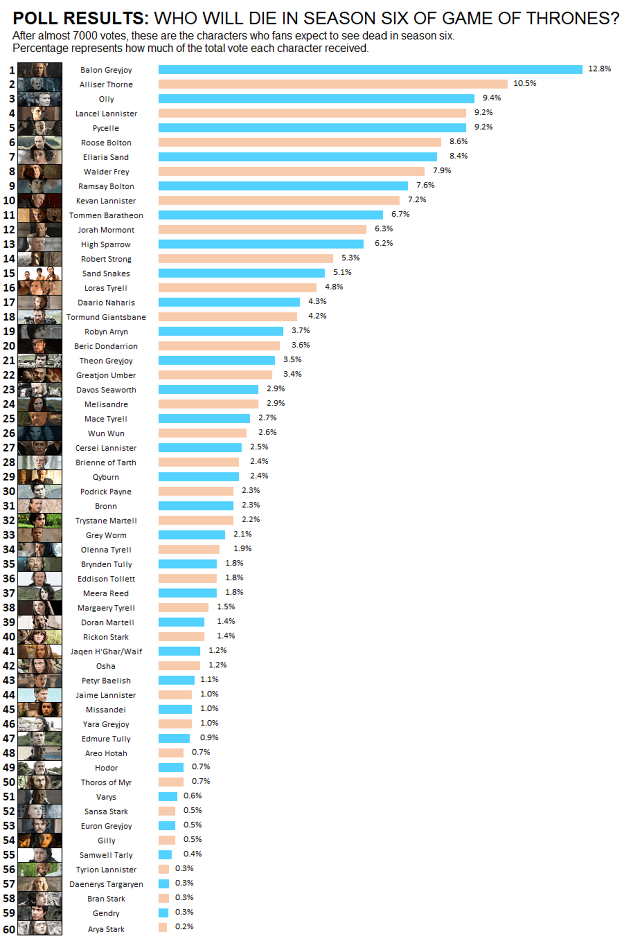
Someone who goes by the handle Iron Bank of Braavos surveyed more than 7,000 fellow Redditors to get an idea of the consensus votes for most likely to meet an end soon. Following the prodigious voter turnout, Iron Bank was kind enough to assemble an infographic with the data that functions as a sort of Westerosi deadpool. Considering that the Reddit audience are more likely to go beyond casual fandom into the realm of those who’ve watched every episode, read the books, and gotten house sigil tatts, these choices are less than random.

At a whopping 12.8% of the vote, Balon Greyjoy is pegged for death this season. Seems like a bet Co.Create would take! All the way down at the bottom of the list with 0.2% of the vote is Arya Stark, whose chances of seeing Season 7 do seem all but written in the blood of wildlings. Perhaps the proof that people are voting from educated guesses, though, and not merely their hearts’ desires, is that Ramsey Bolton is all the way down at No. 9. He would be way higher in Co.Create’s personal deadpool.

Have a look at more picks in the infographic below, and let us know in the comments who you think is a goner.

Related Video: Why George R.R. Martin kills the ones you love (and hate)

[via SomeEntertainment]

Read More