Press Enter / Return to begin your search.

Can Silicon Valley Help The State Department Track Weapons Of Mass Destruction?

The Paris and Brussels attacks got a lot of people thinking about dirty bombs. After all, what if the ISIS perpetrators had acquired a radiological weapon? Top U.S. officials have worried about nuclear terrorism ever since the Soviet Union collapsed and its warheads threatened to roll away into unsavory hands. Indeed, just last month, at the international Nuclear Security Summit, President Obama asked fellow world leaders to contemplate that very prospect. But the U.S. government is also looking to Silicon Valley, and the innovation community as a whole, to help come up with solutions to this frightening problem—and a host of other difficult issues.

Last week, members of the State Department descended on Stanford University to host a daylong brainstorming session on how to contain all sorts of weapons of mass destruction, including nukes. The 150 people who showed up were a far more eclectic group than you’d find at a usual WMD confab. Wireless executives hobnobbed with criminal investigators. Analysts from microsatellite companies traded business cards with military officers. Data-mining experts rubbed elbows with some of the world’s top disarmament officials.

Keeping track of warheads used to be relatively straightforward. Only a few countries had them, and they tended to stay tucked inside giant missiles. If you knew where the missiles were, you knew where the nukes were. It was no cakewalk, but the United States felt fairly confident monitoring Soviet military movements from space.
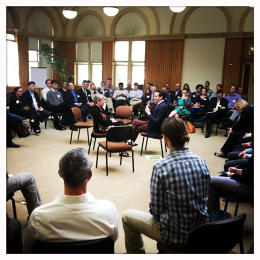
Rose Gottemoeller (L) and Zvika Krieger (R)[Photo: courtesy of E.B. Boyd]

Now, however, it’s potentially much easier to build a radioactive bomb the size of a suitcase. Keeping track of all the “hot” stuff, that can be broken down into smaller pieces, is a fundamentally different puzzle than knowing how to spot big Russian trucks. The sophisticated containment system the world spent decades constructing isn’t suited to this new problem. That’s why some high-ranking officials—including Rose Gottemoeller, the State Department’s under secretary for arms control and international security—are embracing the notion that some of the best ideas on how to tackle the new challenge might come from people who’ve never heard of terms like “isotopics” or “dismantlement queue.” “If Amazon Prime can track billions of small objects,” Gottemoeller told the crowd at Stanford, “there’s no reason we can’t figure out how to better track WMDs.”

The workshop was the latest project in a larger innovation jag spearheaded by Deputy Secretary of State Antony Blinken. Floppy-haired, blues-guitar-loving Blinken stepped into his new role early last year as the second-in-command at the State Department. In addition to his formal duties, a deputy gets to champion a few pet projects. For Blinken, building bridges to the tech community has become one of those areas of focus. “I’ve spent 23 years in government,” he told me at a sunny campus café not far from the workshop. “More and more, it was becoming evident that many of the problems we were trying to solve were at the intersection of foreign policy and technology.” The dirty bomb issue is a prime example—it takes diplomacy to coordinate other governments in the fight against terrorism, and technology to track such hard-to-trace weapons.

Standing at a podium at Stanford, Blinken described how technological innovation is now as crucial to the State Department’s work as its traditional focus on economics and political affairs—even though the department isn’t exactly fluent in tech. As Blinken put it, sometimes it feels like “we need scientists and technologists in the room just to tell us whether we need scientists and technologists in the room.” That’s why Blinken has instituted an “Innovation Forum” at the State Department, which works on convening gatherings like the WMD workshop, and which he hopes will inspire self-starting, out-of-the-box-thinking, unconventional-solution-producing innovators in the tech community to dedicate some of their time and brainpower to tackling major international issues.

For example, in January, the State Department gathered a different group, also at Stanford, to explore ways to educate the hundreds of thousands of Syrian children now living in refugee camps. Without education, those children will have limited economic opportunities in the future—and young adults with limited prospects are especially vulnerable, as Blinken put it at that gathering, to “the siren call” of terrorism. Another meeting, in New York, explored FinTech. Historically, the United States and its allies controlled bad actors by cutting off their bank accounts using antiterrorism laws. But cryptocurrencies such as Bitcoin now let criminal networks make end runs around such controls. A third gathering in Washington sought new ways to monitor adherence to ceasefires, such as using smartphones and geolocation for crowdsourced reporting of violence.
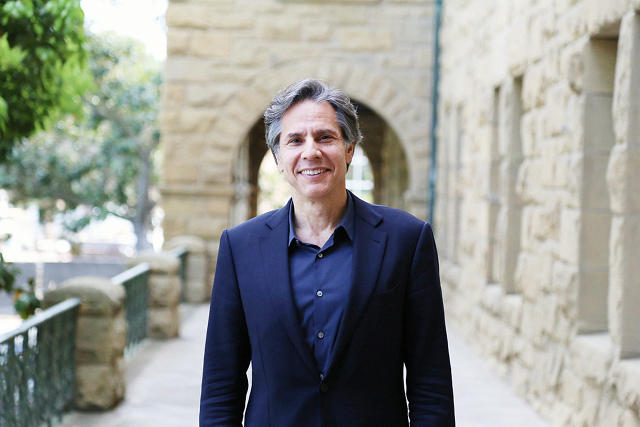
Antony Blinken[Photo: courtesy of William Russo, State Department]

At the Stanford WMD conference, participants were broken into small groups, where they dove into energetic exchanges about how sensors, data, and social media might help officials track fissile material—and maybe even help identify, Minority Report-style, when someone might be planning an attack. One of the participants, Brian MacCarthy, who recently opened a strategic innovations office for Booz Allen Hamilton in Silicon Valley, listened to the discussions—and was impressed. Before he moved out West, he worked inside Washington, selling products and services to government agencies on behalf of a large IT provider. “I was in D.C. for 10 years,” he noted, “and I never could have gotten this kind of a conversation going.”

Blinken’s ideas fall in line with a larger push in Washington to build more bridges to the tech sector and leverage the industry’s creative, can-do spirit to improve the way government operates. Hillary Clinton was the first secretary of state to turn to the modern tech sector for help on the international front. The Pentagon opened an office in Silicon Valley last year, as did the Department of Homeland Security. And, as this publication explored in depth last summer, President Obama has made it a priority to get all-star tech natives to do tours of duty inside the halls of government.

Still, engineering a cultural transformation at the State Department isn’t easy. Washington, like any large, powerful institution, can be set in its ways. “Just the concept of trying new things is an uphill battle,” said State Department senior advisor for tech and innovation Zvika Krieger in a phone conversation after the WMD event. Krieger told me that, when he was planning one of the earlier workshops, he invited some key D.C. stakeholders to participate—but “they were very skeptical. Their point of view was, ‘We’ve never worked with tech before, and we’ve been fine without them.'”
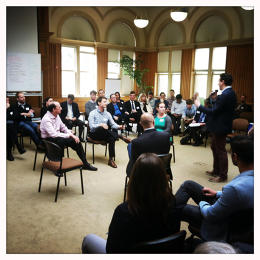
Krieger himself doesn’t share that old-school orientation. He’s a thirtysomething former journalist and innovation specialist who once worked for Secretary of Defense Ashton Carter back when Carter was the number-two guy at the Pentagon. Krieger is taking an iterative approach to the workshops, designing successive events based on learnings from previous ones. “We’re prototyping how we approach Silicon Valley,” says Krieger, who always seems to have a merry twinkle in his eye. “We’re seeing which formats work and what issues we should engage on.”

The difference between traditional government approaches and Silicon Valley methods were visually palpable at the WMD event. Nuclear Security Summits, which take place biannually, are solemn meetings at which world leaders sit stiffly around enormous round tables (that, ironically, and most likely unintentionally, bear an unfortunate resemblance to the ominous war room in Dr. Strangelove). The large conference room at Stanford, by contrast, was strewn with Post-it notes and Sharpie markers, and chairs were pushed aside in favor of casual small-group discussions.

By the end of the day, the teams came up with a handful of ideas—for example, testing how effective crowdsourcing can be at identifying nuclear sites in visual data, or holding a competition to see how well various sensing technologies could identify the presence of dangerous types of radioactive material in a crowded area. The participants were clearly excited by the challenge. “I’ve been working on some pieces [of my research] for 20 to 30 years,” said Kent Langley, a professor at Singularity University and a data-science entrepreneur. One of his companies has developed a platform that crunches large amounts of data to predict the intentions of potential customers, so a company can better market to them. One of the workshop small groups, by contrast, discussed how data could be crunched to figure out a potential terrorist’s intentions. The workshop, Langley said, made him realize his work could help “save lives.” “Let’s do that!” he said.

This is exactly what the State Department is banking on. Blinken and Krieger know that single daylong sessions can hardly hope to produce immediately actionable solutions, but they want to spread the message that the government no longer feels a need to retain a monopoly on solving these problems. Blinken’s team hopes top minds in the Valley and other innovation hubs will be inspired to take a stab at these big, gnarly questions. Their plan might be working. Just weeks after the workshop on Syrian education, some participants forged ahead on their own and tinkered with some of the ideas born during the session, such as using mobile phones for language instruction, or distributing tablets preloaded with educational content in refugee camps and recruiting solar companies to provide the panels needed to power them.

This kind of scrappy, just-dive-in response from Valley denizens gives Krieger hope. “In D.C., we would have spent months battling different bureaucratic hurdles to get all of the different stakeholders to buy in,” he said, “and we would have had to find the money for it when so much of our money is apportioned years in advance.”

On the other hand, Blinken and Krieger have precious little time to make headway. Obama leaves office next January. Even if a Democrat wins the White House in the fall, it’s standard practice for political appointees, like Blinken, to step down, so that incoming secretaries can bring in their own teams. Blinken’s “minimal viable product,” then, is just to produce a credible proof of concept for his meeting-of-the-minds program. “My hope is that this becomes institutionalized by the time we leave,” he said. “And that whoever follows us wants to continue it.”

Photographs courtesy of E.B. Boyd, with the exception of the mushroom cloud (via Wikipedia) and the portrait of Antony Blinken (courtesy of William Russo, State Department)


Read More

GoPro Launches Developer Program

A day after poaching a leading Apple designer—a move that sent its stock roaring up 19%—GoPro announced the public launch of its developer program.

The initiative, which was quietly rolled out with a few partners a year ago, is aimed at offering official support of third-party companies that want to build products with seamless GoPro integration.

GoPro clearly hopes a program like this will help kick-start its business prospects. Over the last year, its stock has plummeted from a high of $65.49 to a low of $9.01. In recent weeks, it’s been bouncing around between $11 and $14, hardly what investors had in mind when the leading action camera company went public in June 2014. In January, the company laid off about 100 people, or 7% of its workforce. Many have speculated that the poor stock performance over the last year has been due to poor sales of its Hero 4 Session camera.

Developers taking part in the new effort can take advantage of three types of integration.

First is having their mobile apps connect directly with GoPro cameras, bringing camera command and control, media management, and live video preview to those apps.

Second is the ability for developers to build devices that can connect with GoPro cameras either physically or wirelessly via Bluetooth or Wi-Fi. Those devices would then have camera command and control, video management, and other controls.

Finally, third parties will be able to build mounting and housing products that specifically meet GoPro specifications, much like Apple licenses some outside companies to make cases or cables for its computers or iOS devices.

To date, 100 companies have joined the developer program. Among them are BMW, which has build an app called M-Laptimer that allows racing enthusiasts to use their GoPro to automatically record car telemetry data and video. Toymaker Fisher-Price is developing GoPro-compatible child-friendly housing and mounts for a series of new toys.

And GoPro’s initiative is launching with a certification program called Works with GoPro that offers third-party companies integrated marketing help and an official logo.

Read More

How To Make A Better Business Case For Diversity

Pondering the business case for diversity, Todd L. Pittinsky, a professor of technology and society at Stony Brook University, observes something isn’t quite right. “Different kinds of people will come up with different kinds of ideas, and the more variety, the better,” he writes in Harvard Business Review. Multiple studies have backed this up.

However, he asks, if that’s the case, then why has Silicon Valley consistently been a locus of innovation? Pittinsky rightly notes that there are other kinds of diversity in the Valley, particularly foreign workers on H-1B visas. And just touting the boost to the bottom line by having more women and people of color doesn’t really stand as an argument when tech is an industry that consistently delivers profits.

“Should we just drop the subject? Abandon the cause?” he asks. “No, we shouldn’t. But we do need to be more honest about our motives and about the case to be made for diversity.” Pittinsky argues that there are more accurate business cases to be made.

Much the way the gender pay gap can’t be boiled down to one single cents on the dollar figure, Pittinsky illustrates that there are nuanced ways to approach support for diversity and inclusion in the workplace.

The Long-Tail Benefit

Workplace diversity has an impact on social good, Pittinsky says. A global study from Harvard University indicates that countries with social cohesion experience greater economic growth. How to get more socially cohesive? By diversifying the population.

“The more the members of an organically diverse society enjoy that diversity and see the visible benefits of investing in shared prosperity and the common good, the more secure and resilient that society will be,” he writes.

This has been true for the U.S. economy as waves of immigrants have come through and assimilated over centuries. And this is the other side of this argument: Companies investing in diversity shouldn’t expect a quick return. But the long-term gains are evident.

Us Plus Them

Multiple studies show that positive emotions boost individual and team performance. Bias, on the other hand, is laden with negative emotions such as fear, contempt, and anger, which are collectively detrimental to collaboration and creativity.

But people who are not like us should not merely be tolerated. Pittinsky cites his own research that measured allophilia, otherwise known as positive and not just tolerant attitudes toward a group other than one’s own. Teams and organizations with higher allophilia were more likely to display “open communication, feelings of inclusion, mentoring across genders and ethnicity, and bringing one’s whole self to work,” he writes. Who wouldn’t want to work for a company that fosters this kind of environment?

The Culture Quotient

Building an “us plus them” mind-set is essentially laying the foundation for a company’s entire culture. Pittinsky’s own research finds that leaders are able to bring together not just a group of diverse individuals, but their respective subgroups, too. The trick is to not have to turn all those people into a collective “we” to achieve consensus quickly.

To be truly innovative, there has to be an exchange of ideas through debate among diverse groups. A cohort of researchers who wrote “Collective Genius,” a paper on leadership and innovation, found:

All too often, leaders and their groups solve problems through domination or compromise, resulting in less than inventive solutions. Innovation requires integrating ideas—combining option A and option B, even if they once seemed mutually exclusive—to create a new and better option.

This, the researchers argue, can only be achieved through these three methods:

  • Creative abrasion. The ability to generate ideas through discourse and debate
  • Creative agility. The ability to test and experiment through quick pursuit, reflection, and adjustment
  • Creative resolution. The ability to make decisions that combine disparate and sometimes even opposing ideas

A leader is able to create the context to allow innovation to unfold by encouraging ideas from a diverse team whose members believe they can truly bring their whole selves to work. This has implications far beyond the company’s walls. As Pittinsky says: “If we can become more disciplined and precise in learning how to create and maintain [diversity] in the right ways, this will make for a more prosperous and productive economy in the future.”

via HBR

Read More

This Coworking Space Will Let You Work There In Exchange For Content

The promise of “exposure” in lieu of payment is a well-known cautionary tale in freelancer circles. Your effort should come with tangible compensation, preferably money. But what if, in return for your work, you were offered a desk in a co-working space, plus access to a photography studio, event space, meeting rooms, and over 20 other freelancer colleagues from a variety of disciplines?

Welcome to Blogfabrik, an innovative coworking space in Berlin that opened in June 2015. Blogfabrik means “blog factory” in German; it’s an apt name. In exchange for a desk, freelancers contribute two articles per month to DailyBreadMag, the space’s online publication. Members are also responsible for promoting their articles through personal social media channels and organizing one event each at Blogfabrik over the course of the year.

Apart from their work for DailyBreadMag, freelancers have the opportunity to work with Blogfabrik’s affiliated agency, Kiosk, for which they’re paid separately.

“We explore [the freelancers’] abilities and skills with the magazine to see if someone is really talented at taking pictures, writing, or designing graphics,” explained Claudio Rimmele, creative director and editor-in-chief of DailyBreadMag. “Then we feel confident about connecting our freelancers with incoming jobs from outside companies.”

It’s an unorthodox experiment—and, perhaps, a sign of what coworking spaces can be.

Inside The Factory

The 500-square-meter coworking space is bright and open, and is dotted with the quirky details you might expect. Walls are covered with chalkboards, stacks of vintage suitcases decorate the foyer, and pastel backdrops in the photography studio are perfect for spontaneous selfies.

Photo: Elizabeth Rushe

The open kitchen includes plenty of informal seating for catching up over coffee. A Polaroid collage of the freelancers who help produce DailyBreadMag spans the walls.

The online magazine sees itself as a think tank that primarily reflects the lives of the Blogfabrik freelancers while also addressing topics like digital culture, accessibility, feminism, and terrorism. The target readership consists of 18- to 35-year-old digital natives as well as “open-minded people from other fields,” according to Rimmele.

Overall, there’s a lot of freedom for the contributors. Rimmele sees it more as a testing ground for the freelancer’s ideas and abilities rather than something meant to resemble a traditional magazine.

“I approve pitches and assign topics for DailyBreadMag, but they have freedom to do what they want as contributors to the magazine,” he said. “When you work with a client, it’s always down to the client’s demands, but that’s not the case with the magazine.”

It’s worth noting that Blogfabrik is not an independent company. The concept was developed and is funded by Melo, a media and logistics company based in Münich, whose main business includes distributing print and digital press. Rimmele told me that Melo wanted to invest in Blogfabrik to learn more about content creation.

“It’s an experiment. Melo does logistics and press distribution, but what they hadn’t done before is create content,” he said. “They know that one day content creators will not need distributors anymore, so they want to see how this new media landscape evolves, and then maybe make a further investment with that knowledge. Bloggers are part the future of the publishing industry and should be supported in their independent publishing.”

Because of the unique system, Kiosk has been able to bring in extra work from companies attracted to the idea of having a talent pool working under one roof. Additionally, Rimmele is already connected to local brands; he was part of the founding team of I Heart Berlin, one of Berlin’s most popular culture blogs.

However, he is quick to dismiss the idea that Blogfabrik is an agency that pays its employees with access to a coworking space. “It’s not like we have twenty agency people here working all day thinking about new ways to make money,” he said. “What we do is make content creators successful and make ourselves successful through them.”

Blogfabrik’s Freelancers

So who are the people that make up Blogfabrik? Thirty freelancers came on board for the initial launch, covering a number of trades like photography, journalism, videography, editing, and blogging. As the site’s one-year anniversary approaches, most of the original freelancers plan to stay on.

Eylül Aslan, an award-winning photographer and writer from Istanbul who moved to Berlin four years ago, has been at Blogfabrik from the beginning. “I come from a culture where it’s not really accepted to be a photographer—it’s not a profession,” she said. “I would definitely say Berlin and the chances that I get here at Blogfabrik—the environment, the network, and the people—really helps. It makes a big difference.”

Marlen Stahlhuth, the fashion editor and a photographer for INDIE Magazine, agreed. “Blogfabrik makes a lot of things easier for me,” she explained. “It’s more official than going to a café or restaurant for meetings. There are jobs coming through Blogfabrik, and there’s a lot of interaction with the other freelancers.”

Blogfabrik is currently working out the details to offer “flex” desks, a part-time coworking option that can be booked in exchange for one contribution to DailyBreadMag per month. And while the magazine has primarily been published in German until now, the site began running articles in English this month.

“It’s very encouraging and motivating to be around everyone—we are like a family,” Aslan said. “I tend to be lazy when [I’m by myself]—I feel like I have nothing to work on. Then I come here and I realize I have lots to do.”

This article originally appeared on [i]Contently and is reprinted with permission.[/i]

Read More

The Most Common Resume Lies (And Who Is Most Likely To Tell Them)

Even in a market that favors job seekers, candidates will go to great lengths to clinch the job of their dreams. So it should come as no surprise that more than half (56%) of over 2,000 hiring managers have caught a lie on a resume, according to the most recent survey from CareerBuilder.

And those lies can understandably cost candidates the job. Another study of hiring managers revealed that the majority (69%) of them said that if they caught the candidate lying about something, it would be a deal breaker.

But that still leaves 31% of hiring managers who would be willing to look the other way. How far is too far, though? Hloom, an online provider of office templates for small businesses and individuals, surveyed 2,000 employed workers to see what they thought about the difference between “harmless white lies” and “serious falsehoods.”

Among the lies that most people labeled “real” were:

  • College
  • Foreign language fluency
  • Academic degree
  • Former employment history

Those ranked harmless included:

  • Computer skills
  • Year of graduation
  • Duties in former position
  • Promotions

These most common fibs were ranked on a scale of one to five, with five being the most serious.

The cause of the padding and exaggerations was overwhelmingly (49.3%) to appear more qualified for the desired job. Coming in second, 21.7% of those surveyed confessed they wanted to embellish their experience to come off as more well-rounded.

Most applicants think they can just get away with it, according to Carly Steele Johnson, a representative from the creative team at Hloom. “It is very easy for an employer to verify information, however, many of them are busy so wouldn’t always check,” she tells Fast Company, adding, “Who has time to check every little detail?”

If they were let go, the likelihood of lying on their resume increases. The New Norms @ Work global survey found that less than half (46.8%) of all workers polled said they would be totally honest about it if they had to reveal whether they got fired from a job. Twelve percent of full-time workers said if they got fired from a job, they would leave it off their CV or LinkedIn profile.

Those who were out of work and actively looking were most likely to tell a white lie, according to the Hloom survey. Unemployed workers who were not seeking employment were most likely to report that they’d tell a real lie.

Age doesn’t play in strongly as to whether or not the applicant will lie. Forty-three percent of the youngest respondents between the ages of 18-24 said they’d tell a white lie, while 48% of those between 55-64 said they would. That latter group also were the most likely to tell a real lie, as 12.7% reported they would.

Education does factor in to whether or not someone will fib. Sixty-eight percent of respondents who completed some high school but didn’t earn a diploma admitted to telling a white lie on a resume, and 38% of them told a real lie. In sharp contrast, no one with a doctorate degree confessed to telling a real lie, and only 13.6% reported white lies.

Gender separated the liars from the truth tellers. “Men told white lies almost 6% more than women, and real lies over 3% more than women,” Steele Johnson says. She could only speculate on the reasons why. “Perhaps since men are still very often the only full-time employee of their household, they feel more pressure to get the job?” she asks.

See what people really think of your resume

Read More

Take A Seat And Enjoy These Photos Of The World’s Best Toilets

Loo, lavatory, bog, pissoir, khasi, throne, thunderbox, dunny, water closet: The humble toilet inspires a lot of wordplay, and why not? These most functional of conveniences are under-considered, despite being essential, civilizing, and, dare we say it, pleasurable.

Some of the finest examples are here, in a book curated by Lonely Planet. There’s the quaint outhouse in the Finnish tundra. The lovely green Berlin urinal from the 19th century. The toilet “island” off the coast of Belize. And the toilets at the Thiksey Monastery in Ladakh, India, with a view of the lower Himalayas in the distance (what a place for a whizz).

It’s also a good reminder that 2.5 billion people around the world lack proper sanitation, which leads to the deaths of 700,000 children each year from water-borne diseases. In other words, be thankful for even the standard, non-photograph-worthy toilets you have.

Thiksey Monastry, Ladakh, India© Bernhard S./500px

“Toilets so often transcend their primary function of being a convenience to become a work of art in their own right, or to make a cultural statement about the priorities, traditions, and values of the venues, locations, and communities they serve,” says the book’s intro, somewhat overstating the restroom’s cosmic importance.

But who can argue with the elegance of the wood-cabin john in Alaska, or the monumental nature of the 10,000 toilet, sink, and urinal sculpture in the Shiwan Park in Foshan, China? These pictures make you appreciate having a decent place for one’s business, especially when one in three in the world, or 2.4 billion people, still live without sanitation.

Read More

Pentagram Sexes Up The Stodgy World Of Finance

The graphic design of the finance world is stodgy, boring, old-fashioned, and marvelously conservative. But money is sexy. So when approached by an influential group of New York security analysts to design a book predicting the future of the stock market, Pentagram partner Eddie Opara aimed to give them a design that was just as exciting and dynamic as money itself.

Published by the New York Society of Security Analysts (NYSSA) in celebration of its 50th year, High Yield Future Tense: Cracking the Code of Speculative Debt is a thick bible that presents the outlook for high-yield bonds—riskier bonds with a higher chance of profit than other types of bonds—as a selection of think pieces, infographics, and formulas from some of the all-stars of the futures world. Approached by NYSSA to design the book, Opara at first had his doubts. “I mean, let me put it this way: If you were a designer, and someone approached you with a book with this title, wouldn’t you think carefully before taking the job on?” he laughs.

What eventually brought Opara on board was NYSSA’s promise that it expected something very different from the usual finance tome. Looking at Amazon’s finance section together, Opara showed me the kind of graphic design he was specifically trying to avoid. “Not to get personal, but these designs all have the aspect of DIY books,” he says. “They look like they’re from the ’80s or ’90s. And when you open the books up, they look like some exam you have to do for accounting class.”

So for High Yield Future Tense, Opara and his team at Pentagram set out to break the mold. The cover has four ultra-modern typefaces (Larish Neue, Domaine Sans Display, Px Grotesk, and Danmark) that vie for readers’ attention. Opara says these typefaces weren’t picked because they necessarily evoked money, but because they created an effect right from the get-go that this wasn’t a book for conservatives, or people living in the past. This was a book for people who aren’t afraid to rip open the future of the high-yield bonds market.

Broken into four sections—market dynamics, active management, analytical innovation, and benchmarking—the book continues to use typography and color as organizing elements throughout, with each section getting its own dominant color and typeface. Colored ribbons, meanwhile, make it easy to flip open to the correct section. Perhaps the most “traditional” nod to the world of finance comes by way of the individual contributor portraits, which are done in a style reminiscent of the Wall Street Journal’s stipple hedcuts.

According to Opara, the most time-consuming element in High Yield Future Tense to design were the illustrations, or graphical “exhibits.” The volume contains more than 168 such exhibits, including 111 charts and graphs and 57 tables. These were challenging for Opara and his team to get right, often because the book’s authors had to explain the financial meaning to the group. When they understood what these charts were about, though, Pentagram realized that these weren’t just stuffy bar charts and line graphs. They were stories, predicting the cause and effect of millions or perhaps billions of dollars being made or lost. Designing each exhibit so it told its story properly ended up requiring so much brainstorming that the end papers of High Yield Future Tense are just Pentagram’s notes and sketches, trying to work out the problem.

The design element of High Yield Future Tense that Opara is most proud of is how the book handles its 31 math formulas. Regular joes won’t make heads or tails of them, but to finance types, the formulas are literally amazing, Opara says: secret equations to die for, published for the first time by some of the greatest minds in the financial world. Opara decided to handle these formulas almost like Playboy centerfolds, pulling them out and turning them on their side so that High Yield Future Tense’s readers can appreciate their beauty.

“For a long time, I’ve wondered why finance books aren’t designed to exude the importance of what they’re stating,” Opara says. “Why are these books so incredibly bland, when it’s not bland content, especially for the person who can see the real content behind the words?” Finance books, Opara says, deserve the same graphical design treatment as books about fashion or architecture, because finance is also about design. “Finance is about trying to design a methodology for us all to live better, richer lives,” he says. And that makes High Yield Future Tense one of the few finance books that looks the part.

All Images: courtesy Pentagram

Read More

Icelandair Wants You To Better Understand The Magic Of The Northern Lights

WHAT: An interactive website, full of big blocks of science, that leads to an interactive “create your own aurora” game, where you can use sliders to adjust the variable factors that influence what the Northern Lights look like.

WHO: Icelandair, who would very much like you to visit Iceland to see those Northern Lights.

WHY WHY CARE: The Northern Lights are very neat—to the point that they seem more like magic than scientific phenomena occurring for reasons that a layperson can understand. In order to drive home how amazing they are, Icelandair launched a site full of information about how they work. The site explains the history of humans looking at the lights, the details about times and days that are best to see them, and information about what a “KP Index,” which measures the geomagnetic activity responsible for the light show. But the real fun is playing with the interactive sliders, which make all of concepts easier for us “learn-by-doing” types to comprehend. There, you can modify the KP Index, the altitude, and the oxygen/nitrogen levels, and get a better grasp of why the lights change colors, why they’re more saturated at some times of day than others, and what situations make the lights strongest. When it comes to understanding the magic of science, it’s a pretty clever thing—especially coming from an airline.

Read More

The Next Frontier For Ambitious Entrepreneurs: Space

Eric Ward, a graduate student at MIT, has always wanted to work in the aerospace industry. “It’s a field full of people who are both very passionate about space and also excited about tackling very hard problems,” he says.

After earning a degree in mechanical engineering, Ward landed coveted internships at NASA and Lockheed Martin Aeronautics, expecting that he would spend his entire career at a big, established space company. But over the last decade, he’s watched a new generation of companies like Virgin Galactic, Blue Origin, and SpaceX enter the space game. “There’s a mythos in the space community surrounding Elon Musk,” Ward says, referring to the founder of SpaceX. “He’s been very successful in changing the way people think about space. He’s forced people to accept that fact that the private space sector is viable and important for the growth of the industry.”

The success of these high-profile companies has inspired other entrepreneurs—or astropreneurs, as they sometimes refer to themselves—to take a stab at starting their own space businesses. NewSpace Global, a firm that tracks the private space industry, has seen explosive growth in the market. Over the last five years, it’s gone from tracking 125 space companies to over a thousand. “We expect to be at 10,000 in the next ten years,” Richard Rocket, NewSpace Global’s CEO, said during a presentation at MIT’s New Space Age conference. “There are more companies emerging that are capable of sending something to space. That’s exciting because it’s going to drive down launch costs and increase launch rates. They’ll help prove that these business models work.”

Ward wants to be part of this new breed of space startups. Over the last year, while working on a degree in systems design and management at MIT, he’s been tinkering with the design of a rocket that will send small satellites into orbit. With a cofounder, he’s currently working on a business plan to secure funding.

Photo: Flickr user Michael Seeley

The Booming Business in Small Satellites

Ward’s startup, like many others that are springing up, is capitalizing on the boom in small satellites.

Small satellites first gained popularity over a decade ago, when universities like Cal Poly and Stanford started encouraging students to build CubeSats—mini satellites weighing less than three pounds—that would go into space to gather scientific information, observe Earth, and even launch amateur radio stations. Through a NASA educational program, CubeSats would be selected to piggyback on space missions. NASA currently has 50 more CubeSats awaiting launch.

But over the last few years, companies have been eager to develop small satellites of their own to gather data for their businesses or test out technology. The global satellite industry is now valued at over $200 billion and is rapidly growing. More satellites were launched into space in 2015 than ever before.

Startups are coming up with more and more uses for these satellites. Two years ago, Google acquired Skybox, which uses CubeSats to provide high-resolution photos and videos of the earth. Mark Zuckerberg’s plan to bring affordable Internet to the entire world will depend on satellite technology. Small satellites have been used to more precisely detect weather patterns, closely monitor crops, provide real-time images of Earth, and even identify how many cars are in a parking lot.

The market is now ready for rockets whose only purpose is to carry small satellites. NASA is currently developing its own rockets to do this, and it is investing in other companies that are working on technologies specifically designed to launch small satellites. L.A.-based Rocket Labs has already developed a vehicle called “Electron” that provides low-cost, high-frequency launches for small satellites. It has one big contract for 12 launches over 18 months as soon as its facility in New Zealand is complete. Another company, Firefly Space Systems, offers a similar vehicle, and has secured a $5.5 million deal with NASA to launch a constellation of CubeSats in 2018. Virgin Galactic and SpaceX are also working to provide this service.

Ward believes there is room in the market for many more companies like this, given the many small satellites that are currently looking to hitch a ride into space. Right now, companies need to wait two years to send a small satellite into orbit. “We will provide the transportation infrastructure to the rapidly growing small satellite market,” Ward tells Fast Company.

Space Angels

Over the last year, Ward and his cofounder have been designing the hardware to launch these small satellites. With their engineering background, they have the technical skills to develop a rocket, but in order to get a vehicle off the ground (literally), they will need a significant amount of capital investment. This is why they are at MIT’s Sloan School of Management, acquiring the skills they need to launch a business.

From Ward’s current projections, he believes several million dollars in funding should allow them to make progress, though it will take up to $50 million to be fully up and running. Fortunately, there are investors eager to pour funds into startups like Ward’s. For instance, there’s the New York-based Space Angels Network that invests in early stage space startups. The group receives hundreds of applications from startups every year, and invests in about 5% of them. “You’re looking at investment profiles closer to biotech,” Ward said. “Higher capital costs, longer duration investments, but the potential for these even bigger payouts.”

There are also space incubators that help astropreneurs go from an idea to a business plan. The Silicon Valley Space Center and Lightspeed Innovations are both aerospace accelerator programs that help promising entrepreneurs land angel funding. “We’re using the TechStars model,” Ellen Chang, Lightspeed’s founder, said at the MIT conference. “We’re focusing in on 10 companies, and our challenge is to get to the point where they are investable in four or five months.” Last year, for instance, Lightspeed helped to secure investment for Phase Four, a startup developing plasma-based technologies to propel satellites into space. It also helped Kubos, another early stage startup that is building open source software to support small satellite missions.

Because space travel is so complex, startups are rushing in to meet very specific, specialized needs. Astroscale, for example, is a Singapore-based startup developing a satellite that will remove orbital debris and decommissioned spacecraft from space. It hopes to have a demonstration mission in 2017 and to be fully operational 2018. Last month, it secured $35 million in funding from a group of venture capitalists investors from around the world.

Besides launching spacecraft and satellites, startups are also analyzing vast quantities of new data and sorting out communication systems so that information can pass from Earth to space and back again. On the backend, there needs to be extensive resources to coordinate and manage missions from the ground. These different companies are working together, creating a new ecosystem.

Google’s acquisition of Skybox Imaging in 2014 for $500 million, only four years after the company was created, sent a ripple through the investment community, signaling that space startups had the potential to make big, profitable exits in a short amount of time. “Skybox will not be an outlier,” Rocket said. “We will see an increase in the number of space unicorns with valuations of north of a billion dollars, though this might take several years.”

Photo: Flickr user Joshua Davis

Space 3.0

Lisa Porter, who has held top positions at NASA, DARPA, and other intelligence wings of the government, says that we’re now in the third chapter of the space industry. “We call it Space 3.0,” she said. At first, governments invested heavily in space exploration; then companies with large budgets entered the industry. “There are new opportunities and new capabilities now,” she explained. “The distinction is that they are all driven by cost innovation. The mindset is first and foremost about getting the cost very low.”

Rocket Labs is a good example of this thinking at work. It has managed to create a vehicle that will drive down the cost of sending a rocket into space to $4.9 million per launch, 95% less than the average cost right now.

For someone like Ward, who is just getting his feet wet as an astropreneur, it still feels like there are gaps in the market, particularly if he focuses on creating a system for getting satellites into space that is cheaper than those of his competitors. While starting a space company is daunting, it does not seem impossible. “Launching a space startup is very much a doable thing,” says Sean Casey, the founder of the Silicon Valley Space Center. “There is still room for a lot of additional players.”

That’s not to say that it will be easy. In fact, Ward expects it to be the biggest challenge of his life. He’s been brainstorming names for his new company and recently, he settled on Odyne Space. “She’s the Greek goddess of pain,” he says.

Read More

Now Competing To Be The Master Of Your Domain: Squarespace

Squarespace and a handful of companies like Wix and WordPress parent Automattic serve as the 800-pound gorillas of the website hosting and content worlds. Now Squarespace is looking to take on GoDaddy and other web domain registrars with a new product—domain purchases made and processed exclusively through Squarespace.

The company’s new product, Squarespace Domains, is a GoDaddy competitor that entered soft launch in early April. CEO Anthony Casalena tells Fast Company that he is enthusiastic about the new product while also taking some veiled digs at other domain services.

“We looked around at the competitive landscape,” Casalena said. “And we were like ‘My God, this industry is so old and has so little innovation,’ and there were very antiquated products for people doing this even though it’s such a fundamental piece of doing a website.”

Depending on the name of the URL that’s purchased, Squarespace charges between $20 and $70 a year. Pricing is set depending on the top-level domain used and includes an ad-free parking page that follows Squarespace’s aesthetic along with WHOIS privacy. By comparison, the company’s fully hosted plans hover between $96 and $144 yearly for personal accounts.

By offering this product, Squarespace is able to offer a workaround for a price point issue that’s challenged them for some time: Customers with a Squarespace account (Disclosure: This writer uses Squarespace to host his own website) have to pay separately for each site they open with the company. No volume discounts or package deals are normally offered.

This means that, in the past, a customer such as a small business that’s looking to set up a separate site for something like a pop-up sale had to either buy a separate account (which can be quite pricey) or be lost to competing products such as About.me, Wix, Weebly, or WordPress. Most importantly, those customers registered their domains through third-party providers—even though they were already paid-up Squarespace consumers.

It also gives the company a lower-priced product to hook customers who aren’t completely sold on a full-featured website yet. Promotional materials sent to Fast Company mentioned that “a 2014 survey by Vistaprint found that 43% of small businesses choose a domain name before doing anything else online, and anecdotal evidence suggests that many of our customers prefer to start with a domain as well.”

Casalena added that “domains aren’t the most exciting thing in the world, but we have a good take on it and we’re excited to bring it into the modern age.” In the coming months, the company plans to add free SSL certificates—and, crucially for keeping users in their ecosystem—the ability for current Squarespace customers to shift their non-Squarespace domain registrations to the company.

Domain hosting is the latest in a number of new product launches that Squarespace has made in the past year to target specific customer niches. In late 2015, the company introduced single-page websites with limited functionality that cost $60 per year at press time (making them cheaper, in some cases, than the domain product) and a new e-commerce product targeted at small businesses that starts at $312 yearly.

Squarespace’s goal seems to be simple: Keep their customers in their ecosystem for as long as possible, and introduce progressively lower-priced products with limited functionality to attract customers who’d otherwise use competing products (including free and freemium alternatives). Their hope is that by offering domains, they’ll attract users who will be more than happy to build a full-featured website later on.

Read More