Press Enter / Return to begin your search.

Airbnb Is In Negotiations With A Major Labor Union

Airbnb is in the “final stages” of a deal with the Service Employees International Union (SEIU), under which Airbnb would direct hosts to union-approved cleaning services that pay employees at least $15 per hour, a source close to the discussions tells Fast Company.

Despite its apparent good intentions, the deal faces backlash from labor unions, city governments, and housing activists. Members of the New York state senate assembly and New York City council, according to the Guardian, went so far as to send the SEIU president a letter that called the agreement “troubling.” Many of these same groups have championed the movement for the $15 minimum wage, so you might be wondering: Why the negative reaction?

Some see the deal as part of Airbnb’s strategy to subvert housing laws. As affordable housing advocates accuse Airbnb of contributing to rising real estate prices, Airbnb could claim it is bringing good jobs to cities. As with Airbnb’s efforts to remit taxes on host income, the agreement would further legitimize the company.

An SEIU spokesperson provided the following statement:

We actively and regularly engage in conversations with companies who are committed to doing right by their workforce by paying better wages and giving them a voice at work through their union. Airbnb is one such company, however, there is no formal relationship or agreement between SEIU and Airbnb.

Airbnb has already piloted a program similar to the one it would offer under terms of the SEIU deal. In New York City, its website presents hosts with an option to hire Cooperative Cleaning, whose cleaners are members of a local chapter of the SEIU and paid $15 per hour plus benefits. So far, more than 1,300 Airbnb listings in Brooklyn have purchased cleaning services through that pilot program.
Read More

How Being Pessimistic Can Help You Succeed

I’m an eternal optimist. I seek out the upside in any situation, sometimes to the chagrin of my coworkers. Once in Brazil, the hotel we were staying at had a bed bug outbreak. While my American colleagues panicked, I reminded everyone that while we had bed bugs, at least we were together, and on the beach in Brazil! I’ve never seen a group’s collective anger turn so quickly.

What makes me optimistic and positive, however, isn’t naïveté or ignoring problems and living in a bubble. In fact, I’m an incredibly positive individual because I practice negative visualization. Seems counterintuitive, but as recent case studies and the ancient Stoics show, thinking negatively can make you more appreciative in your personal life and successful in your professional pursuits.

In his 2009 book, A Guide to the Good Life: The Ancient Art of Stoic Joy, author William Irvine describes negative visualization as the activity of imagining your life without the comforts you currently possess. “The easiest way for us to gain happiness,” he says, “is to learn how to want the things we already have.”

Irvine’s argument is that we should not take things for granted. Once we become used to our environment, we lose the appreciation and love for the miracles that happen in everyday life. So, we must fight against this “hedonic adaptation” and aim to see every instance, every moment as if we were seeing it for the first time.

Try it. Imagine your life without your job. Imagine your life without your siblings. How much more would you appreciate these things if just for a moment you contemplated their absence from your life? This may sound depressing. But as Irvine elaborates, while we should contemplate such misfortune happening to us, we shouldn’t worry about it.

“Contemplation is an intellectual exercise, and it is possible for us to conduct such exercises without it affecting our emotions.”

It’s like being a doctor. He/she knows and is aware of all the ailments that can strike the human body. But they don’t live in hypochondriac fear of being stricken by sickness. They’re simply aware and know that they could happen. Try something today, or tomorrow. As you go about your routine of eating breakfast, going to the gym, and getting into the office, imagine what your life would be without the things we do daily and take for granted.

  • “What if I didn’t have this nourishing food to eat?”
  • “What if I didn’t have the health to go to the gym every day?”
  • “What if I didn’t have a job or couldn’t work?”

Of course contemplating every action you do isn’t scalable. But pick a few moments in the day, try it, and see how each moment becomes more special and new again.

By coming face to face with our worst fears, we’ll see we can survive the ordeal. Think of the first time you fell in love and the first time you had your heart broken. Part of the fear of a breakup is we think we will never get over it. But as anyone who’s ever gone through heartbreak will tell you, you’ll survive and become more resilient. And that’s the aim of Seneca’s exercise: to teach resilience by bringing you head on with your biggest worries.

Do A “Premortem” On Big Projects

This exercise can be applied to business as well. A “premortem,” as Gary Klein explained in the Harvard Business Review in 2007, “begins after the team has been briefed on the plan. The leader starts the exercise by informing everyone that the project has failed spectacularly. Over the next few minutes those in the room independently write down every reason they can think of for the failure—especially the kinds of things they ordinarily wouldn’t mention as potential problems, for fear of being impolitic.”

The idea is to anticipate and prepare for factors that may impede the success of a given project. In preparing our sales goals for 2015, our team ran through a similar mental exercise. We asked ourselves: What will prevent us from hitting our targets? We talked about understaffing, fluctuating currencies in Latin America, and inadequate sales support. With those possibilities in mind, we structured our targets and planned for those possible outcomes. We obviously hoped they wouldn’t come up. But if they did, then we were prepared.

A premortem isn’t a long and elaborate process. All you have to do is gather the stakeholders of a project and talk open and freely about what can go wrong. We do ours over an hour or two every few months or when a new project is on the horizon. In the grand scheme of things, it’s a small time investment, but the payoff can be big.

As Tyler Tervooren writes:

There are no guarantees when you’re taking on a big, risky project. Sometimes things will go wrong that you didn’t—or even couldn’t—anticipate. But taking a few hours to go through the pre-mortem process is a wise investment for any project that’s important to you.

Once you’ve done it, you can go to bed each night knowing all your bases are covered. Don’t underestimate the value of peace of mind.

I’m all for positive thinking and an optimistic outlook on life. But the paradox is that to truly attain the two, one needs to become comfortable with negative visualization. In your personal life, it helps you become appreciative. And in your professional pursuits, it prepares you and curbs most surprises.

Eric M. Ruiz is a writer and strategist for Waze, the GPS and navigation app that was acquired by Google in 2013. A native of Modesto, California, Eric now resides in New York City. Follow him on Twitter at @EricMartinRuiz.

Read More

The Racial Gap In Entrepreneurship Is Costing The U.S. Economy Billions

Minority businesses could boost the economy by as much as $300 billion.

How? A new study from the Center for Global Policy Solutions titled, “The Color of Entrepreneurship: Why the Racial Gap Among Firms Costs the U.S. Billions,” analyzed business owners by race from 2007-2012 and found that firms owned by people of color have contributed to the economic recovery. The research was based on the U.S. Census Bureau’s Survey of Business Owners (SBO), which comes out every five years.

During that five-year period, non-white business owners added more than 72.3% of the jobs created by privately held companies. Nearly all entrepreneur-of-color groups experienced significant growth in the number of their firms, with Asian-American women-owned businesses taking the lead at 37.6% growth.

That’s just a fraction of the potential, according to the report. Discrimination, both past and present, is inhibiting the true growth of these businesses. Without that, an additional 1.1 million businesses could be established and could produce an estimated 9 million more jobs. This would increase the nation’s income by the aforementioned $300 billion.

The report also analyzed the differences between firms with employees and those operated by sole proprietors. This is important because annual sales and job creation have a major economic impact.

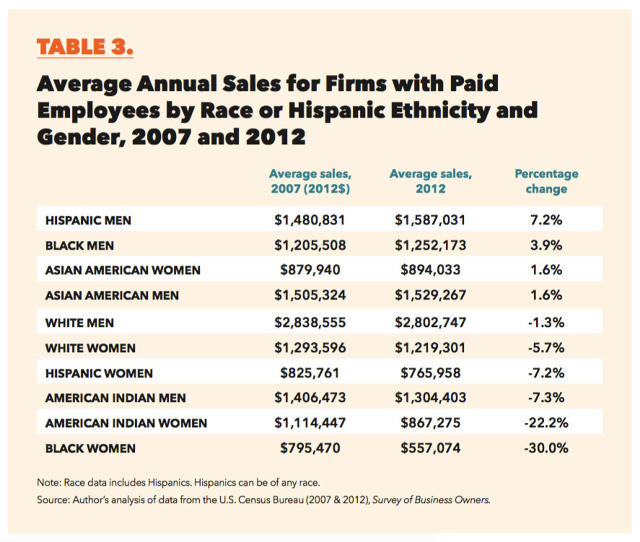
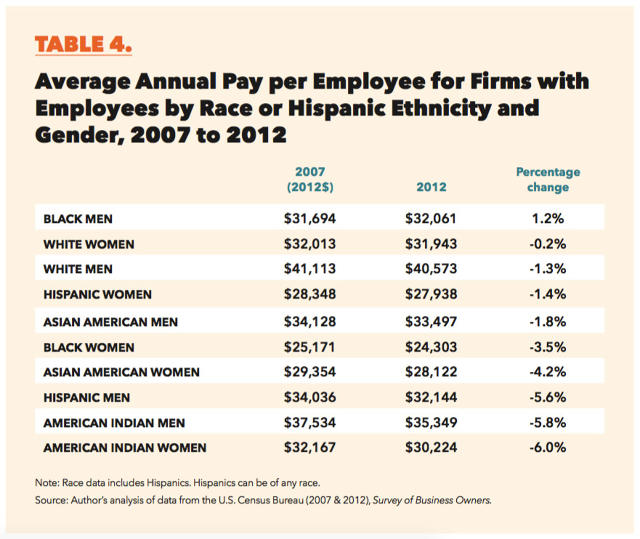
For example, on the growth side, the strongest annual sales were posted by firms owned by Hispanic men, increasing 7.2% to $1.6 million in five years. The boost came thanks to industry concentrations in wholesale and retail. Overall, firms owned by men had higher than average annual sales that translated to higher than average pay for employees at these businesses.

According to the data, 67.3% of firms without employees had annual sales of less than $25,000. Not only does that make it likely that the profits were only a fraction of the sales, but also that they weren’t able to keep their owners and the owners’ families out of poverty.

However, there are more entrepreneurs of color operating businesses without a single employee. For example, 71.5% of businesses owned by Asian-Americans (not broken down by ethnicity) were without employees, as were 97.5% of businesses owned by African-American women.

Although they are a growing part of the labor force, Hispanic women-owned businesses didn’t fare as well. Average annual sales declined by 7.2%, due in part to a 26.2% drop in average sales of Hispanic women’s construction firms and a 13.5% decline in average sales of Hispanic women’s retail trade firms.

Why Become An Entrepreneur, Anyway?

The researchers point to a number of economic and social factors that play into making the decision to become an entrepreneur. They write:

“Research shows that individuals who are wealthier, better-educated, and foreign-born are more likely to start a business. Also, individuals who cannot find a decent job or who feel that they are not being treated well in the labor market may feel pushed into starting their own businesses. The overall overrepresentation of Asian-Americans as business owners is due to economic and social factors such as these.”

Fast Company previously reported how African-American women in particular are more likely to step off a corporate career track and start their own business. This is because there aren’t other leaders of color at the executive level, and they lack the champions necessary to support their climb through the ranks.

Unsurprisingly, African-American female entrepreneurship increased by 20.2% while their participation in the labor force only grew by 8.8% between 2007 and 2012. These new businesses mostly concentrated in the health care and social assistance industries, but had lower than average annual sales.

Other Factors That Inhibit Success

The researchers observe that “it takes money to make money.” Indeed, access to capital is key to start and operate a successful enterprise. And the difference between what a white man can expect to raise in startup capital is radically different for his American Indian female counterpart.

The report cites the work of economists Robert W. Fairlie and Alicia M. Robb, who found that lower levels of startup capital explain much of the difference between the success rates of businesses with white owners versus those owned by people of color (with the exception of Asian-Americans). Their businesses’ success relative to whites is attributed to Asian-Americans investing more startup capital in their firms.

Those who rely on the bank of mom and dad or other family members’ money to start their enterprise also bump up against racial inequality. “At the median, Asian-Americans have about 80% of the wealth that whites have,” the researchers say. “Hispanics and African-Americans have less than 10%.” This is due to being historically disadvantaged, they say:

Much of American history can be understood as a story of brutal alchemy, where American Indian wealth is transformed into white wealth. African-Americans have been disadvantaged because of slavery, Jim Crow, segregation, redlining, and their exclusion from the G.I. bill and homeownership incentives that enriched whites after World War II.

Because wealth is an important driver of business success, it is necessary to encourage wealth building in communities of color, the researchers note. Measures such as tax credits to promote venture investing in minority business would help, as would credits for low-income entrepreneurs, and the use of alternative credit data. Other initiatives from providing disadvantaged minority groups with quality pre-K education, all the way through executive mentorship through SCORE and similar organizations, could change the ratio of successful businesses owned by people of color and have lasting impact on the U.S. economy.

Read More

How To Tell The Difference Between Optimism And Wishful Thinking

Most new businesses fail. Even the rosiest estimates of new business success suggest that only 50% of new businesses will still exist in five years, and only about a third will continue to exist for a decade. Given those odds, why would anyone become an entrepreneur?

In general, entrepreneurs overestimate their chance of success. They have intimate knowledge of the business they are creating, and so they believe those factors will protect them from the grim statistics.

Of course, entrepreneurs are not alone in this optimism. There are many forms of overconfidence bias in psychology. People believe that their skills at many tasks ranging from sports to math to playing a musical instrument are better than they actually are. In general, only real experts in a particular domain are well-calibrated about how good they are.

Why does this overconfidence bias persist? Intuition would suggest that we should strive to be as accurate as possible in our assessments about ourselves and our chances of success.

As it turns out, though, optimism has real benefits.

In particular, people’s motivation to pursue a goal depends on two factors. One is their belief about the importance of the goal. The other is their belief about whether they will succeed at achieving the goal.

Overconfidence makes the gap between present and future seem possible to bridge. If you have a realistic assessment of the future, you may come to believe that the goal cannot possibly be attained. Believing that the goal is achievable engages you to work on that goal.

There are two benefits to working on a goal that may actually be out of reach.

First, the motivation to pursue a goal based on overconfidence may actually spur you to work hard enough to achieve what might otherwise have been unattainable. That is, you may actually delude yourself into success.

Even if you fail at the particular goal you were striving for, it may have significant benefits for the future.

Most goals are not binary. That is, you don’t either completely succeed or completely fail. You may not reach the heights you hoped for, but you may still accomplish a lot.

Second, you will learn a lot in the process of pursuing a goal. That learning may improve your skills and make you better able to achieve a future goal than you would have been if you had given up.

Third, striving toward a goal may get your work (and your work ethic) noticed by other people. Your effort and hard work may open up future valuable opportunities.

Of course, there is also a potential downside to optimism.

Your motivation to work on any task depends on your estimate of success. Overconfidence is good when it leads you to believe that something that might be nearly impossible is actually something that you could achieve. However, overconfidence can be dangerous when it leads you to believe that you have nearly succeeded at something that actually requires a lot more effort.

Chances are you can think back to an exam you took in school that you thought you were completely prepared for up to the moment when you looked at the first question. You may have studied less hard than you could have because of your belief that you were adequately prepared.

In situations in which your confidence in an uncertain outcome leads you to coast, it may be more helpful to try the opposite delusion: “defensive pessimism.” In this case, you inflate your sense of how far you have to go to achieve your goal. You use the power of anxiety to keep you working hard at an outcome that is nearly assured.

For both overconfidence and defensive pessimism, you are taking a biased view of reality. As it turns out, though, a realistic view of the future is overrated. Your chances of success in the future depend much more on your continued effort than they do on a realistic assessment of your odds of success. Anything that keeps you motivated is a benefit. Even a bit of delusion.

Read More

Will Twitter’s New Board Members Help Solve Its Diversity Problem?

In November 2015, a former Twitter developer lambasted the company for its inability to foster a diverse workplace. “There were moments,” Leslie Miley wrote in a Medium post, “that caused me to question how and why a company whose product has been used as an agent of revolutionary social change did not reflect the diversity of thought, conversation, and people in its ranks.”

Last week, Twitter announced two new board members. Many saw this as a chance to prove that it was ready to tackle the problems Miley and others enumerated. Ultimately, the company went with Martha Lane Fox—a U.K.-based travel website cofounder and digital advocate—and PepsiCo executive Hugh Johnston to its board.

The Twitter board now consists of two women, eight men, and one person of color. Two of those eight men will be leaving the board following the 2016 annual meeting. After the announcement, Twitter CEO Jack Dorsey tweeted that more board members would be added soon—”ones that will bring diversity”—but no word yet about who they are or when they’ll be announced.

The two new board members are undoubtedly seasoned executives. Johnston has worked at PepsiCo for more than a decade, as well as served on AOL’s board for three years (he vacated his seat last June). Lane Fox is a well-known British businessperson. In the ’90s she cofounded the travel website lastminute.com, and has since been involved in various other businesses. She also founded the online advocacy group doteveryone.org.uk, which highlights how Internet technologies can be used for the greater good.

Despite the new blood, it does leave an elephant in the room. Twitter has been dealing with diversity issues for quite a while now. It’s last diversity report—published in August 2015—indicated that less than 30% of its leadership was non-white, and only 2% of the company’s entire staff identified as black or African-American. Following the release of these numbers, Twitter committed to fostering a more diverse workforce. Miley’s comments, which were published four months after Twitter’s pledge, sent a message that perhaps the company’s public comments didn’t match the reality.

Building A More Diverse Board

For months, people wondered who would fill these seats. One prominent rumor said that Twitter was courting TV producer Shonda Rhimes. Instead, Lane Fox appears to represent the voice of diversity on Twitter’s board—at least for now. In an op-ed for the Telegraph, she writes, “Diversity on boards is critical to sustaining and advancing performance.” But is her presence enough?

Many see the omission of a person of color as the most glaring issue. “I do think there ought to be on Twitter’s board several representatives of those who are among the most active Twitter users,” says Freada Kapor Klein, a California-based investor, diversity advocate, and philanthropist. Dorsey’s tweet hinted that this may change, but no updates have been divulged.

Kapor Klein has spent years advocating for equality and diversity in the tech industry. She and her husband Mitch Kapor oversee the Kapor Center for Social Impact as well as its investment arm, Kapor Capital. She not only invests in startups that address social concerns, but frequently gives talks to larger companies about how to improve their work culture. In fact, Kapor Klein has spoken at Twitter more than a few times over the last few years—and even gave a talk to its engineering team.

When giving these talks, she tries to enlighten attendees about hidden biases. She sees this as one of the reasons companies have trouble diversifying—people naturally align themselves with people like them. She added that that’s why “employee referral systems will never get you to diversity.”

Twitter is a specifically acute situation. Not only has it been under fire for its lack of diversity, but its user growth has flattened. The company brought on Square CEO Jack Dorsey to begin its turnaround, and is now attempting to redefine itself as a vital social platform for the masses. While Kapor Klein admits that she has yet to form an opinion of the new board members, she does see the need for Twitter to bring on a voice that better represents its users.

User Base Versus Representation

Part of this equation is proving that the company cares about and is representative of its user base. As Rachel Thomas—an instructor at the all-women coding institute Hackbright who’s written about tech’s diversity shortcomings—says, Twitter has “a large user base of black people.” A good start, then, would be to have the internal company makeup try to mirror its most ardent customers. “That’s something they should be working on,” adds Thomas.

But another issue that Kapor Klein sees is companies considering diversity an afterthought—a “check the box” approach, as she calls it. They should be tackling this issue from the get-go. “It’s phenomenally easier to bake in diversity and inclusion to a startup,” she says, “then to try to retrofit it to a company.” Twitter has been around a long time in tech years, and is just now coming to grips with these cultural issues.

The stakes are high for Twitter—as they are for nearly every company out there. Organizations like Twitter, Facebook, Apple, and Google are now releasing their employee demographic breakdown, and most are more than 50% white and 60% male. Meanwhile, retention remains a huge problem; one Harvard Business Review study says that women are twice as likely to leave tech companies.

Companies are combatting this with new positions aimed at mending these cultural fissures. Earlier this year Pinterest hired a head of diversity. And late last year Twitter brought on its own head of diversity (which it poached from Apple). Although, much like the majority of the company’s boardroom, this new executive tackling these hard issues was a white male.

Now the company says it’s trying to change things. While this latest round of appointments may not have lived up to expectations, eyes will still be fixed on how Twitter continues to evolve. And hopefully new members will be announced soon. Fast Company reached out to Twitter about the new appointments, as well as its diversity attempts. A spokesperson replied via email that the company had nothing to add about the new board members beyond the original announcements and also highlighted various ways it’s seeking out and supporting diverse candidates. They went on, “At Twitter, we prioritize inclusion and are working to advance diversity in our company. Just as inclusion lives on our platform, we want Twitter to be a great place to work for everyone, and we want our workforce to reflect the vast backgrounds of the people who use Twitter.”

Other tech companies like Slack have also been making strides at transparently releasing diversity data as well as attempting to make the work environment more inclusive. In fact, Slack just hired former Twitter developer Leslie Miley.

Companies like Twitter still have huge hurdles to overcome. And people are waiting for a real cultural change. “No one has gotten it right,” says Kapor Klein. “I think that’s sobering.”

Read More

How Designers Are Helping HIV Researchers Find A Vaccine

The Collaboration for AIDS Vaccine Discovery (CAVD) consists of a group of labs across the world, all pooling their data with one goal in mind: to create an AIDS vaccine as fast as possible. But the theory of sharing vast amounts of data is easier than the practice.

“The data sharing policy has been in place for a very long time . . . but it’s hard to actually do that in a way that’s not randomly sharing Excel files,” says Nicole Frahm, CAVD member and associate professor at the University of Washington’s department of global health. “Even though we all work together, sometimes were a little bit siloed.”

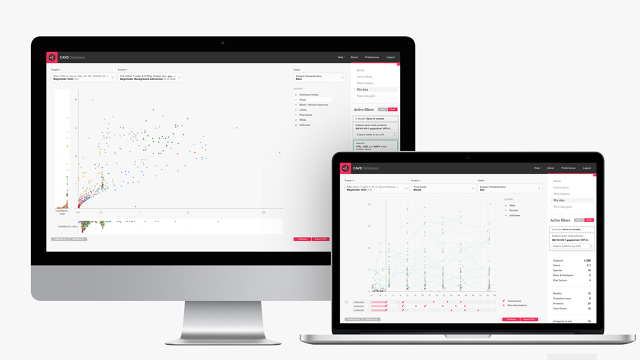
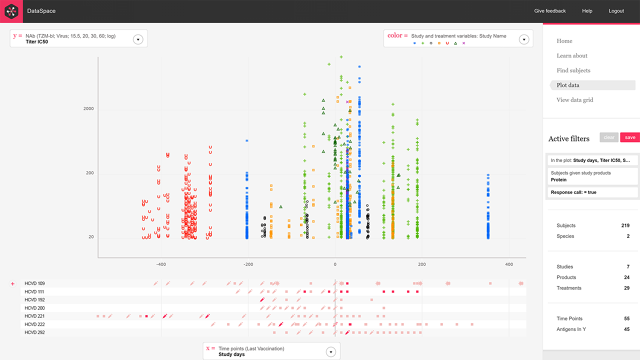
In response to the problem, the statistical analysis firm SCHARP—which crunches data for the group—developed a new platform called DataSpace, working with the design firm Artefact and with funding from the Bill and Melinda Gates Foundation. DataSpace is sort of like using one of those really nicely polished interactive data visualizations, but instead of just mining one big source of data, researchers can actually compare the results of many different scientific studies at once, rearranging patients from different trials into one simulated study. In turn, they can instantly chart how patients across studies responded to the same drug—with all the data rendered on a perfectly articulated graph with the same timelines.

“We’ve already harmonized the data . . . we’ve lined everything up, put it in the space, made it so you could ask questions you didn’t set out to ask,” says Dave McColgin, UX design director at Artefact. “You can sort of stumble into additional questions, if that makes sense.”

Frahm, who worked with Artefact in the early rollout of DataSpace, refers to the platform as a hypothesis engine. While it’s hard to see in these screens, everything is linked, as if you’re surfing Wikipedia and can continually do a deeper and deeper dive on a subject. The secret sauce is that aforementioned data harmonization. Artefact learned which sorts of data points were most helpful in HIV research from scientists, and, working with LabKey and SCHARP, hand-coded that data into the back-end of DataSpace so they could be easily correlated and compared. Basically, the graphs are nice—but the real magic of the platform is thanks to the invisible labor ensuring all study results were presented in the same apples-to-apples figures.

[vimeo 143024487 w=604 h=340]

DataSpace’s primary goal is to surface the data hiding in published papers, making it more accessible and comparable at the same time. But what about all the papers that don’t make it to journals for whatever reason? DataSpace’s even greater contribution could be as a venue to share raw data that, just because it lacks an earth-shattering discovery or conclusion, wouldn’t be published and made public.

“Our currency in science is publications, so you have to get publications out,” Frahm says. The problem is that to publish something in a journal, you need results—in this case, proof that a potential HIV vaccine made some measurable impact on the virus’s spread. Because they aren’t published, all of those failed studies—the funded research in which scientists spent valuable time and money learning some vaccines didn’t work—may be duplicated by another lab making the same mistakes.

“People won’t publish things with negative results,” Frahm says, referring to the long-standing phenomenon known as publication bias. “People won’t publish that information, and that’s data that could be uploaded into the system.” DataSpace, specifically because it’s not a platform for scientific papers but for data itself, could be a collection point for all of the studies generating null results.

For now, DataSpace is built only with a select set of CAVD data. In the future, however, Artefact imagines it could serve researchers across medical disciplines. “We’ve learned from people working on tuberculosis or malaria, you want to be able to compare those studies or tests,” McColgin says. “We think the basic patterns of how data is organized . . . are all in common with other diseases.”

Read More

How A Former Pixar Executive Is Building A VR Company Based On Pixar Principles

Before Tom Sanocki formed the Seattle-based virtual reality company Limitless Entertainment, he spent 11 years at Pixar, where he designed characters for films such as Cars, Ratatouille, Brave, Monsters University, and The Good Dinosaur. His first job was creating the jellyfish in Finding Nemo. When he first arrived at Pixar, the company had just 250 employees and felt very much like a startup. Sanocki thus got a front-row seat as Pixar transformed, as he says, “from an animation company into an animation powerhouse.”

Tom Sanocki

Sanocki’s experience at Pixar, which is famous for its highly creative work culture and rigorous dedication to problem solving, greatly influenced Sanocki, who is taking many of the principles he learned in Emeryville and applying them to Limitless. Sanocki also spent four years at the video game company Bungie, which he says has also influenced his new company (video games and VR content have much in common given that both are designed to respond to players or viewers). But the Pixar ethos is what most infuses Limitless, both in terms of corporate culture—Sanocki implemented a “feedback loop” whereby employees are constantly sharing ideas and opinions with each other—and what it’s creating. The company’s first VR short film, Gary the Gull, has a distinctly Pixar-ian feel. The animation is superb, and the humor is smart and knowing. Much thought has clearly been put into the main character, a fast-talking gull who Sanocki describes as “a conman, a scheister.” Gary has one goal: to steal the lunch from the cooler that you have just unpacked from your car and placed down in front of you on a beach. His methods are mostly verbal.

As Sanocki says, “Gary is fundamentally a used car salesman. And just like a used car salesman will do, he’ll ask you questions, he’ll engage you, but he doesn’t need you to answer a certain way to accomplish his goal. If you say that you like convertibles, well, he has a great convertible for you. If you say that you don’t like convertibles, there’s a great sedan over here, that’s perfect for you.”

Unlike most VR characters, Gary truly does interact—and not just to your voice. If you nod your head, he knows what you mean and will respond accordingly. If you move in too close to him, he’ll fly away briefly. “His personal space is very important,” Sanocki says. The film’s story line ultimately depends on how you react to him.

This interactivity, and the technology that allows it, lies at the heart of Limitless, and is how Sanocki thinks he can push VR forward. “People are actively avoiding characters” in VR, he says. “I’ve been told by other executives that characters are ‘just too hard.’ The ones people do are robots, which are easy to do. Its true—characters are really hard to do. But I don’t think they’re as hard as people think they are. So the right response isn’t ‘let’s be afraid, let’s avoid it.’ It’s ‘let’s find a way to make it easier.'”

In the case of Gary the Gull—which will be available on the Sony PlayStation VR this October; release dates for other platforms are still being worked out—the San Francisco-based company Motional Entertainment handled the creative aspects of the film and came up with the character. Motional’s founder, Mark Walsh, is another Pixar alumnus—he was a writer and director at the company for 18 years— who is used to collaborating with Sanocki. “When we were working on the jellyfish character on Nemo, we went to Tom. He’d use all his creative skill in technology to build a character like that. I was on the design team, he was on the construction team. So he could invent technology for creatives like myself.”

Mark Walsh

For Gary the Gull, Sanocki and his team built technology that takes into account subtle human interactions, such as head movement. “Right now, on your phone, you say, ‘Siri, tell me what time it is. What’s the capital of Brazil.’ It will tell you,” says Walsh. “It’s hearing your voice and spitting information back. The limits in technology right now are the inputs. Your voice. Limitless uses your voice, but also where your head is pointing.”

This boundary-pushing approach to both technology and art is something both men say they learned at Pixar and are applying to their new companies. As are their management and team-building styles. Sanocki elaborated for Co.Create how that plays out on a day to day level.

FOSTERING COMMUNITY

Sanocki says that creating a sense of community between employees is crucial for a rich work environment. Regardless of what title or position someone holds, they should feel comfortable directly approaching others at the company in order to have the most valuable exchange of ideas. This is something that was drilled into him at Pixar from the very beginning, when he was enrolled at Pixar University, a 10-week training class that new hires are required to take.

“One of our homework assignments at Pixar University was to take this list of 10 fundamental advances in computer graphics—texture mapping, all that, we had to find out who made that invention. But we weren’t allowed to look it up on the Internet,” says Sanocki. “We had to talk to people in the company about it. So we did that, took all those names, and had to get their Pixar, four-number extension, and add it up, and that was your answer to your homework assignment. So it was designed to be social, you had to talk to people. And it was designed to help us realize how much sheer brain power and fundamental advances were made by the people there. But just as importantly, it helped you feel connected to that. So you weren’t just—they weren’t on this side of the fence, and you were on this side of the fence, we were all in one big company together.”

The class also provided an opportunity to bond, because “you’re doing it with a bunch of people who you can form friendships with, you go to lunch with them, you get to know them. And now when you have a question about something in a different department, you now know two or three people in that department whom you can talk to. That department now has a friendly face. It’s not the effects department that constantly keeps bugging us, it’s Keith! It’s Keith and Chris, who, I know them! And I like them. And now I’ve put a face onto a department.”

CONSTANT FEEDBACK

“The company culture at Pixar was designed to be very collaborative and very focused on people giving feedback. You know, when you had a screening of a film, each film screened four times a year, often six, and at the end of each screening you could give feedback to the producers. You’d send an email, you could write down notes. And they collect that for Brain Trust (an elite squadron comprised of Pixar CEO John Lasseter and top directors) meetings,” says Sanocki.

“There are elements of that on a more local level as well. That’s kind of at the high level, the script level. Then, in each review, if you’re showing your work to a director, you go to a screening room and you sit next to the director. You’re getting feedback directly from him or her. And you show them your work, you talk through it, and they give you feedback. Everyone in the room is also available to chime in as well. So you have your whole team there. Even if the rest of the team isn’t showing, they’re there, hearing that feedback, listening to it. And you have your production manager, you have your art director, animation, everyone else that’s connected. And they give feedback freely. Animation does this and it’s a riot, they’re constantly chiming in with ideas, riffs on this, and so forth. So that’s kind of general principle for feedback. You want to be able to talk, speak up.

“If you’re a junior guy, as long as you’re respectful, you want to make sure you come across the right way, you’re encouraged to go and give those ideas. And that’s the principle we have with our company. We want folks to be honest, to give feedback, to be involved in lots of different things. Don’t silo people. Let people be connected to the whole process, and be comfortable talking about things that are outside of your wheelhouse. If you have a comment on sound, then you should make that comment on sound, because your feedback is valuable. And if you want to actually go and work on sound, then sure, go and do it. If no one else is doing it, and you have a take on it, you should feel free to do that. Because we’re a startup and we don’t want people to feel siloed. So everybody’s a storyteller, everyone is working on the storytelling experience together, no matter what their job title or discipline.”

ASKING THE RIGHT QUESTIONS

“The feedback loop is simple to talk about, it’s hard to do,” Sanocki explains. “It’s hard to make people honest. I learned a lot from Pixar about asking the right questions. It’s all about asking the right questions and figuring out what people aren’t saying. It’s easy to say, ‘How do you like that?’ to an art director. And they’ll give you some feedback. But then, based on all the time I had at Bungee and mostly at Pixar, you learn to ask certain questions, and half of it’s intuitive, and half of it’s a script that you follow. You ask specific questions about, well, what about the color of that iced tea? Is that the right color?

“If a director says he doesn’t like the color, then you can ask him follow-up questions. But the hard part is getting them to be specific and to make sure you’ve gotten all the questions out. Because as an executive, I’m not always involved in the creative decisions. I may be providing input, but making the creative decisions isn’t really, there’s better people to do it. Really what I need to be doing is making sure everybody’s feedback is coming out honestly. So I ask you, how do you like the coffee table? You say, Yeah, I like it. And it’s going to be up to me to say, ‘Okay, well, do you like the colors? Is that good? Is that the right wood grain?’ You want to ask more detailed questions to make sure everyone really is being honest about it.

“It’s one of those things that sounds simple, but the trick is in the implementation of it, and it’s constant vigilance to make sure everyone’s being really honest and that you’re getting all the right people giving opinions. And that includes bringing people in from the outside to give a fresh look.”

FIGURING OUT HOW PEOPLE SOLVE PROBLEMS

Because companies like Pixar and Limitless are so group oriented, it’s important to know how people work not just independently, but with others. Sanocki says he learned from Pixar how to get a good sense of how people do that by having them talk through projects.

“Pixar’s hiring process was not as rigorous as I was expecting when I first interviewed there,” says Sanocki. “I was used to the technology interviews where they pepper you with questions and give you brain teasers. And Pixar was largely about talking about your projects and asking some questions. And honestly, it works pretty well. A lot of it’s about instinct, a lot of it’s about how people talk about their projects.

“You kind of drill down on some questions about how people solve problems. You talk about how people solve problems and do that as a way to figure out whether they’re a good fit. And you look for unique ways to solve problems. You know, you don’t want the people who say, ‘Yeah, for this problem I did A, B, and C, the obvious things.’ You want someone with a unique approach. One inspiration I took from Bungie that I adapted to more of a Pixar style is to have somebody design something. It’s not required to be good and correct, but just to talk through it. So I might say, Let’s design a character for a story that takes place on a beach. So let’s do that. So just talk through how they do it, see what questions they ask you. For a technical interview, it might be, let’s design some software together. Like, design a cross-simulation software package. Ideally, it’d be something that they don’t know anything about, so you see what questions they’re asking. Because our work is collaborative, it doesn’t make sense for us to be interviewing people and evaluating on how they solve problems by themselves. You want to figure out how they solve problems with other people.”

Read More

The New World Order Is Ruled By Global Corporations And Megacities—Not Countries

Ask yourself, honestly: If Uruguay or Guinea-Bissau disappeared off the face of the Earth, would you really notice? Now what about if Google disappeared from your Internet browser or Coca-Cola from your grocery store shelves?

We all know that quite a few corporations or terrorist groups have more influence in the world than many states do, but have yet to place them all in a single framework that measures them according to their reach and relevance. And yet such a “Mindshare Matrix” is precisely what we need to properly understand the 21st century landscape of power. Rather than comparing only apples to apples (countries to countries, companies to companies) in silos—as all existing rankings of power, wealth, brand recognition, or other assets do—this matrix would place countries, cities, companies, cyber-communities, and other contenders on the same playing field.

Frank L Junior via Shutterstock

Consider how an American or French citizen can kill in the name ISIS, a non-state terrorist regime in Syria where the civil war it stokes has caused a refugee wave of more than one million migrants into Europe alone, shaking the world’s wealthiest nations’ domestic and foreign policies. Or how Argentines have been using the cryptocurrency Bitcoin to evade their government’s capital controls, undermining a once hot emerging market’s credibility in global financial markets. Whether acting as a state or serving as the conduit to evade one, ISIS and Bitcoin—or Anonymous and Telegram—blur the traditional boundaries between domestic and international, physical and virtual. They are perfectly at home though in the Mindshare Matrix, where loyalty is up for grabs.

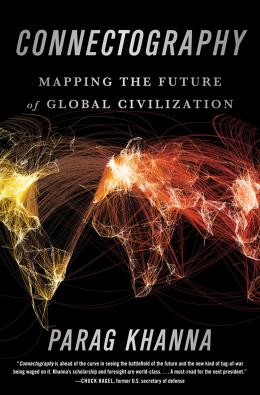
The following is an excerpt from the a new book, Connectography: Mapping the Future of Global Civilization, by Parag Khanna, a senior research fellow at the Center on Asia and Globalization at the Lee Kuan Yew School of Public Policy in Singapore.

The 5 “Cs” of a Complex World

A simple typology helps us to understand the range of players competing in the Mindshare Matrix. These are roughly the 5 “Cs”: countries, cities, commonwealths, companies, and communities. What matters more than their latent power—nuclear weapons or cash piles—is their ability to deploy resources to build leverage within the system. Power, then, is a function of connectivity—only the most connected powers can win.

Let’s start with countries. There are only a handful of “systemically relevant” countries on the global stage, to borrow a phrase from the global financial regulatory lexicon. The U.S. and China stand out as superpowers, with the U.S. leading in military and monetary terms and China edging ahead in trade and outbound infrastructure investment. China is now the largest trade partner of 124 countries, more than twice as many as the U.S. (52).

Meanwhile, second-tier states such as Russia, India, and Brazil are as fragile as they are ambitious. Emerging powers from Nigeria to Iran to Indonesia are, at most, regionally influential. As for the remaining mostly postcolonial states created since World War II, more than one hundred of them together represent less than 3% of global GDP and an even lower share of world trade—they lack both economic mass and international connectivity. What Adam Smith mused about 18th century China applies to them in spades: If it were “swallowed up by an earthquake,” even civilized observers would make little more than “melancholy reflections” and express “humane sentiments,” but ultimately would return to their business or pleasure “with the same ease and tranquility, as if no such accident had happened.” In other words, they just don’t occupy much mindshare. For better or worse, if half the countries in the world sunk into the sea, as is happening to the Maldives and Kiribati, it’s not likely it would be covered on the evening news in America (and certainly not during an election year)—unless Madonna or Angelina Jolie were on holiday or adopting a child there.

Joe Ferrer via Shutterstock

There are quite a few more systemically relevant companies than there are countries. More than 30 financial institutions have consolidated assets greater than $50 billion each—meaning each has more assets than two-thirds of the world’s countries produce in annual GDP. For hundreds of millions of customers around the world today, bank accounts are a lifeline as or more important than citizenship. Looking beyond banks, there are fewer than five countries in the world whose GDP is larger than the more than $200 billion of liquid cash Apple holds in securities worldwide, meaning Apple could buy many countries’ combined output (minus their debt). Having sold almost 2 billion products to more than one billion people, Apple not only has more money but also occupies greater mindshare than most nations as well.

Importantly, many of the world’s largest and most powerful private companies are no longer (if they ever were) agents of their “home” countries; they are becoming stateless superpowers in their own right. America’s consistent soft power appeal is rooted to some degree in the appeal of it brands: From Microsoft to McDonald’s, American companies dominate the advertising giant WPP’s brand index in visibility and reputation. But many of these companies are not so much American as “American.” Their brands transcend their national origin—as do their commercial ambitions. Whereas countries need companies as ambassadors, the reverse is far less true. It is no surprise then that Facebook or Coca-Cola can enjoy such success worldwide irrespective of foreign publics’ sentiment toward the U.S. The high-profile cases of American corporations using transfer pricing and inversions to create conglomerates domiciled in low-tax jurisdictions to evade U.S. corporate taxes are further evidence that companies increasingly view countries not as sovereign masters to be obeyed but jurisdictions to be negotiated. Just ask Halliburton—but make sure you call during daylight hours in Dubai, to which it has shifted its global headquarters.

Because foreign investment dwarfs official aid flows, and brings with it jobs, skills, and technology, companies hold growing leverage over where to locate their operations. Governments have become what early political economist Susan Strange called “supplicants” engaged in a “triangular diplomacy” with firms to attract their catalytic benefits. The first thing new Kenyan president Uhuru Kenyatta said (as do so many other leaders desperate to reassure markets) upon taking office in 2013 was that his country is “open for business.”

abydos via Shutterstock

Small and weak countries in Africa and Southeast Asia are learning that the only way to have influence in a Matrix that cares more about connectivity than sovereignty is to lash together into currency and customs unions, free trade areas, or infrastructure-sharing agglomerations—anything to make them appear a larger market to invest in or to increase their bargaining power in negotiations. The Caribbean CARICOM, East African Community (EAC), and Southeast Asian ASEAN group all strive to be low-grade versions of the European Union, the archetype of the third “C”: commonwealths. The world is becoming a collection of these internally borderless mega-regional groupings—including even the South American Union and eventually, as the successor to NAFTA, a North American Union.

These commonwealths are far more relevant players than the civilizations hypothesized by the late Harvard professor Samuel Huntington. Neither Christianity nor Islam (nor any other religion) has the coherence that these regional groupings are acquiring. The European Union, for example, remains the largest economic block in the world, and the 600 million citizens of ASEAN represent a larger GDP than India and attract more FDI than China. These regional confederations are much more the building blocks of the future world order than countries.

So too are cities (the fourth “C”). Germany may be a more important country in the world than the U.K., but London is a far more connected and influential city than any other in Europe. All cities belong to some state or the other, but in the Matrix, many cities matter as much to the world as to their home country—which is often a mere hinterland to the city. That is certainly the case in London, whose financial industry and real estate market are global centers of gravity while the city sucks all the talent from the rest of the U.K. In emerging markets, Sao Paulo, Lagos, Moscow, Johannesburg, and many other cities represent one-third to one-half of their national GDP. Developing-world megacities from Cairo to Mumbai to Manila have populations so large, and expanding geography so vast, that they have become urban archipelagos unto themselves whose orbit most “city-zens” will never actually leave. Not surprisingly, the popularity of mayors from Buenos Aires to Istanbul to Jakarta has propelled them to become heads of state in record numbers.

The 5th “C”—communities—is the ultimate expression of a Matrix world in which mindshare constitutes a discreet form of authority on par with national sovereignty. Diasporas and religious groups, to the extent they can congeal into meaningful associations, belong in this trans-territorial category. The Chinese, Indian, and Jewish diasporas, for example, are rich cultural and financial zones spanning every continent contributing to the $540 billion in remittances logged in 2014.

These are the largest of the “cloud communities” whose overall number and size are growing thanks to the Internet, which Wikileaks founder Julian Assange credits with enabling connected groups to anneal into empowered collectives. Nearly universal digital utilities such as Facebook are expected to run themselves as pro-member communities with greater, almost Constitution-like transparency within as they pursue their state-like agendas to expand connectivity worldwide to increase their user base (or membership). But social networks don’t hold sovereign territory and neither do citizens in any traditional or legal sense—rather they provide the tools for people to shape their welfare in an era where ever more of our personal, professional, and commercial life is mediated online. These ties can be used to motivate and crowd-finance virtual and real-world activities using cryptocurrencies.

Hacker groups such as Anonymous, the digital recruiting militants of ISIS, the recently terminated online drug bazaar Silk Road, the Facebook groups that helped self-organize the young revolutionaries of the Arab Spring, and many other cyber networks don’t exist just to challenge states but to serve their own agendas—often against each other. North Korean hackers steal data from Hollywood studios, Al Qaeda and ISIS compete for turf in Africa, Anonymous declares war on ISIS. If nations are merely “imagined communities” as the late Benedict Anderson famously termed it, then Facebook groups and other cloud communities can seem just as real.

pikappa51 via Shutterstock

From Followers to Believers

Assessing the wide spectrum of the 5 Cs together rather than separately helps us to appreciate today’s bewildering complexity. Indeed, the most fundamental attribute of our emergent global system isn’t the shift from unipolarity to multipolarity (structural change), but rather the shift from a state-centric order to a multi-actor arena (systems change). Structural change happens every few decades; systems change only every few centuries. Structural change makes the world complicated; systems change makes it complex. The forces of capital and technology, which are accelerating the rise of non-state authorities, cannot be put back in the bottle by any hegemon, whether America or China.

Have we reached the tipping point where loyalty to horizontal or digital tribes truly supersedes the sense of belonging to vertical nation-states?

The recently published Global Trends 2030 report of the National Intelligence Council titled “Alternative Worlds” includes a very plausible scenario in which urbanization, technological advance, and capital accumulation accelerate the rise of private entities who effectively govern far-flung populations through supply chains and special economic zones (SEZs). “It is as if the central government acknowledges its own inability to forge reforms and then subcontracts out responsibility to a second party. In these enclaves, the very laws, including taxation, are set by somebody from the outside. Many believe that outside parties have a better chance of getting the economies in these designated areas up and going, eventually setting an example for the rest of the country.” My only quibble with this fine analysis is that it describes the world of 2013, not 2030.

The scenario is illustrative of how supply chain operators have already begun to command loyalty. As Western governments cut public payrolls, millions of citizens have been left to fend for themselves amidst fewer benefits and higher taxes. Especially among youth, the future will be one of self-sufficiency rather than entitlement. National welfare, then, increasingly depends on the provision of employment by companies, and the economic activity and tax revenue they generate. In countries such as Greece, the lucky employed ask themselves: How much time does one spend as an engaged citizen in the public sphere, versus just getting by however one can?

pavel dudek via Shutterstock

For those in the developing world not fortunate to leave home, de facto loyalty shifted from state to firm long ago. From the city of Jamshedpur in India, whose company-run services make it effectively a wholly owned subsidiary of Tata Steel, to FoxConn’s assembly plants across China, major corporations are not only a source of employment, but also skills training and thus relevance in the global economy. Whereas a half-century ago, there were only a half-dozen such SEZs. Today there are more than four thousand, making these new-age factory towns the world’s most rapidly spreading urban form.

The rise of thousands of pop-up cities is a major indication of the shift toward a hybrid public-private Matrix world. So too is the movement of people to them, both within and across borders. Migration provides very tangible evidence of the unmooring of nationality as the sole anchor of actionable loyalty. There are now more migrants than ever in history, nearly 300 million, with a sizeable proportion potentially never returning “home.” These hundreds of millions of expats occupy every rung of the value chain from corporate executives in Asia to third-world guest workers in the Middle East. The highest number of Americans ever recorded, more than 9 million, now live abroad, with a record number—more than 4,000—giving up their U.S. citizenship each year. Despite the high-profile efforts of Facebook to lobby for larger visa quotas to recruit programmers to the U.S., most Silicon Valley technology companies are devoting their efforts in the opposite direction: Building their presence in fast-growing emerging markets. Will America experience brain drain as the quality of life in high-growth markets improves even more?

Furthermore, the more spending power Brazilians, Nigerians, Emiratis, Russians, Indians, and Chinese accrue, the more their passports are welcome visa-free in the West. At the same time, the automatic privileges of Western passports may erode given security concerns that Canadians, Americans, Swedes, British, and French citizens could also be ISIS members. The likely solution: A blockchain-based passport system linked to individual credentials rather than national identity. Your human right to mobility will be linked more to who you are today than the incidental fact of where you were born. This is not only a wonderful potential evolution on centuries of institutional prejudice, it also implies a world full of individuals for whom geographical roots are secondary to connectedness and access. Talk of “global citizens” won’t just be reserved for idealistic Model UN conferences.

One place is already becoming a stateless melting pot: Dubai. The world’s fastest-growing city, Dubai is already populated more than 90% by foreigners and allowing in on average more than 1 million people each decade with ambitious plans to colonize the desert. The millions of foreigners in Dubai will likely never become citizens of the United Arab Emirates, yet they are increasingly loyal to the place that allows them tax-free living and nonstop global connectivity. You can measure mindshare by seeing how people vote—with their feet.

The more mobility people have—physical and virtual—the more their loyalty will pass to whomever provides them with security and skills. This is how companies excel where governments have failed. Some companies spend more on upgrading employee skills than than entire countries do on education. WPP, whose annual profits hover around $16 billion, invests nearly $100 million per year on the training and well-being of its staff of 158,000, with greater numbers in the BRIC countries than the U.S. and U.K. combined. PWC conducts constant “re-skilling” of workers to transition to higher growth client sectors. DHL and Unilever, the world’s most extensive supply chain operators who can reach geographies that the Internet still hasn’t, sponsor frequent staff relocations to experience life with clients and counterparts in diverse markets.

Virtual connectivity is also building new and more stable loyalties. In a world that is more geodesic than geographic, the “where” becomes much less important than the “what.” Facebook’s 1 billion members therefore don’t compete with nations, they transcend them. Facebook is not a country but a conduit for generating flash mobs of allegiance. China and other countries may seek to impose an oxymoronic “network sovereignty” on free access to information within their geographic borders, but this ultimately won’t stop the flows of data that make the Internet as a whole a universe of association and competition for mindshare.

Countries run by supply chains, cities that run themselves, communities that know no borders, and companies with more power than governments—all are evidence of the shift toward a new kind of pluralistic world system. The ranks of such global authorities that belong in a holistic Mindshare Matrix are rapidly growing.

From the book Connectography: Mapping the Future of Global Civilization by Parag Khanna. Copyright © 2016 by Parag Khanna. Reprinted by arrangement with Random House, a division of Penguin Random House, Inc. All rights reserved.

Read More

Why Patients Are Getting Hit With Surprise Bills After Genetic Testing

Leslie Parks* was 34 and ready to start a family, but struggled for a year and a half to conceive. Before embarking on fertility treatments, her doctor required that she and her husband get screened to determine their carrier status for various genetic diseases. He recommended a Silicon Valley-based startup called Counsyl and assured her that the test would be fully covered by her insurance.

Weeks later, Parks received a bill for more than $1,494 after her insurer deemed the test “experimental.” Parks was shocked. As she later learned, that is the rate that Counsyl charges insurance companies; by contrast, their fee for uninsured patients is $349.

Under Counsyl’s guidance, Parks entered into a lengthy appeals process with her insurance company, writing letters and making phone calls for months. She asked Counsyl representatives if she could pay the uninsured patient rate of $349, but they declined and insisted she press ahead with the appeals process. More than six months later, her insurance company upheld their denial of the claim, and she was still faced with the $1,494 bill. She called Counsyl and asked again to pay the $349 uninsured patient fee instead. The representative finally agreed.

In the meantime, Parks got pregnant. Two months into her pregnancy, her ob-gyn recommended that she have an advanced version of the routine prenatal testing. While Parks didn’t have any high-risk factors, she would be 35 years old by the mid-point of her pregnancy, putting her in the “advanced maternal age” category. Her doctor said this would qualify her for a blood test at 11 weeks to determine whether her unborn child was at high risk of genetic conditions like Down Syndrome. Again, she was informed by her doctor that her insurance company would pick up the tab, or at the very most she’d have to pay a “couple hundred dollars” if the test was out of network.

Yet a few weeks later, “basically the exact same thing happened again,” she says. But this time, Parks received an $8,000 bill. The company, Natera, based in San Carlos, California, and founded in 2004, was a little more forthcoming when Parks called, distraught that she’d have to pay such a large sum. She says that Natera promised that they would handle the appeals process with her insurance company. If the claim was denied, however, they would send her another $8,000 bill but she could call and ask to pay the patient adjusted rate of $200. She asked if she would receive a bill for this adjusted amount. The representative said no, they wouldn’t put that rate in writing.

Parks says that the bills she received from both Counsyl and Natera made no indication that there was another tier of pricing, and it was only after calling and pressing for alternatives that the lower price was revealed.

A Counsyl spokesperson says the company doesn’t comment on individual patient cases, but that its goal is to offer transparency around billing. “Health care pricing is dynamic and complicated, but Counsyl is fully committed to providing patients with a clear and transparent assessment of screening costs,” a statement reads. The company also pointed to its new billing section, which explains the process to patients. A Natera spokesperson says, “It is unfortunate that the patient . . . experienced shock at receiving such a big bill. However, in the health care industry, a company’s “list price” is typically substantially higher than the price ultimately paid by a patient. The final amount paid by a patient is dependent upon the price for the testing that was negotiated by the insurance company, the patient’s insurance plan’s coverage, and the plan’s associated copayment and deductible.”

Stories like Parks’s are becoming increasingly common as hundreds of genetic tests flood the market. Forums for new and expecting parents, like Babycenter.com, are now filled with endless comment threads of patients fighting their insurance company after a claim is denied, or sharing feelings like being “misled” or “used” by the genetics companies, their doctors, their insurance—or a combination of the three.

When Regulation Lags Behind Market Demand

The crux of the problem is that genetic testing has exploded, but regulation has been slow to catch up. The U.S. Food and Drug Administration is still finalizing its guidance for how it will oversee the category of lab-developed tests, which includes some 60,000 genetic testing products already on the market.

Furthermore, insurance companies are in the midst of determining whether to reimburse for all or part of the cost of genetic tests that do not offer clear diagnoses, but instead dabble in probabilities. Some insurers have opted to cover genetic tests in cases where the patient is deemed high risk (a common case is the breast cancer risk test, which insurers tend to pay for only when the patient has a family history of cancer). Other insurance companies will only reimburse for tests that it determines are “medically necessary.”

“Insurance coverage of genetic testing is an underappreciated, but huge and important question,” says Patti Zettler, an associate professor at Georgia State University College of Law, who specializes in health policy.

According to Zettler, coverage will vary depending on the person’s medical history, their employer, and the state that they live in. The final bill is also dependent on the patient’s deductible, whether they meet certain medical criteria, and whether the testing company is in-network or out-of-network.

In short, it’s complicated.

“Private insurance companies can essentially make their own decisions about what are medically necessary services and what are not,” Zettler explains. And these decisions aren’t particularly clear cut to anyone, let alone patients.

“Too Frustrating For Everyone Involved”

“You’ve put your finger on why we got out of the reimbursement business,” says Troy Moore, chief strategy officer for Kailos Genetics, in response to hearing Parks’s story. “It was simply too frustrating for everyone involved.”

For two years, Kailos offered a reimbursement model. The company pulled in higher revenues overall by filing claims to insurers, but it also meant dealing with calls from confused and angry customers. According to Moore, many would demand the lesser, out-of-pocket rate after their insurance company rejected their claim, but it wasn’t always that simple.

Moore says many insurers don’t have a problem with a genetics company offering a lower cash rate to patients who don’t use insurance. The assumption is that it is cheaper to avoid insurance, as there’s no administrative burden in filing and dealing with claims. But that doesn’t apply to cases in which the claim has already been filed and rejected by the insurance company; in that case, it’s harder to justify a vastly different cost for the patient. Moore says it might be considered fraudulent to overbill the government in cases where the patient is using Medicare or Tricare.

For these reasons, his team recently made the decision to offer all their tests for a flat rate of a few hundred dollars. No insurance. No angry phone calls. No tedious billing process, which might involve faxing forms to insurers that are filled out with the requisite blue ink. But that also meant taking a good portion of the company’s revenues off the table, which had to somehow be replaced.

“Now, to make the same amount of money, we have to reach a lot of people and keep them happy,” says Moore. “If they order once, we hope that they’ll order again.”

Other genetic-testing companies remain divided on the question of whether to accept insurance and the hassle that comes with it. Most have settled on a mix of insurance (with different rates for in-network and out-of-network), flat cash rates, and financial assistance for those who need it. In that category: Counsyl, Natera, Myriad Genetics, and Invitae. Others, like Color Genomics, are taking a similar approach to Kailos by refusing to take insurance altogether.

For her part, Parks just wishes the process was more clear. During one of her countless phone calls she expressed her frustration, saying, “Can you imagine how upsetting it is to be surprised with an $8,000 bill?” The representative replied, “Yes, I imagine so.”

*Parks requested to use a pseudonym, as she is still in the negotiations process.

Read More

How The Boardlist Plans To Get More Women Onto Startup Boards

Karla Martin remembers the phone calls. A recruiter would be putting together a slate of board candidates for a company and would reach out to see if she was interested. The hitch: She would have only until the next day to decide. Martin, a former director of global business strategy at Google with more than 20 years of experience advising companies on how to drive growth, was certainly qualified to sit on a board. But her mentors warned her to be wary of becoming the token female and African-American candidate: If recruiters were seriously considering her for the position, they would have reached out earlier. “I’m sure there’s a good number of women and people of color who respond, and they do get the board seat,” Martin says. “But my experience has been roughly what my mentors expected.”

When Facebook went public in 2012, its directors included venture capitalists and tech and media executives—but not a single woman until chief operating officer Sheryl Sandberg was added to the list a month later. Twitter went public the following year with no female directors (it has since added two). And it continues. Fitbit’s high-profile IPO last year was conducted without a woman on its board. Which raises the question: How can otherwise forward-thinking companies have such retrograde boards?

Sukhinder Singh Cassidy, a serial entrepreneur and former Google executive, wants to change that dynamic. Currently the CEO of the shopping site Joyus, she has plenty of board experience herself: TripAdvisor, Ericsson, and formerly J.Crew. But a few years ago, she started paying more attention to the overwhelming maleness of Silicon Valley boards. She saw how it could hamstring female colleagues, who miss out on invaluable opportunities to raise their profiles, meet other high-level executives, and learn important management skills. Just as important: A lack of gender parity can affect businesses. Companies with diverse boards mirror their customers’ demographics and have been shown to function better—a recent meta-analysis published in the Academy of Management Journal found that female representation is associated with increased board-level monitoring and strategy.

When Singh Cassidy recently polled male founders and CEOs for an explanation, she kept getting the same answer: Finding great female directors takes too long and is too hard. Singh Cassidy suspects that most people simply aren’t considering the right women. “You may not know her, but that doesn’t mean she doesn’t exist,” she says. In February, she launched the Boardlist, a searchable, for-profit database of female candidates, nominated largely by Silicon Valley businesspeople. The site, which operates as a benefit corporation, offers a fast and simple solution to the problem of locating qualified women for boards. But, as Singh Cassidy is discovering, the issue may not be so easy to address.

The standard board appointment process for tech startups—candidates advertise themselves, founders ask around—has been largely informal. And given the demographics of Silicon Valley’s elite, it has favored white men. Singh Cassidy’s insight in creating the Boardlist was to take that back-channel process and replicate it more formally online. (Though the Boardlist isn’t the only database of female candidates—see “Shattered Glass”—it is the most Silicon Valley–centric.) The site allows a curated group of executives and investors (including, yes, many men from Sand Hill Road) to nominate women for inclusion on the list. The site’s staffers create profiles for each candidate, populating them with information, such as whether the nominator believes a woman is best suited for an early-stage startup or a company that is further along. Women, crucially, are not allowed to nominate themselves (they can only submit a request for consideration), though they may edit their profiles once they have been created.

There are now more than a thousand women on the list. CEOs can search for potential board members for free, while frequent users such as venture-capital firms and recruitment companies pay a fee. If a board is interested in someone, the Boardlist’s staffers contact her to gauge interest and make introductions. The idea is not only to introduce founders to more women, but to make the process less frustrating for the candidates themselves.

A few months after the Boardlist launched, following a beta period, it touted more than five dozen active searches and one early success: The site facilitated Martin’s appointment to the board of Challenged, an app that promotes social media challenges along the lines of the ALS ice-bucket phenomenon. But no other appointments had followed. “It’s going slow,” Singh Cassidy admits. One issue has been that Singh Cassidy and her colleagues had to play executive recruiters—phoning Boardlist members to persuade them to take interviews, advising CEOs about attainable candidates. They hope this time-consuming process will eventually become more automated. But Singh Cassidy has also learned that boards’ gender imbalance isn’t just about supply, as people often claimed. At least as often, it’s about demand.

The root of the problem lies in the way startup boards are often constructed. Most of a typical company’s seats are filled by its founders and funders—who, in Silicon Valley, are disproportionately white men. The remaining, independent seat frequently goes to someone with CEO or founder experience (again, usually a man). The result: Only about 22% to 25% of private tech boards include any women, compared with 97% among S&P 500 companies. What’s more, when the Boardlist, with the analytics firm Qualtrics, surveyed CEOs and founders about their boards, 39% said their independent seat—the best hope of getting a woman appointed—was still unfilled. These habits stand in contrast to those of big public companies, which fill seats as soon as they’re vacated and seek people with specialized expertise (auditing finances, compliance issues), creating opportunities for female candidates who may not have CEO–level experience.

Clara Shih, who sits on the board of Starbucks and is the cofounder and CEO of the social media management startup Hearsay Social, has experienced both sides of the gender challenge. She joined the Starbucks board after Sheryl Sandberg stepped down and recommended Shih as a digital expert. While Shih is one of three female Starbucks directors, she’s the only woman on her own four-person startup board. Shih would like to fill a fifth seat, the independent one, with a woman—someone with a tech background who has been a founder and CEO. “I want to bring in someone who’s been through it,” Shih explains. That’s difficult to do. But Shih isn’t in a rush. As the CEO of a small, fast-growing startup, she has higher priorities. And so the seat remains vacant.

Similar stories have taught Singh Cassidy that the Boardlist can’t just focus on supplying female candidates. She also has to convince founders to fill their seats. “We thought it would be enough to build a self-service website,” she explains. “We actually have to make the market.” Today, Singh Cassidy makes a point of counseling founders on the importance of that independent board seat. She tells them that having an independent member mitigates their investors’ control, delivers an outside perspective, and adds a tie-breaking fifth vote to four-member boards. And since female board candidates with CEO and founder experience are relatively scarce in Silicon Valley, she encourages startups to consider lower-level executives who nonetheless have overseen growth—a group that includes far more women. Someone who runs a big division of Facebook, she argues, may be just as knowledgeable as a higher-level executive elsewhere.

On the Boardlist, CEOs can look for candidates by skill—an approach that may encourage some boards to broaden their searches. Lynzi Ziegenhagen, the CEO of the ed-tech startup Schoolzilla, is searching for an independent director. She wants a woman and, like Shih, prefers founder-CEOs of high-growth tech businesses. But when Ziegenhagen recently searched the Boardlist, she found, along with three impressive CEOs, two non–CEOs who had relevant experience. She’s considering them.

Ziegenhagen’s board, however, is already atypical in that two of its three existing members are female. That’s because its CEO and an important investor (Shauntel Poulson of Reach Capital) are both women. “If you solve the investor problem and the founder problem,” Ziegenhagen notes, “this issue [of all-male boards] would go away.” It’s an important point and one that exposes a limitation of the Boardlist’s approach: No matter how many female directors they help place, Silicon Valley boards won’t get anywhere near gender parity until more women create and invest in startups. And that kind of systemic transformation is going to require a much bigger investment than Singh Cassidy’s fast and simple solution.

Read More