Press Enter / Return to begin your search.

What I Learned From A Week Of Limiting My Tech Use

True story: I love productivity and life-improvement hacks. I love them so much that I’ve tried them all, from the Pomodoro Technique to the Eisenhower Method.

So, when The Muse recently published an article about fitness coach Craig Ballantyne’s 10-3-2-1-0 rule, I knew I had to give it a shot. And for science’s sake, I recorded my results for you.

No, really. I lived by the rule for seven days, stuck to it religiously, and ended up with some good conclusions that I think might inspire you to check it out.

What Is The 10-3-2-1-0 Rule?

Before I dive into my experiment and what ended up happening, I should probably start by explaining what these numbers are all about.

  • 10 hours before bed: no more caffeine
  • 3 hours before bed: no more food or alcohol
  • 2 hours before bed: no more work
  • 1 hour before bed: no more screen time
  • 0: the number of times you hit the snooze button in the morning

Basically, the idea here is to give yourself a daily routine that makes you more productive by allowing you to fall sleep quickly, stay asleep, and wake up feeling ready to tackle your day. If this is done “correctly,” you shouldn’t feel the need to slam your hand on the snooze button or toss and turn throughout the night. Sounds amazing, right?

My Grand Hypothesis

I’ll admit, I went into this one with a little anxiety—you know, over the whole “not being able to do things when I wanted to” part of it. I’m always a little skeptical of productivity hacks that require you to put limitations on how you live your life. What if I got hungry right before bed? What if a big work emergency came up but I didn’t have my phone out? What if news broke and I couldn’t watch it live because no screens? How would I survive?

I predicted I wouldn’t. Well, I mean, obviously I’d survive—but I wouldn’t survive in one piece. Naturally, I assumed I’d end the week feeling exhausted from keeping up with the timing of everything and that it’d be unsustainable. Plus, would I really learn anything all that insightful about my work habits? I wasn’t convinced.

The Results

Twist: I actually really liked the 10-3-2-1-0 rule! Interestingly, the part of the experiment I thought would give me the most trouble gave me the least. Plus, it brought a few other issues to light.

The Anxiety
For one, I actually didn’t have that much anxiety about stopping work two hours before bed. I’m a huge TV junkie, so getting excited about shows throughout the day and powering down my laptop to turn on Survivor or The Voice became a fun daily ritual. And on other days, when my shows weren’t on, I hung out with friends or read. The rule reminded me that it’s important to treat yourself every single day, which can definitely be a challenge for some people (ahem me).

The Addiction
In contrast, what I didn’t originally anticipate being a problem is how truly attached I am to screens. In fact, I believe the word may be addicted. On the first night, I shut down my laptop and vowed to read a book before bed to keep up with the “no screen time an hour before shut-eye” rule—but then I subconsciously picked up my phone almost immediately. I wasn’t even trying to answer emails or do any work; my fingers mindlessly went straight to Instagram, where I scrolled with no purpose.

After dealing with this two nights in a row, I decided to charge it at an outlet across my bedroom. Yes, I experienced a bad case of phantom phone hands for the next couple of nights, but after a week, I finally started to recover. I’m even thinking of just buying an old-fashioned alarm clock so I don’t even have to keep my phone in my room for that reason.

The Pointless Popcorn
Finally, the other possibly life-changing observation I noticed is how much I enjoy late-night snacking, even if I’m not that hungry. Just like my phone, I’d immediately grab a bowl of popcorn or chips to relax. Well, it turns out that I really am able to fall asleep faster on an emptier stomach. Who knew?

Overall, while I probably won’t follow the exact 10-3-2-1-0 rule to a T from here on out (hey, stuff comes up), I definitely want to avoid drinking caffeine in the afternoon, eating late-night snacks when I’m not hungry, working right up until lights out, and having my phone within reach at all times.

These aren’t groundbreaking conclusions, but they are game changers for me, so I’d definitely recommend you try this out. Trust me, you’ll learn something.

This article originally appeared on The Daily Muse and is reprinted with permission.
Read More

How To Get Your Employer To Finally Recognize Your Potential

It’s the job of every manager to size up their team members and evaluate their potential. That means understanding not just their current talents, but also their likelihood of developing them for higher-impact roles. It’s no small challenge, and it’s one that even good managers sometimes fall short of. So it’s helpful if you can show off your high potential in a way that’s conspicuous without being obnoxious.

Whether they’ve laid it out in an official framework or otherwise, many companies use roughly the same criteria to determine which of their employees have the highest potential to move up their ranks. The three most common aren’t all that surprising: likability, ability, and work ethic. Here’s how to make sure you’re authentically showing off all three.

1. You’re Easy And Pleasant To Deal With

Can you build and maintain positive relations with others, and generally show good organizational citizenship? Great! That will help you when it comes to likability, which is often a function of high emotional intelligence, not to mention the ability to hold in check the darker sides of your personality (arrogance, greed, selfishness, and passive aggressiveness).

And since your potential is mostly evaluated by your direct manager, who plays the single most important role in deciding your success in the company, it goes without saying that it’s important the two of you get along. Unsurprisingly, many individuals are promoted mostly because of their ability to manage upward.

Not to put too fine a point on it, but your political skills can be as important in the workplace as genuine likability and emotional intelligence. So even if it takes a conscious effort, make yourself easy to work with and you’ll be more likely to get recognized.

2. You’re Obviously Capable

Ability concerns both the hard and soft skills connected with your actual job performance. Hard skills are a function of experience and expertise—how well you can ignore the irrelevant stuff and get down to solving a tactical problem, for instance. By comparison, that piece of someone’s ability is easy to judge based on their past performance.

Soft skills, on the other hand, concern IQ, good judgment, and curiosity, which enable you to go beyond what you already know and acquire more job-relevant skills. Typically, employers assess your ability by comparing your maximum performance—the best you can do, based on what you’ve already done—with your peers, notably employees with similar experience or who work at the same level. If you can appear more capable than your colleagues on both hard and soft skills, you’ll stand a better chance at your employer seeing your potential.

3. You’re Willing To Work Hard (For The Right Reasons)

How driven, proactive, and persistent are you most of the time? Work ethic isn’t a question of perfectionism, as many people imagine. Instead, it’s a function of your personality, especially your ambition. However, everybody is more motivated when their jobs seem meaningful and interesting, and this comes by aligning employees’ roles with their own interests and values.

In that sense, potential roughly comes down to personality in the right place. If you love your job and you’re usually engaged at work, you’re probably in the right career and organization. This increases your chances of being picked out as a high-potential employee.

That said, these three criteria for potential won’t always translate into exceptional performance at higher levels of organizations. Even when employees are rewarding to work with, highly capable, and work hard because they’re intrinsically motivated to do so, it isn’t always enough. Transitioning from an individual contributor to a manager, then from manager to leader, require a different set of skills and characteristics altogether.

So in addition to being liked by your boss, cultivate a reputation for being fair, consistent, and trustworthy. The higher up you move, your relevant skills and expertise will be less important than your ability to build and maintain a high-performing team, with the goal of achieving through others. Finally, your work ethic will progressively depend less on your own engagement with the technical aspects of your job and more on how well you can engage your team.

In other words, once your potential is recognized and you begin managing others, your potential to move even higher depends on manifesting those same three qualities in your team members.

Read More

5 Signs Your Career Has Stagnated

If you feel like you’re doing your job on autopilot, you’re not alone. In 2015, only 32% of U.S. employees said they were actively engaged in their jobs, according to a Gallup poll. For many people, that disengagement is tied closely to a sense that their career development is stagnating.

Please note, however, that stagnation isn’t the same as disliking your job. When you truly hate your gig, you’ll likely feel compelled to do something about it, says Anna S.E. Lundberg, a London-based career coach. “On the other hand, it’s those of us who are just plodding along, not hating our careers but also lacking any real engagement with our work who are likely to feel stuck and remain in a role or even a career that has no real future,” she adds. Stagnation, therefore, is far worse for one’s career, since it doesn’t lead to any action.

Whitney Johnson, career coach at Harvard’s Executive Education program and author of Disrupt Yourself: Putting the Power of Disruptive Innovation to Work, uses an S-curve to illustrate how the various stages of a career might look: “At the base of the curve there is slow growth,” she says. “It takes time to master new information or skills. At this stage, what may feel like stagnation could in reality be growth, requiring patience and effort until things get more lively.”

If you can slog through that slow period, she says, you will rapidly grow and move up until you reach the top of the slope. And that’s when actual stagnation becomes a real risk to your career. But how do you know if you’re in the good part of the S or the bad—or, whether what you’re experiencing is a natural slowdown or an actual career rut? If you answer “no” to three or more of these five questions, you’re stuck in the mud.

1. Are You Motivated At Work?

Everyone gets bored with work sometimes, but boredom shouldn’t be your everyday. If it is, your motivation will start to erode. Cue the career rut. Whether you know it or not, you need motivation to work hard. Without drive, your career growth is DOA.

If your performance has plateaued, you have no desire to learn anything new, and you don’t feel compelled to go beyond what’s strictly necessary to do your job, it’s time to do a little soul-searching to figure out why, says Marilyn Santiesteban, assistant director of career services at The Bush School at Texas A&M.

Maybe you’ve been doing the same tasks for too long; maybe you need to be challenged more. It’s important to figure out why you’re bored before you can tell truthfully whether you’re in a temporary lull or a not-so-temporary rut.

2. Has It Been 4-Plus Years Since Your Last Promotion?

If you’ve been in your position for that long with no promotion, then it’s probably not going to come, Johnson says. Management likes you right where you are.

Of course, it’s frustrating to be repeatedly passed over for steps up you feel you’ve earned, so you need to figure out why it’s happening. Perhaps your boss doesn’t know you’re interested in moving ahead, or maybe you need to learn a new skill or two to climb to the next step on the ladder. This calls for a frank conversation with the person above you to find out exactly what it would take to get ahead.

Maybe you’ve reached a ceiling in your organization, or if there’s no space for you to move up, Johnson says. And if so, hearing it may just be the call to action you need to move on.

3. Are You Meeting New People At Work?

If your company isn’t bringing in any new people and workplace events are always the “same old, same old,” then it might not just be you that’s stagnating.

Organizations can also plateau, but when they do, the careers of the company’s employees usually do also. So, while you can learn quickly in the right role with such a company, you’ll eventually stall out as well, Johnson adds.

Check your organization as a whole for signs of stagnation, Santiesteban says. Look for flat sales, retooling of existing products or services rather than creating new ones, executive team members and senior management that have been around forever, or static or slightly shrinking market share.

4. Are Your Performance Reviews Exceptional?

If you’re consistently “meeting expectations,” you’re not “growing in your career.”

“Maybe things are not terrible, they’re just okay; fine,” Lundberg says. “Is that how you want to live your life? Sort of average, things plodding along but with no passion, no excitement, no real feeling of fulfillment?”

When everything you do at work is only average, it may be time to shake things up. Easier said than done: But you’re going to have to go a little above and beyond if you want to break free from the shackles of stagnation. Take on a new project, or at least give your next project your all.

5. Are You Sure You Want To Stick Around?

If you spend your days fantasizing about doing something else, whether it’s a childhood dream or simply changing companies or fields, it’s likely a sign that your career isn’t meeting fundamental needs for you, Lundberg says.

“If you dig into the underlying values behind these fantasies and plans, you may find what’s missing from your current career,” she says. “Is it a sense of freedom and independence, the ability to make your own decisions, an opportunity to learn something new, or is it a question of earning more or working less?”

If you can answer those questions, you might be able to re-inject some of those missing elements into your current career, she adds. On the other hand, if you have a passion you’ve been dreaming of following for years, then now may be the time to make it a reality.

Read More

The Three Questions You Need To Ask Before Your Job Interview Wraps Up

You don’t need anyone to explain to you the fundamentals of job interviewing—maximize your network, scrub social media of even marginally NSFW words or images (after all, it’s the W you’re after), and don’t answer “excessive modesty” when interviewers ask, “What’s your biggest weakness?”

You’ve probably also worked up a beautifully embroidered—yet excessively modest—yarn for the inevitable, “Tell me about your roughest professional challenge and how you overcame it.”

If you really want to get competitive, you need to go a level or two deeper. Just as your résumé doesn’t say everything important about you, job postings and descriptions don’t say everything important about a job. Crammed with dry lists of “responsibilities,” job listings are often written in a hurry, or by HR people without firsthand knowledge of what the job actually means to the team looking to fill it. If you can figure out the truly important stuff between the lines, you’ll be better able to prove your value to the organization while learning vital lessons about the its culture.

And the time to suss that out is vanishingly short. It comes after the interviewer is done with their questions for you and asks if there’s anything you’d like to know before shaking hands and parting ways. Don’t let this opportunity go to waste. You’ll want to have a few key questions on standby.

What Your Questions Should Reveal

Take time before an interview to write down how you can contribute to your future team beyond just checking off all the qualifications listed in the job posting. Even if you’re off the mark, you’ll get the upper hand by framing the discussion about your potential impact on those larger objectives and distinguishing yourself as someone who thinks ahead.

Next, be aware that hiring managers and good HR pros judge you not only on the quality of your answers but also on the quality of your questions. They’ve got your résumé, and they’ll be checking references. What they don’t know is the story behind your story and what’s going on inside your head.

So when the interview, apparently winding down, comes to what sounds like a tacked-on formality—”Now, do you have any questions for me?”—the moment has arrived to separate yourself from the swarm that usually says, “Umm . . . no, I think that about covers it.” The best way to let the hiring manager into your head—while unearthing crucial truths about the organizational culture you’re seeking to join—is to ask questions that can lead to deeper conversation. Good questions are like little stones you throw against a window to find out who’s inside. Here are three.

1. Is The Org Chart Here A Flexible Suggestion Or An Iron Commandment?

It doesn’t matter what role you’re applying for. Modern organizations should be like sports teams: No matter what position you play, your primary concern is the welfare of the entire team, and at any moment you could be asked to do something other than your assigned job. The offense must always help the defense, and vice versa.

Try this: “I want to learn as much about this company and this market as I can, going beyond the job we’re talking about. Will I sometimes be asked to jump into other people’s roles or other departments? How often does the organization have an ‘all-hands-on-deck’ moment when people from every department get together and do whatever’s needed to meet a big challenge? What’s your advice on how I can make a difference here?”

2. What’s The Culture Of Achievement Like?

At the center of job satisfaction is working in a culture you love, and drawing strength from that culture every day. As the borders between life and work melt away (for better or worse), it’s essential to work in a culture that makes you happy and leaves you feeling like you’re actually advancing.

Try this: “Tell me something about the culture here, and what the organization is doing to build and strengthen that culture.” It’s a short question, but the resulting answer will hopefully be long on illumination.

3. Can I Be An “Intrapreneur” Here?

Sure, maybe it’s a silly neologism, but simply put, “intrapreneurs” are employees who exhibit the energy and innovation from inside the organization. Being an intrapreneur is the best job of all, since it combines security with the elastic freedom to excel. Organizations that support intrapreneurship help employees get better at their jobs, reach higher to do things they’ve always wanted to do, and boost their professional passion and satisfaction.

Try this: “What kind of program does the company have to encourage and support entrepreneurial behavior inside the organization? What tools and training does the company offer to empower me to contribute beyond the one role we’re talking about today?”

Finally, take a pad and pen into every interview and take notes. This is a personal obsession of mine. When I interview prospective team members who don’t take notes, I write that person off (no pun intended . . . well, maybe a little). Taking notes shows you’re listening, that you care. What will your notes reveal? If you ask the right questions, they’ll capture the all-important story behind the story in every job-seeking encounter.

Kelly Max is cofounder, president, and CEO of Haufe USA, a next-generation San Francisco-based talent management/HR company that custom-tailors combinations of consulting, software, and service-related offerings to enable clients to meet their strategic business goals.

Read More

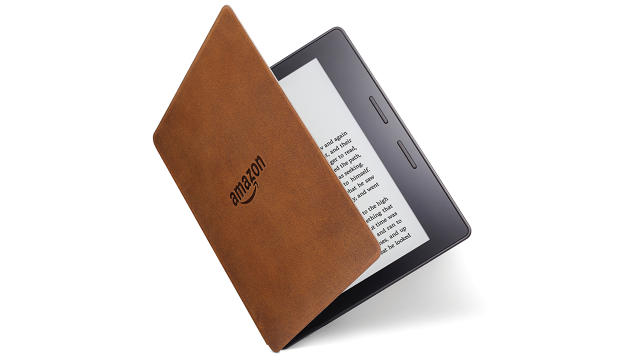
Amazon’s Kindle Oasis: The Highest-End High-End Kindle So Far

For years, the conventional wisdom about Amazon’s Kindle e-reader was that the company, which likes to say that it wants to make money when customers use its products, would eventually make buying e-books irresistible by offering a Kindle e-reader for free. But Amazon has refused to play along. For the time being, the cheapest Kindle is $80, which is actually 10 bucks more than the least expensive model of a few years ago.

My hunch is that Amazon isn’t under much pressure to slash Kindle prices to nothing—or at least next to nothing—because most of us already own free Kindle e-readers, in the form of smartphones that can run the company’s Kindle app. That’s left the company free to pursue a strategy that I sure didn’t see coming: It’s been releasing ever-more refined, high-end Kindle e-readers, aimed at people who love the idea of a device that’s optimized for reading, and only reading.

This trend became clear in 2014, when Amazon released the $200 Kindle Voyage. With its sleek industrial design and ultra-readable E Ink display, it supplanted the Kindle Paperwhite as the the top-of-the-line Kindle.

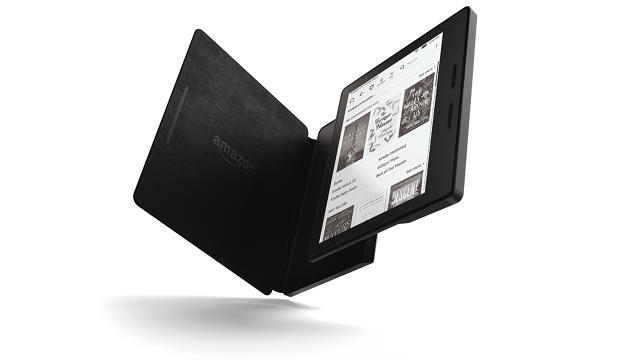
And now the company is introducing the Kindle Oasis, teased by Jeff Bezos last week and then leaked in more or less its entirety. The $290 model, which starts shipping on April 27, does to the Voyage what the Voyage did to the Paperwhite. But it accomplishes that with some new twists which, if it weren’t for the leak, would be wholly unexpected.

Thinner And Thicker

In designing the Oasis, Amazon made most of the device really thin via a unique design gambit: It shoved most of the electronics into an thicker, 8.5mm pod on the left-hand side of the device. (Or, if you choose, the right-hand side—the e-reader has an accelerometer, and will flip the display around if you rotate it by 180 degrees.) That let it shave the rest of the case down to 3.4mm, or less than half the thickness of the Voyage. The thick-thin design gives the Oasis a handle of sorts and evokes both a folded-back dead-tree paperback and the original 2007 Kindle, which sported a quirky angled case that disappeared in the second-generation model.

Amazon also greatly reduced the e-reader’s bezel—except on that edge with the rear hump, which provides room for page-turning buttons—leaving the case size far more pocketable than before. It’s so diminutive that you might be tempted to call it the Kindle Mini, if it weren’t for the fact that the display size remains 6″, the same as with nearly every other Kindle ever made. This time around, the monochrome E Ink display isn’t a radical upgrade from the excellent 300-dpi version in the Voyage, but Amazon did move the LED lighting from the bottom of the screen to the side, thereby allowing it to boost the brightness by squeezing in additional LEDs.

One of the Kindle’s signature features has always been its marathon battery life—up to six weeks in the case of the Voyage, assuming that you read on average for a half hour a day. I always assumed that such endurance was sacrosanct, but with the Kindle Oasis, Amazon has messed with its recipe in a new way. The device is so small and thin that it packs a rather dinky battery, which Amazon says provides up to two weeks of power, again based on an average of 30 minutes of reading a day. But every Oasis comes with a posh leather case with a much beefier built-in battery. The case snaps on magnetically—its battery sits next to the hump on the e-reader, and fills in the surrounding area—turning the whole package into an e-reader that can run for up to two months, a new Kindle record.

When the Oasis is in its case, it automatically draws power from the battery; if you plug it into power, the e-reader and case charge as if they were one. And the cases, which are available in three styles, are beautifully crafted. Basically, you can choose between having a really thin Kindle with reasonable battery life and a chunkier one with incredible battery life, and switch back and forth on the fly.

Judging from a bit of hands-on time I had with a Kindle Oasis during a briefing by Amazon executives, the device pushes the Kindle line a bit closer to the original vision that Jeff Bezos articulated back in 2007, which was that a Kindle should disappear in your hands. It looks wonderfully polished. But it’s polished in an idiosyncratic, Amazonian way. I can’t imagine that cramming all the electronics in a gadget into a lump on one side will start a trend among other gadget makers, and many Kindle aficionados, I suspect, will be perfectly happy with the battery life of a lesser Kindle.

At $280, the Oasis is the priciest e-reader that Amazon has offered in many years, and it may cater to a niche rather than being the romantic ideal of every Kindle still to come. Anyone who doesn’t want to pay that sort of money for a Kindle still has lots of options. All the current models will remain on the market: the $200 Kindle Voyage, the $120 Paperwhite, and the $80 plain old Kindle.

In an era of smartphones and tablets, you might assume that a monochromatic computer devoted to reading would be an anachronism, doomed to suffer through a long decline until it finally goes away. But Amazon, which is famous for not providing actual sales figures for its products, says that Kindle sales continue to grow. The arrival of the Oasis is confirmation that the device has avoided the fate of a frozen-in-time gizmo such as iPod: It’s not just still on the market, but evolving in ways that go beyond superficial tweaks and cost reductions. For now, at least, there’s life in the old e-reader yet.

Read More

Two Reasons Not To Turn Your Side Hustle Into A Full-Time Gig

My brother, Mike, is a jazz musician in New York City. Over the years, he’s invested countless hours developing his skills and reputation in the music scene. He’s lugged his saxophone all over New York and all over the world, gradually moving up in his industry and making a name for himself.

If you ask him why he chose to be a musician, his answer is simple: Music chose him. That was the only thing he ever wanted to do, and he made the sacrifices required to do it, especially in the early days when he could barely pay his bills. With success, he’s found that he can live a much better life than he might have imagined a decade ago. Perhaps he’ll even hit it big someday.

Still, if he were looking for fame and a big payday, he’d have chosen a different path. Mike once told me that he sees being an artist today as akin to being in the clergy. You do it for passion, not for money, and in that sense, you’ve already struck it rich.

It Isn’t About Getting Rich

I see entrepreneurship much the way my brother sees music. Contrary to popular perceptions, you don’t become an entrepreneur because you want to be rich or famous. You become an entrepreneur because it chooses you. That may sound overly romantic to some, but no matter when you take the plunge, you know in your gut that you just have to go for it.

Perhaps you’re the person who’s been launching businesses since you set up your first lemonade stand. Maybe you knew from the outset that you were never going to work for anyone else. Or maybe you reached that decision after years working for other people. However you got there, you had to accept first that success is terrific if it comes but that it can’t be the only thing driving your decision.

Entrepreneurship is simply too hard a road if you try heading down it for the wrong reasons, or without thinking long and hard about what lies ahead. Sometimes a great side gig should stay a side gig. If you’re considering taking that project full time and setting up shop on your own, here are two perfectly rational reasons why you might opt not to.

1. The Lifestyle Can Be Pretty Lousy

In September 2014, an entrepreneur named Ali Mese published a post on Medium titled “How quitting my corporate job for my startup dream f*cked my life up.” Mese, a former Bain & Company consultant, chronicled the unexpected personal, familial, and social stresses that resulted from his decision to leave the safe and prestigious world of management consulting to start his own company.

Having been caught off guard, Mese wanted to make sure that all the bored consultants, understimulated corporate types, and frustrated bankers who dreamed about startups from their cubicles also saw the other, darker side of the entrepreneurial allure, so he laid it bare. Clearly, the risks and trade-offs of pursuing entrepreneurship are on a lot of people’s minds; Mese’s post went viral, racking up millions of views.

The time and focus required to launch and lead a company takes a toll on you and everyone in your life. You have to rethink your financial goals, your lifestyle, and your definition of success, all while being plagued with self-doubt.

It’s generally believed that divorce rates among startup founders are the highest of any occupation, as a result of the long hours and stress. Even if your company thrives, your lifestyle may not be luxurious. If you leave your corporate law job to open a bakery and finally make a business out of your grandmother’s famous cookie recipe, you may find yourself working far more hours for a fraction of the pay. Sure, you have “freedom,” but you also have long hours, demanding clients, and the stress of making ends meet on less money, at least at the outset.

Lives, like careers, are rarely in balance, and you may find that your “dream job” has even less equilibrium than your previous job. After all the hard work and sacrifice, how terrible would it feel if you opened your bakery only to discover that you should have stayed at the law firm? It took you going all in to realize that while you enjoyed baking a few batches of cookies for your friends, you hate doing it 12 hours a day.

2. You Can Ruin Your Finances

A recent study of more than 10,000 founders revealed that 73% of respondents pay themselves less than $50,000 a year in cash compensation. Those figures are surprisingly low when you consider how much responsibility they carry on their shoulders. They recruit teams, craft and execute growth strategies, and try to raise millions of dollars of venture capital from deep-pocketed investors who expect the founders to make them richer. All those pressures and obligations for less than $50,000 a year sounds like a raw deal, right?

It may sound like a raw deal, but that is generally the deal.
Investors expect startup founders to put all their eggs in one basket and make money as the value of their shares in a company increase. Now consider that the typical venture capital–backed business takes between five and seven years to go from raising its first round of capital to producing returns for its shareholders, including the founders. Even Facebook, one of the undisputed tech heavyweights of the last decade, took more than seven years to reach its IPO. So even if your company is wildly successful, you’re going to have to wait to see the payoff.

Jonathan Olsen, an entrepreneur who’s both founded and invested in early-stage ventures, puts it best: “If you want to be an entrepreneur, you have to give up things, starting with your flat-screen TV.” And, I’d add, quite possibly much more: You may no longer be in a position to help out your parents with unexpected costs, and you won’t be writing generous checks to your alma mater.

If you’ve gotten used to being the one who takes care of those around you, having to count every penny is not an insignificant change. Everyone likes to tell stories about the founder who ran down his savings and lived off multiple credit cards before finally making it big. No one talks about the founder who couldn’t repay those bills.

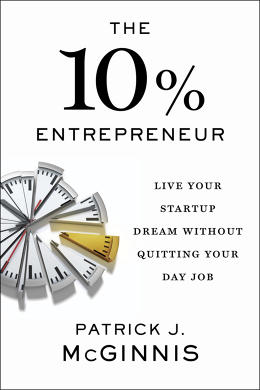
This article is adapted from The 10% Entrepreneur: Live Your Startup Dream Without Quitting Your Day Job by Patrick J. McGinnis. It is reprinted with permission from Portfolio, an imprint of Penguin Publishing Group, a division of Penguin Random House LLC. Copyright (c) Patrick J. McGinnis, 2016.

Read More

20 Reasons To Attend Our Creativity Counter-Conference

This spring, Fast Company will be blanketing L.A.—from Venice to Burbank, downtown to Playa Vista—for a meeting of the most creative minds. On day one, attendees will be treated to exclusive, behind-the-scenes Fast Tracks at companies like Whisper, Awesomeness TV, BeautyCounter, and Jaunt VR Studios. On day two, we will descend on the sprawling, historic campus of advertising agency 72andSunny for a full day of talks, workshops, and interactive experiences. Here are just a few reasons why you should join us!

  1. Hear from Academy Award winner Geena Davis about her mission to promote diversity in filmmaking.
  2. Go inside Tinder with CEO Sean Rad and discover what’s ahead for the culture-shaping dating app.
  3. Listen to WWE champion John Cena share his secrets of creative storytelling.
  4. Learn how AwesomenessTV is developing the next generation of movie-making with president Brett Bouttier, CEO Brian Robbins, and DreamWorks Animation CEO Jeffrey Katzenberg.
  5. Discover the secrets of building content with a purpose for multicultural millennials with Russell Simmons, Sanjay Sharma, and the team at All Def Digital.
  6. Find out how to be creative in times of crisis with Jeni Britton Bauer of Jeni’s Splendid Ice Creams.
  7. Listen to stories of turning passion into profit from Kenny Lao and Dakota Weiss.
  8. Explore YouTube Space LA’s Broadway-quality sets.
  9. Uncover how 50 years of authenticity has fueled success at Vans.
  10. Get inspired by BeautyCounter’s mission to take on the FDA and regulate the cosmetics industry.
  11. Learn how Blumhouse Productions injects creative thinking into its horror-movie hits.
  12. Go behind-the-scenes of Taco Bell + Deutsch LA’s winning social campaigns.
  13. See the ways Hasbro is innovating to expand the reach of its iconic toy brands in Hollywood.
  14. Go inside the still nascent but booming world of podcasting with Midroll Media.
  15. Discover the surprising power of anonymous content for brands with Whisper president Mark Troughton.
  16. Celebrate the new class of Fast Company‘s Most Creative People in Business.
  17. Meet surprising new people and jumpstart your next great project at one of our purposeful networking sessions.
  18. Learn how to design for YOU with a shoe design workshop from PENSOLE’s D’Wayne Edwards.
  19. Turn your users into your content creators with a creative writing crash course from Wattpad and star writer Emily Lindin.
  20. Release your creative juices in a hula hoop-athon with hula hoop world record-holder and performer Marawa Wamp.

And so much more!

Read More

Inside Sean Parker’s $250 Million Bet To Cure Cancer

Sean Parker is deathly allergic to peanuts. If he accidentally eats a rogue nut and doesn’t receive an epinephrine injection, he will stop breathing.

Parker’s struggle with life-threatening allergies hasn’t stopped him from achieving fortune (as the first investor in Facebook), fame (Justin Timberlake played him as a charismatic hustler in the film The Social Network), and a track record for changing entire industries (remember Napster?). It did, however, inspire him to spend countless hours in an Internet rabbit hole researching the mysteries of the human immune response.

“I’m totally fascinated by the immune system,” he told me by phone this week, while trying to escape the New York rain. “Like my interest in other scientific fields, I took a deeper dive and got more and more invested.”

In December 2014, he got his feet wet by making a $24 million donation to the Stanford University School of Medicine, which is earmarked for allergy research. Today, he is announcing the $250 million-funded Parker Institute, a research effort to develop targeted therapies to treat cancer, which is noteworthy in its ability to evade the immune system. That’s the single largest financial contribution to the field of immunotherapy ever. It’s also Parker’s most ambitious effort in biotech.

To discover breakthrough therapies, Parker has personally helped recruit a brain trust of more than 40 laboratories and 300 researchers from the top cancer centers, including MD Anderson, Memorial Sloan Kettering, Penn Medicine, Stanford, and the University of California, San Francisco (UCSF). Strategic advisers include Jeff Huber, a longtime Googler who is now working to develop a blood test for cancer detection, and executives from a variety of pharma companies including Amgen and Merck. Dr. Jeff Bluestone, a well-known researcher and a former provost at UCSF, is leading the initiative as its chief executive offer. “I’ve been following the explosion of cancer immunotherapies in the past five years,” Bluestone says. “I met Sean a few times, and he asked if I’d join.”

Parker seems confident he can create momentum outside the ivory towers of medical research, even though $250 million is a drop in the bucket compared to the costs of drug development, which is typically in the billions. The Parker Institute is hoping that its partners, the pharmaceutical companies, will fund the early clinical trials and shoulder the costs of bringing a new therapy to market. “From my perspective as an entrepreneur, I know we can see results faster,” he says. He’s identified two major flaws with research today: The lack of collaboration between researchers, and the frequent intellectual property disputes over new technologies.

As a condition of partnering with the Parker Institute, researchers are expected to work with each other instead of pursuing personal glory. They must also agree to license any new technology they develop through the institute. After watching scientists behind one of most important biotech breakthroughs in recent history, a gene-editing technology known as CRISPR, get embroiled in a messy legal battle over patents, Parker is desperate to avoid a scenario in which technologies sit on the shelf for decades while researchers duke it out in court.

“I joke around that if you were to roll back the clock and design an industry or field that would produce a breakthrough technology for treating patients and curing disease, this is the last structure you would come up with,” Parker adds.

Photo: Flickr user Ach K

The Cancer Moonshot

In 2011, Parker’s good friend, the legendary film producer Laura Ziskin, passed away from breast cancer. The two had frequently discussed the potential of immunotherapy, which was also a subject close to Ziskin’s heart. After she died, Parker set about quietly deploying capital into immunotherapy. “I set up a dream team in the scientific establishment, which hadn’t embraced the idea yet,” he says.

But the field quickly entered into a kind of renaissance. Today, immunotherapy is central to the Obama Administration’s “moonshot” to cure cancer. Vice President Joe Biden recently predicted that immunotherapy will progress cancer research more in the next 10 years than it has in the past 50.

Broadly speaking, cancer immunotherapy researchers seek to understand the mechanisms by which cancer cells evade detection. They are bringing new therapies to market, notably immune checkpoint inhibitors, which help the immune system recognize and target cancer cells as foreign. These therapies are more specific than chemotherapy, which causes damage to many healthy cells.

“The way I describe it to my patients is to think about the last time they had a bacterial infection and got really sick,” says Dr. Dale Shepard, a medical oncologist at the Cleveland Clinic. “That’s an example of a robust immune response.” By contrast, some of Shepard’s patients have advanced cancers that present with few symptoms. “I see patients all the time that have five-inch tumors that are totally ignored by the immune system.”

Oncologists like Shepard are cautiously optimistic about the prospects of cancer immunotherapy, as they’ve seen it work firsthand. Some of the newest treatments, which have been most effective at treating kidney, colon, prostate, and lung cancers, have brought some of Shepard’s patients with advanced tumors back from the brink of death. The therapies have even proved tolerable to nonagenarians, like former president Jimmy Carter. But for some patients, such as those with slower-growing cancers, the response has been minimal at best.

That said, cancer immunotherapy is not quite a home run yet. The next step for researchers is to better understand why some patients aren’t receptive to immunotherapies at all, while others show near-miraculous improvement. Oncologists are also hoping to see new therapies for hematologic cancers, like leukemias and lymphomas. Some 1,500 cancer immunotherapy drugs are currently in the research and development pipeline.

Bluestone, who is heading up the Parker Initiative, has already scoped out some near-term research initiatives for the coming year, such as new ways to modify T-cells (the immune system’s anti-cancer warriors) to better recognize and kill cancer cells. Additionally, the initiative will provide sophisticated technology to labs such as machines for DNA sequencing. And Bluestone is researching how to apply medical imaging technology, which can offer a three-dimensional picture of tissues and tumors to better understand how these cells communicate with each other. “We want to look deeper than ever before,” he says. “We want to identify what cancers come back, and seek out subtle changes in the immune system that we can exploit.”

Photo: Flickr user Milosz1

Challenging The Status Quo In Research

Dr. Prateek Mendiratta is a clinical associate of medicine at Duke Cancer Center. He treats patients with cancer every day, and is keeping a watchful eye on developments in the field of immunotherapy. I ask Mendiratta for his thoughts on Sean Parker making a big impact in the space.

“Oh wow,” he said, seemingly puzzled that a household-name tech billionaire would want to plant a flag in this particular area of research. But on further reflection, Mendiratta came around to the idea of Silicon Valley types investing their time and resources into the space. “We have to keep thinking outside the box,” he says. “If more patients can see durable responses and remissions, I’m excited to see people outside of the industry step in.”

The oncologists I spoke to recognized that physicians desperately need a new set of tools to treat patients. And if an outsider from the tech industry can do it, all power to them.

For his part, Parker asks every researcher who wants to get involved about the projects they wish they were doing (a very Silicon Valley question). He says he wants to fund the ideas that have been deemed “too complicated or too ambitious” for the status quo.

Shepard is ready for this kind of thinking. “It’s a daily frustration for me that traditional chemotherapies don’t work as well as we’d like,” he says. “I think enough people are willing now to stand up and do the right thing for patients, even if that means changing the way we do things.”

Sean Parker on why Facebook never should have won:

Read More

In Memory Of Linda Tischler

Fast Company editor Linda Tischler died Monday after a long illness. Linda started at Fast Company in 2000 and pioneered the magazine’s design coverage at a time when few, if any, mainstream publications paid attention to design. Through her exuberant stories on everyone from architect Michael Graves to industrial designer Yves Béhar, she highlighted both the business of design and the importance of design in business. It is much to her credit that design has evolved into a core business practice, embraced by companies large and small. Here, we asked colleagues and friends to share memories of Linda.—Eds.

Gadi Amit, founder, NewDealDesign
I met Linda at a Fast Company event, when the economy was in a rut. At first, I was quite shy about approaching her, but we started chatting and when I suggested that we should pay more attention to design for the middle class—and less for the 1%—she lit up. With her warmth and intelligence, she said, “Okay, why don’t you do that? Write something!” The whole discourse around the democratization of design—Linda had a huge role in that. She always had a social conscience.

Paola Antonelli, senior curator of architecture and design, Museum of Modern Art
I have great memories of Linda in many different places—at MIT’s Media Lab and at the Aspen Ideas festival, at MoMA at my marathon events and at evening panels with young designers. Everywhere, she was my kindred spirit, holding the design flag high with intelligence, open-mindedness, and generosity. Everywhere, her eyes pierced the air like curious, bemused laser beams, crowned by her bob that reminded me of my favorite Italian singer when I was a child. She was a force. She loved design and was able to explain it to all, very simply, honestly, and elegantly. I will personally miss her tremendously, and so will the design world.

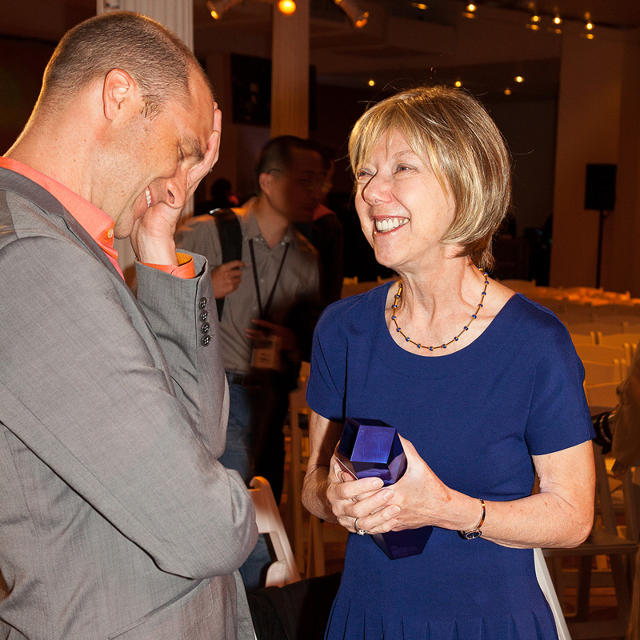
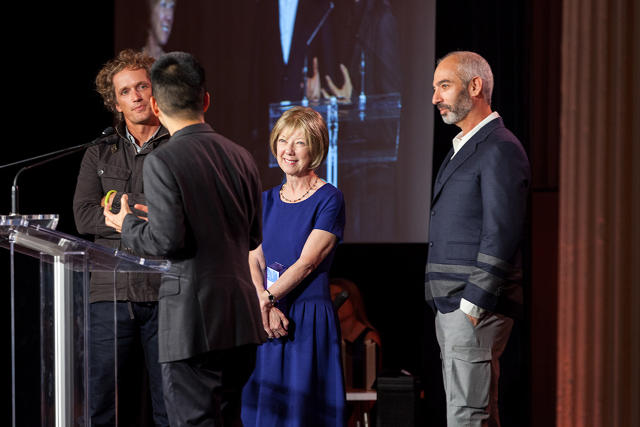
Linda received a lifetime achievement award at the 2014 Innovation By Design conference

Rinat Aruh, cofounder, aruliden
Linda taught me about what really mattered. Not just about design, but about friendships, business, and people. She always had to time to listen, looked out for me and gave the most appreciated feedback—straight to the point without any fluff! She was our biggest champion, constantly encouraging us to keep doing what we do while sharing her point of view with enthusiasm and humor! I will miss her dearly.

Yves Béhar, founder, fuseproject
Through great times and tough ones Linda was a force with a smile. She was understanding and inquisitive, always curious about the world. I will never forget those qualities, and aspire to them. A couple of years ago, we spoke on stage at the Aspen Ideas Festival—it was fun and entertaining, it was just a solid human conversation about design and life. And this moment reminded me of how every conversation with Linda was always just that: a human story at the center of design. All of us designers are lucky she applied her talent and wit to design. I am lucky to have known her. It aches to say it: So long Linda.

Ken Carbone, founding partner, Carbone Smolan Agency
Every designer owes Linda their deep gratitude. Linda was a courageous champion for all design disciplines and no one expressed the value of what we do better that her. Through her brilliance, curiosity and generous spirit, her influence on design and business was nothing short of singular.

Beth Dickstein, founder, BDE
If you’re lucky, you get to work with good people. If your luckier, you get to make a great friend. I was luckier, as Linda and I were great friends. One I will miss tremendously. Her brilliance, humor, generosity and warmth were always there. When her illness was getting worse, I said, “I’ll pray for you everyday.” In her wonderful witty way she said, “Okay, better put it in overdrive, baby.” I know the industry lost a dynamo, a straight shooter, a true journalist. Her family lost an irreplaceable force. I lost an amazing and caring friend.

Walter Herbst, professor, Segal Design Institute, Northwestern University
Like all who met her, it was an instant love affair.

Linda visited our Management program in Product Design and Development at Northwestern University, some years back, which started it all.

I invited Linda to speak at our annual design event, Design Chicago, which I knew came at the same time as the Milan Fair. She quickly shot back, that she had seen enough chairs in her life, and agreed to come. She captured the entire audience, which included our own design and development master’s students as well as our Kellogg MBA’s, our engineering students, as well as the president and the Deans of the university. Her influential talk may have led to what Northwestern University has now—”Design” as one of our pillars.

We were always checking in, and she was always finding time to talk about our kids and of course design. I will miss her, as will everyone who knew her.

Judy Klavin, president, Kalvin Public Relations
Nobody covered the intersection of design and business the way Linda did. We started working together in 2008 when I arranged meetings for her with my design firm clients. Before the meeting, we’d spend hours reviewing story ideas that we thought for sure she’d be interested in. Then she’d zero in on a completely different angle or something she saw on a designer’s desk that caught her eye. And, the story she’d develop and write was always smart and engaging. Shortly after, she was recruiting design leaders to be guest bloggers on the inaugural FastCoDesign site. She had a gift for encouraging the creative community to articulate their vision and bring it to life. I am so grateful for her friendship, honesty, insight and determination. Thank you, Linda, for uncovering so many stories that might never have been told. We all learned so much from you.

Cliff Kuang, founding editor, Co.Design
Linda was a giant. Our readers today often remark how Fast Company has brought design into the realm of business and innovation; Linda pioneered that ideal as an editor here in the early 2000s. Moreover, she kept with it. Through the relationships she cultivated in the profession, she helped make the very first iterations of FastCompany.com into a platform for designers to be heard. And it was because she believed in the power of design, and she believed in the optimism inherent in making the world a little bit better with the things you do every day. All of us at Fast Company, who’ve found our careers bringing design stories to the world, owe Linda a debt. Hopefully, we can repay it by continuing the work.

Nicholas Calcott

Stuart Leslie, president, 4sight Inc.
Conversations with Linda about design were always the highlight of my day and I looked forward to each one. Her enthusiasm in understanding the unique angles she was exploring was contagious and left me energized, thinking differently about design each time. What a rare treat it was to be able to escape the day to day routine and have a few minutes of thought provoking discussion to remind me of all the reasons I became a designer.

Danielle Sacks, senior editor, Inc.
The first time I encountered Linda Tischler was through her words. I was 25, and had just started my first journalism job as a lowly fact checker at Fast Company. I was fact checking a colorful profile on Howard Dean’s campaign manager, Joe Trippi, written by a senior writer at the magazine—Linda Tischler—who I had yet to meet. I was taken with the story’s attitude, its writerly flair. I needed to meet this Linda woman.

Little did I know that Linda and I would soon become fast friends, despite the years between us. She became the person I decided I wanted to become when I “grew up.” As a young writer, she always took me seriously as a peer, even though I was learning what she had already been doing for decades. When she began immersing herself more deeply in the design world, she let me pick up the pieces of the advertising beat, which she had once carved out for herself. But she graciously relished in watching me take it on, and we’d gab endlessly about stories and reporting strategies and industry scuttlebutt.

She was able to do what very few writers can—she wrote just as she spoke. When you read her work, you could hear her whispering in your ear—her sharp sense of humor, her wit, her word choices, her energetic voice always filled equally with edge and compassion. She’d pluck a word out of thin air that wouldn’t reveal pretension, but her dimension, her worldliness, her many selves as a lover of language, of culture, of the arts. And she was timeless, ageless. Her stories had the hipness and energy of a twentysomething, with the depth and perspective of a much wiser soul. She could go head to head with anyone—and you’d want to be a fly on the wall to watch.

Thirteen years since we first met, Linda is still the woman I want to be when I grow up. She managed to raise two children whom she was fiercely protective of, become a grandmother (albeit, too briefly), a domestic goddess and a feminist, and a successful career journalist who left the field different than she found it. She has helped me navigate my journalistic career with two young kids, just as she did. She has been an incredible friend, making me laugh even during her darkest days with cancer. From a hospital bed, she managed to turn the most mundane, ugly moments into a rollicking, laugh out loud story. It’s hard to imagine a world without another Linda Tischler conversation.

Chuck Salter, senior editor, Fast Company
For years, I had the best seat at Fast Company‘s New York offices: the one next to Linda Tischler. Our friendship traced back to the magazine’s early years, when we bonded over our newspaper backgrounds. But we had always worked out of different cities. In New York, we became next-desk neighbors.

Hearing Linda do countless interviews gave me a deeper appreciation of her craft—how she tirelessly developed and worked her design beat, how quickly she thought on her feet to dig another layer deep, and how she treated people. No wonder her subjects trusted her enough to open up: She was fearlessly human—candid, curious, funny, empathetic. Long before facing cancer herself, she wrote memorably about the professional and personal impact of the disease on the designer Michael Graves and IDEO’s Tom Kelley.

Linda was a generous spirit in a business that’s often competitive and territorial. She shared sources, story ideas, an honest critique — and so much of her time. Her gushy emails when she connected you to a source could make you blush.

As anyone who knew her will attest, Linda was a force. A veteran journalist wired with the energy of a 25-year-old. A critical and creative thinker. A prolific and elegant writer. A devoted friend. My inbox is filled with emails that start more or less, “How are you?”—after a big story, the birth of my son, my mom’s heart surgery. Being friends with Linda made you almost like another beat that she followed with the utmost attention.

I will miss her terribly. Fortunately, her voice remains, not just in her stories, but in our wonderfully rambling email conversations over 16 years. In recent years, although I knew she was often struggling with chemo or pain, she sounded as vibrant and irreverent as ever. In December, she joked that the implant she was getting for pain might let her stream the new season of “Transparent.”

Cancer took her life but not her soul, and definitely not her humor. She wouldn’t let it. That much was clear from one of her earlier notes to me following her diagnosis:

I’m trying to think of this as a reporting experience. Taking notes. All of life is fodder, right?
Keep the jokes coming.

And later, from another note:

Love the idea of a line of Chemo Cupcakes. Maybe coded to specific toxic drugs. Tangerine for taxol, cherry for carboplatin, etc. Who could resist? Step aside, Martha [Stewart]. I claim this niche

.

That was, and to my mind, will always be, Linda.

Ravi Sawhney, founder, RKS
Linda Tischler was such an incredible person, one of the truly inspirational, loving, insightful and passionate ones. There was a certain spirituality in Linda that I always wanted to be close to and valued dearly. She showed incredible strength and optimism as she battled her cancer, never giving up. I feel blessed to have crossed paths with her, to have become friends, and to have had many conversations about life, design, politics, and mortality. There are those who not only touch your life but somehow become part of the fabric of your world. Linda was such a person, as all her friends and family would tell you. She’ll be so dearly missed.

Leslie Smolan, founding partner, Carbone Smolan Agency
Linda Tischler was my design hero. She could also be called a design aficionado, advocate, supporter, inquirer, explorer, groupie, devotee, maniac, evangelist and connoisseur. She loved design and designers. And she loved to tell the world about us — what we do, why we do it, and why it matters. Losing Linda means we’ve lost an incredibly important voice in the ongoing dialogue about design. And we’ve lost an incredibly kind and generous friend.

Nicholas Calcott

Bill Taylor, cofounder, Fast Company
I’m sure that many of the tributes to and remembrances of Linda will focus on her wit and smarts, her mastery of design, and the legacy of articles and books she left behind. But as I have reflected over the last two days, saddened and stunned at her passing, I thought back to that often-repeated quote from Maya Angelou: “People will forget what you said, people will forget what you did, but people will never forget how you made them feel.”

I will never forget how Linda made me, and all her colleagues in the early days of Fast Company, feel. She was an essential part of Fast Company during the crazy boom times, she was there for the dark and challenging down times, and she was my office next-door neighbor for a chunk of that time. Every single day, she was one of the few grown-ups in an organization filled (professionally speaking) with gangly adolescents. To many of the young people on the staff, she was a mentor and a sounding board. To me, she was a peer, a pal, a trusted colleague to whom I looked for advice and reassurance. Linda exuded a sense of quiet strength, of emotional and intellectual maturity, that is all-too-rare in the world in general, and in the world of media in particular. Those times when I would stroll into her office, pull up a chair, and say, simply “Do you have ten minutes to talk through something?” were some of the best times of my week.

Truth be told, I can’t remember much of what she said in those conversations so many years ago, or what I did as a result of them. But I remember like yesterday how they made me feel. And I feel so blessed to have known and worked with Linda.

Rick Tetzeli, editor-at-large, Fast Company
When I came to Fast Company in 2010, I arrived with one question: Why does this magazine spend so much time on design coverage? It didn’t take me long to figure out the answer, thanks to Linda. Editing her stories, and listening to her patient, humorous, skeptical, and good-natured explanations, I came to understand that the best design writing shows readers how gnarly problems get solved creatively. Linda had been doing this for years—she was a real pioneer. But she was wide open to telling those stories in new ways. One of my favorite experiences with her was working together on a story about architect Bjarke Ingels. As we discussed Ingels, she talked about his energy, his intellectual agility, his almost superhuman capacity for complex projects across the world. We decided that the best way to tell the story was through a comic strip, and the result was one of the freshest things I’ve worked on at Fast Company. The story delighted Linda, who loved the challenge of continually expressing herself—and highlighting work she deeply admired—in new ways. At its best, Fast Company encourages original thinking across creative enterprises. Linda lived this.

My daughters attend a school that’s just a couple of blocks from Ingels’ recently completed apartment complex on West 57th Street in Manhattan, which was featured in our comic strip. In the midst of that dreary neighborhood of glass blocks, Ingels’ building stands out for its angular optimism, a bold, light and unusual burst of energy. Kind of like Linda.

We will all miss her deeply. She had spirit to spare, and we are lucky she shared it with us.

Alissa Walker, writer, Gizmodo (via Facebook)
Even if you didn’t know Linda Tischler you very likely read one of her stories in Fast Company over the years. She was a true champion of the design industry, introducing this sometimes complicated world to the mainstream press and explaining its importance in an incredibly accessible way. She was also a great friend and mentor to me in those early days of my writing career. I will never forget her pulling me aside at one of Fast Company‘s first design events—after she had moderated a panel with her signature quick wit—and telling me that us ladies in design had to stick together. I will miss reading her work and knowing she was always on my side.

Alan Webber, cofounder, Fast Company
Everyone knows that magazining is a team sport. That’s even more true in the early days of a magazine, when it takes everyone on the team to figure out what it is you’re trying to do, not only in the pages of the magazine when it comes out, but also in the creation of the ideas that go into the magazine, the culture of the office where there’s no substitute for good energy, all the things that create magic and sustain it.

That was Linda. She got it. She relished it, for the very first moment of the first day. It was like she’d been invited to be one of the hosts of the very best party you could ever hope to throw or attend. You could see it in her smile, her enthusiasm for the whole venture/adventure. Infectious energy, unstinting generosity, unlimited colleagueship—and of course, remarkable talent, curiosity, work ethic, and heart.

One of the early tenets of Fast Company was that a great organization needs leaders at all levels. Linda was a leader—without seeking a leadership role. Sure, she was smart and able and good at her job. But the thing about Fast Company was, it never was all that clear what your job was, except to demonstrate every day that we were all in it together, and that none of us was as smart as all of us—and she was one of the people who lived that and made it happen.

A magazine is the people who put it out. We were incredibly fortunate to have Linda to help put it out. I loved her then and I will always love her.

If you’d like to share a story about Linda, email slabarre at fastcompany dot com.

Read More

The Burr-Feinstein Encryption Bill Is Probably D.O.A.

The encryption bill being floated by Senators Richard Burr and Dianne Feinstein already seems marked for failure because of a promised filibuster, a hostile House of Representatives, an eventual POTUS veto, and universal opposition from Silicon Valley and privacy groups.

The bill, which was leaked last Friday and circulated Wednesday, mandates that U.S. technology companies establish an encryption “backdoor” through which government agencies can access user data on the power of a warrant or court order.

The main problem with the bill, sources say, is that it touches only U.S.-based hardware and software companies, and so will do little to curb terrorism. The Internet, after all, isn’t confined by borders, so bad actors could easily abandon tech products with backdoors and move to ones with better security. Terrorist networks are already known to use apps Telegram or Signal, which are operated by companies outside the United States and use strong, open-source encryption.

The Burr-Feinstein bill will next be discussed and marked up in the Senate Intelligence Committee, which Senator Burr chairs and of which Feinstein is the ranking member. If the marked-up bill passes a vote in the committee it could be introduced on the Senate floor.

But Senator Ron Wyden (D-Oregon)—the second-ranking Democrat on the Intelligence Committee—has vowed to be waiting there with a filibuster if that happens. Wyden does not believe the problems with the bill can be fixed with markups, a spokesman said.

Even without a filibuster, Congressman Darrell Issa (R-Calif.) said the bill almost certainly lacks the votes for passage in the Senate. It’s even more unlikely that a companion bill would be introduced in the House, where passage is next to impossible.

The White House has already said that it won’t support the Burr-Feinstein bill in its current form.

At least one Republican member of Senate Intelligence Committee—Senator Dan Coats (R-Indiana)—came out in support of the bill in an interview with NPR Wednesday night.

Other than Coats, it was difficult to find members of Congress who are in support of the bill. A Coats spokesman said in an email note he knew of no others supporting it.

“The discussion draft was released just yesterday and staff is in the process of talking to stakeholders,” said a Feinstein spokesman. “I’m sure we’ll be in a position to discuss support for the bill down the road.”

It was far easier finding people in Washington to speak out against the bill.

“The bill goes to an inherent constitutional question of do we have a right to produce a product that commits no crime, or provide a service that commits no crime, and guarantees security, or do we have to presume that locks have to be insecure so that law enforcement can get to them?” Issa told Fast Company Thursday.

The question still remains as to whether it’s really possible to write a viable law that would both allow the government access to encrypted data without seriously weakening personal data security in a time when hackers are becoming more resourceful and aggressive.

“People are trying to find the middle ground between encryption and national security,” Congresswoman Zoe Lofgren told Fast Company Thursday. “If there is some middle ground that I don’t know about I would be happy to hear it, but if you create holes in the encryption you make security weaker.”

Both Issa and Lofgren sit on the House Judiciary Committee, which held a hearing on encryption where both Apple and the FBI testified.

Both Senators pointed to an editorial in the San Jose Mercury News titled “Feinstein still clueless on technology after all these years.”

The language of the bill indeed does expose a big disconnect between the thinking of the national security community and the tech community.

Apple, which has been at the center of the encryption debate, also chose not to comment. Apple and the FBI will testify in front of another Congressional committee—the House Energy and Commerce Committee—next Tuesday.

Several members of Congress have told Fast Company that the political winds are blowing away from carte blanche government surveillance and toward stronger encryption in a broad sense. Just yesterday members of the House Judiciary Committee voted overwhelmingly to increase the personal data security protections in the Email Privacy Act.

Read More