
Press Enter / Return to begin your search.

Two Simple Rules To Get Control Of Your Email

While an overflowing inbox is undoubtedly overwhelming, the emails it contains are not created equally, says organization expert Claire Diaz-Ortiz. In her book Design Your Day: Be More Productive, Set Better Goals, and Live Life on Purpose, she says creating a strategy and identifying the types of email you have can help you tame your inbox.

“At face value, it seems like email is the biggest blow to productivity the world has ever seen. But first impressions can be deceiving,” she writes. The first step is to know the two rules of email, and understanding these “truths” will explain why some email management systems work and some don’t.

1. Handle It In Bulk. Reading and responding to email in one sitting or at designated times of day helps you be as productive as possible, because switching between tasks robs you of 40% of your productivity, writes Diaz-Ortiz. Avoid the drain by doing it all at once. List “email” as a task on your schedule, checking it once a day or at two or three preplanned times, such as noon, 3 p.m. and 6 p.m.

2. Do It When You Have Low Energy. Real productivity is about managing your energy, not your time, says Diaz-Ortiz. “Times of peak energy should be used for the most difficult things on your plate, and those that require intense focus. The vast majority of the time, that is not email,” she writes. This means checking your email first thing in the morning is a bad idea; this time should be reserved for your most difficult tasks and those that require a fresh mind.

While email doesn’t produce tangible results, it is a necessary part of worklife. Once you understand the rules, Diaz-Ortiz says thinking of email in categories will help you handle each one accordingly:

Daily/Urgent Emails

Daily or urgent emails include live projects that require quick attention or urgent requests for help or information that directly impact your own workflow or productivity. Daily emails also include life-changing emails, such as a request from the media or an exciting business opportunity. “Inner circle emails” are messages from your friends or clients that give you energy, and these are also on the daily list. “We all need circles—and emails—like these,” Diaz-Ortiz writes.

Handle daily emails in bulk and on the day they are received during one of your designated email periods. Be careful not to put all work projects into your daily list. “If a project is far off, in incubation stage, or on the back burner, it doesn’t require such vigilance in your life, or in your email inbox,” Diaz-Ortiz writes.

Weekly Emails

Weekly emails are usually about another person’s agenda, and you don’t require prompt attention. They may include queries from people who want your help on something, pitches to do a job you may or may not want to do, or questions that aren’t urgent in responding to, writes Diaz-Ortiz.

These are emails you likely do want to respond to, but should not do so on a daily basis if you want to get your own work done. Handle these emails once a week. You can put them into a separate email folder to easily identify and sort them.

Never Emails

These emails don’t require any attention or action. This kind of email could be a status update, an email that you’re copied on, a subscription email or an unsolicited request.

“We all have different standards for what these may be, and their volume varies greatly on whether or not you are someone who receives a regular stream of unsolicited emails,” Diaz-Ortiz writes. Never emails should be deleted.

“Email is a fishbowl of semi-distracted people pinging each other back and forth ad infinitum,” writes Diaz-Ortiz. By practicing “real emailing,” devoting a chunk of time to handling them in bulk, you will avoid the overwhelm you will no doubt feel if you tackle email by sending one-off responses from your phone while you try to finish your work.

related video: 2 useless phrases to eliminate from your email

Read More

7 Essential Lessons From The Harvard Innovation Lab

Jodi Goldstein knows a thing or two about innovation. With more than 20 years’ experience as a high-tech entrepreneur and investor with a focus on consumer technology and a stint as a venture capitalist, she’s held leadership posts at several startups, including PlanetAll, a social networking site that sold to Amazon in 1998 for more than $100 million.

Now, she heads up the Harvard Innovation Lab (I-lab), a collaboration and education space launched in 2011 to help develop students’ interest in entrepreneurship and innovation. A Harvard MBA herself, it’s her job to get students to develop bold creative ideas and bring them to fruition. She uses a cross-disciplinary approach—her bosses are the deans of all 12 schools within the university, so no pressure there—to foster new ways of thinking.

“The diversity of ideas is pretty profound,” she says. Current I-lab entrepreneurs are working on projects that range from creating snack foods from insects to improving the lives of those in the military. The lab has been the incubator for more than 600 startups since its launch.

Over the years, Goldstein has learned some important lessons about how to create an environment where innovation thrives. Here are seven essentials.

Be A Sponge

Innovators are intellectually curious and thrive on absorbing new information that may help their ideas. The I-lab holds regular programming and has a mentoring program to help innovators learn as much as they want to learn. Even if you don’t have the benefit of the I-lab, continually seeking out the information you need and people who can teach you essential skills and information is an important part of being innovative, she says.

Narrow Is A Good Place To Start

Big ideas are great, but most of us have limited resources. Trying to be the next Amazon or Google right out of the gate is going to lead to burnout and frustration. Instead, try a more focused approach and grow from there, she says. If you want to lay the groundwork for a big idea, focus on developing one segment of it until it has strong roots. “Pick a vertical. Pick a focus area. Keep it simple,” she says.

Competition Is Good

Whether it’s in the marketplace or between peers, competition can create a sense of urgency and motivation that can spur innovation. Goldstein tells her students that finding a competitor already in the marketplace is a sign that someone else has looked into the idea and found a market for it. To succeed, they just have to do it better.

The I-lab also holds challenges where students are given a problem in the world and form teams to come up with solutions. That kind of creative exercise and working with teammates in a competitive environment can develop problem-solving skills that help innovative thinking, she says.

Ideas Are Great—But Execution Is What Matters

Many people can come up with a good idea. However, from the team you assemble to how your product or service will be formed, marketed, and delivered, the real opportunity for innovation lies in how you make it happen, Goldstein says.

Spend Time With People Who Are Different From You

“A diversity of backgrounds and experiences is absolutely critical,” she says. If you have a group of people who all have the same experiences, viewpoints, and backgrounds, you’re limiting the potential for innovation. The I-lab’s cross-disciplinary approach brings together people who may never have met, she says. A student with a public policy background may be working with a PhD in chemistry or a law school student. I-lab founders often say they never would have come up with their ideas or ventures if they hadn’t met people who thought differently than they did, Goldstein says.

Getting Better Is Messy

People who go to Harvard are not really used to failing, Goldstein says. She encourages them to get over it. Being creative and innovative means that you’re going to try many things that don’t work. You have to develop prototypes that aren’t right and try approaches that bomb before you get to the combination that works, she says. If you get your feelings hurt or throw in the towel because your first iteration was truly awful, you’re not going to be able to free yourself to be truly innovative.

“We do a lot around here around design thinking and human-centered design, testing early ideas with customers, really giving them the opportunity to fail fast before you spend six months or a year building a product that no one wants to buy. We work with them quite a bit on that,” she says.

Innovation Isn’t Lightning—It’s Simmering

When Goldstein brings in founders to speak with students, she doesn’t want them to share the “happily ever after” version of their stories—she wants to hear about what went wrong and how they handled it. You learn more from mistakes—and from hearing about mistakes—than from successes. She wants her students to know that the stories of “overnight successes” are often predicated by long periods of frustration and attempts at innovation.

“We all know too well that [immediate success] is the exception, not the rule. That’s what you end up hearing about, but that’s not reality. It’s a long slog, and it takes a lot longer than they think it’s going to be,” she says.

Read More

Here’s What Each Presidential Candidate Would Do For U.S. Workers

The economy and employment are big areas of concern, not just to campaign watchers and Fast Company readers, but to anyone with a job or who’s looking for one. So far, the election cycle has been filled with plenty of bluster, so sometimes it’s difficult to suss out the candidates’ actual policy positions.

So we’ve done some of the sussing for you. Here’s a quick, if far from comprehensive, snapshot of the four leading candidates’ major proposals on job creation, employment, and business—some of the items that would have the biggest impact on the world of work.

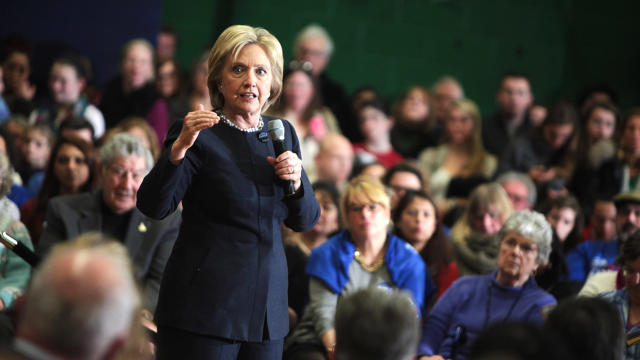
Hillary Clinton

What she has promised to do. In a plan called “Make It in America,” Clinton proposes to invest $10 billion in “partnerships that link together all parts of the supply chain and build on the strength of a region in particular industries,” according to her website. “It builds on President Obama’s National Network for Manufacturing Innovation and bipartisan legislation written and spearheaded by Senator Sherrod Brown.”

The plan would also force companies that outsource jobs to forfeit tax relief and would impose an “exit tax” on companies that move their headquarters abroad in order to lower their tax burdens.

Photo: Flickr user Gage Skidmore

Clinton has proposed raising the minimum wage to $12 an hour and supports guaranteeing workers 12 weeks’ paid leave, “fully paid for by a combination of tax reforms impacting the most fortunate.” In a debate in Miami in March, she advocated for equal pay for women and wider support for women- and minority-owned small businesses.

Citing their negative impact on U.S. jobs, Clinton opposed the CAFTA and TPP trade agreements (after initially supporting the latter) yet supports other efforts to facilitate global commerce. “Trade has to be reciprocal,” she said at a New Hampshire debate in February. “That’s the way the global economy works. But we have failed to provide the basic safety-net support that American workers need.”

The praise and criticism for her proposals. Clinton’s plans, while more modest in scope and budget than Sanders’s, would likely face Republican resistance for both their spending and corporate tax components, and they’ve been challenged on the left for ceding too much ground to business interests. The Sanders campaign has called Clinton’s record on trade “abysmal,” citing her initial support for TPP, NAFTA, and other trade agreements.

When Clinton lost the Michigan primary in March, Sanders as well as some observers attributed it to her stance on free trade and its impact on Rust Belt workers. Still, Clinton enjoys considerable support from labor unions, including the National Education Association, the nation’s largest teachers’ union, despite criticism that her positions on labor have been uneven.

In 2009, the AFL-CIO, one of the oldest and largest unions in the country, gave Clinton a lifetime score of 94%, and according to the International Business Times, major labor unions have contributed some $6.3 million to super PACs and other organizations affiliated with Clinton’s campaign.

Bernie Sanders

What he has promised to do. Sanders has outlined a “Rebuild America Act” that would dwarf Clinton’s proposed job-creating expenditures, pouring $1 trillion into domestic infrastructure projects over a five-year period. “It would be paid for,” his website says, “by closing loopholes that allow profitable corporations to avoid paying taxes by, among other things, shifting their profits to the Cayman Islands and other offshore tax havens.”

A separate initiative would earmark $5.5 billion to fund state and municipal youth job-training programs. As a senator, Sanders has also introduced legislation to make it easer for workers to form and join unions, and to lower other obstacles to collective bargaining.

Photo: Flickr user Gage Skidmore

Sanders is categorical in his opposition to free trade, believing most such agreements to reflect the interests of large multinational corporations and their lobbyists as opposed to workers. Asked last October whether he’s been satisfied with any free trade agreements the U.S. has negotiated, Sanders replied no. He supports a nationwide $15 minimum wage and, like Clinton, ensuring 12 weeks of paid family and medical leave, but Sanders proposes to fund the latter through a $1.61 per employee weekly payroll tax—part of a bill that he and 18 Democrats have introduced in the Senate.

The praise and criticism for his proposals. Sanders’s proposals have come under fire for being unworkable given their high levels of spending and the likelihood of a Republican-controlled House (if not Senate), a charge he’s countered by underscoring the need for a “political revolution” that could remake the composition of Congress.

A University of Massachusetts–Amherst economist claimed earlier this year that Sanders’s plan would generate almost 26 million jobs and boost the median income by roughly $22,000, an analysis other economists sharply criticized, including prominent Obama Administration officials. Some of Sanders’s leading economic advocates, including Robert Reich, President Clinton’s labor secretary, seem to agree with the candidate’s critics that a broad electoral shift is the prerequisite to policy initiatives on this scale. They differ over the probability of that. Reich has written that “there’s a higher likelihood of kicking Republicans out if Bernie’s ‘political revolution’ continues to surge around America,” a premise that the Clinton camp and independent analysts say doesn’t look likely.

Still, Sanders’s free trade position clearly resonates with many primary voters, which is all the more noteworthy, as New York magazine points out, for breaking with Democratic Party orthodoxy dating back to Martin Van Buren. Sanders receives high marks from many of the leading U.S. labor unions, and last December scored an endorsement from the Communication Workers of America, a major force in the media sector.

Donald Trump

What he has promised to do. “I’m going to bring jobs back from China, Mexico, Japan, Vietnam,” Trump said in a February debate in South Carolina. “They are taking our jobs. They are taking our wealth.” While he has not offered specifics on how this might be accomplished, Trump has framed job growth in terms of tax and trade reforms.

Like Clinton, Trump says he supports free trade as long as it’s fair. His website emphasizes a need to reset trade relations with China by, among other things, holding the country accountable for “currency manipulation.” In addition, he supports “putting an end to China’s illegal export subsidies and lax labor and environmental standards,” lowering the U.S. corporate tax rate, and “attacking our debt and deficit so China cannot use financial blackmail against us.”

In a debate in November 2015, Trump said he would not raise the minimum wage and has expressed skepticism of federally mandated paid leave. He has been an outspoken advocate of tighter immigration policies, including deporting nearly 11 million undocumented immigrants in a bid to preserve jobs for current U.S. citizens.

Photo: Flickr user Gage Skidmore

Trump hasn’t taken an official stance on collective bargaining, but in February, the Washington Times reported, he struck a diplomatic note, telling New Hampshire voters, “I have tremendous support within unions, and I have tremendous support in areas where they don’t have unions . . . my support is really with those workers, those people.”

The praise and criticism for his proposals. Trump’s support, particularly among white, working-class voters, has survived intense criticism across the political spectrum on the feasibility of his plans to create and protect American jobs. Economists are doubtful as to Trump’s ability to reverse outsourcing. According to one Harvard economist who spoke with CNN Money in February, less than 5% of the roughly 20 million Americans who lose or change jobs involuntarily each year do so as a consequence of growing exports. In the same report, a University of Virginia economist puts it bluntly: “I can’t imagine anything our government could actually do to return employment in the manufacturing sector to the level it was before.”

Trump’s plan to deport millions of undocumented immigrants and construct a wall along the Mexican border—likewise in the name of safeguarding domestic employment opportunities—has been ridiculed as unfeasible or inadvisable by his opponents in both parties, rejected by the Mexican government, and estimated to cost up to $600 billion if fully implemented. The Tax Policy Center estimates his tax plan to cost the federal government $9.5 trillion over the next 10 years.

Trump’s claims to broad appeal among union workers appear largely true, judging from the intensifying efforts by labor leaders to defeat him. The AFL-CIO, for instance, has announced plans to ramp up its anti-Trump campaign earlier in the political cycle than the organization typically starts by making appeals to members.

Ted Cruz

What he has promised to do. Like Trump’s, Cruz’s jobs plan focuses on tax reform as a means of generating employment opportunities. He has proposed virtually abolishing the IRS and implementing a 16% flat tax on businesses in place of existing corporate income taxes, part of a plan that Cruz claims will boost the GDP by nearly 14% above current projections within the next decade and create nearly 4.9 million new jobs.

Photo: Flickr user Gage Skidmore

He opposes raising the minimum wage on the grounds that it would eliminate jobs, particularly among Hispanics and African-Americans, and opposes paid leave and widening other employment benefits for the same reason. “Extending unemployment benefits does exacerbate the jobless situation,” he told the AARP in 2012, “because it subsidizes unemployment and increases the tax burdens on those who are employed. Cruz supports a nationwide “right-to-work” law, similar to a measure adopted by Wisconsin under Governor Scott Walker last year, designed to limit the power of labor unions, which overwhelmingly oppose his candidacy as a result.

The praise and criticism for his proposals. The bulk of Cruz’s proposals on job creation and employment focuses on tax reform and rolling back commercial regulations, but he’s come under fire for offering few details on which spending cuts would cover the lost revenues from reducing taxes. A nonpartisan tax policy group estimates the cost of Cruz’s tax plan at $8.6 trillion. Some observers argue that Cruz’s business tax constitutes a value-added tax (VAT) since it would charge companies over the course of production, making them likely to pass those costs onto consumers by raising prices—something that would almost certainly be politically unpopular.

Cruz has underscored his support for small businesses, saying that his tax plans will benefit them the most. Last week he told ABC News, “My focus is very much on small businesses because economic opportunity, jobs, come from small businesses.” Cruz’s critics argue that his vaunted support comes at the expense of workers, whose employment benefits Cruz would limit, and of labor unions, whose influence he’d seek to curb.

Read More

Now Competing To Be The Master Of Your Domain: Squarespace

Squarespace and a handful of companies like Wix and WordPress parent Automattic serve as the 800-pound gorillas of the website hosting and content worlds. Now Squarespace is looking to take on GoDaddy and other web domain registrars with a new product—domain purchases made and processed exclusively through Squarespace.

The company’s new product, Squarespace Domains, is a GoDaddy competitor that entered soft launch in early April. CEO Anthony Casalena tells Fast Company that he is enthusiastic about the new product while also taking some veiled digs at other domain services.

“We looked around at the competitive landscape,” Casalena said. “And we were like ‘My God, this industry is so old and has so little innovation,’ and there were very antiquated products for people doing this even though it’s such a fundamental piece of doing a website.”

Depending on the name of the URL that’s purchased, Squarespace charges between $20 and $70 a year. Pricing is set depending on the top-level domain used and includes an ad-free parking page that follows Squarespace’s aesthetic along with WHOIS privacy. By comparison, the company’s fully hosted plans hover between $96 and $144 yearly for personal accounts.

By offering this product, Squarespace is able to offer a workaround for a price point issue that’s challenged them for some time: Customers with a Squarespace account (Disclosure: This writer uses Squarespace to host his own website) have to pay separately for each site they open with the company. No volume discounts or package deals are normally offered.

This means that, in the past, a customer such as a small business that’s looking to set up a separate site for something like a pop-up sale had to either buy a separate account (which can be quite pricey) or be lost to competing products such as About.me, Wix, Weebly, or WordPress. Most importantly, those customers registered their domains through third-party providers—even though they were already paid-up Squarespace consumers.

It also gives the company a lower-priced product to hook customers who aren’t completely sold on a full-featured website yet. Promotional materials sent to Fast Company mentioned that “a 2014 survey by Vistaprint found that 43% of small businesses choose a domain name before doing anything else online, and anecdotal evidence suggests that many of our customers prefer to start with a domain as well.”

Casalena added that “domains aren’t the most exciting thing in the world, but we have a good take on it and we’re excited to bring it into the modern age.” In the coming months, the company plans to add free SSL certificates—and, crucially for keeping users in their ecosystem—the ability for current Squarespace customers to shift their non-Squarespace domain registrations to the company.

Domain hosting is the latest in a number of new product launches that Squarespace has made in the past year to target specific customer niches. In late 2015, the company introduced single-page websites with limited functionality that cost $60 per year at press time (making them cheaper, in some cases, than the domain product) and a new e-commerce product targeted at small businesses that starts at $312 yearly.

Squarespace’s goal seems to be simple: Keep their customers in their ecosystem for as long as possible, and introduce progressively lower-priced products with limited functionality to attract customers who’d otherwise use competing products (including free and freemium alternatives). Their hope is that by offering domains, they’ll attract users who will be more than happy to build a full-featured website later on.

Read More

The Next Frontier For Ambitious Entrepreneurs: Space

Eric Ward, a graduate student at MIT, has always wanted to work in the aerospace industry. “It’s a field full of people who are both very passionate about space and also excited about tackling very hard problems,” he says.

After earning a degree in mechanical engineering, Ward landed coveted internships at NASA and Lockheed Martin Aeronautics, expecting that he would spend his entire career at a big, established space company. But over the last decade, he’s watched a new generation of companies like Virgin Galactic, Blue Origin, and SpaceX enter the space game. “There’s a mythos in the space community surrounding Elon Musk,” Ward says, referring to the founder of SpaceX. “He’s been very successful in changing the way people think about space. He’s forced people to accept that fact that the private space sector is viable and important for the growth of the industry.”

The success of these high-profile companies has inspired other entrepreneurs—or astropreneurs, as they sometimes refer to themselves—to take a stab at starting their own space businesses. NewSpace Global, a firm that tracks the private space industry, has seen explosive growth in the market. Over the last five years, it’s gone from tracking 125 space companies to over a thousand. “We expect to be at 10,000 in the next ten years,” Richard Rocket, NewSpace Global’s CEO, said during a presentation at MIT’s New Space Age conference. “There are more companies emerging that are capable of sending something to space. That’s exciting because it’s going to drive down launch costs and increase launch rates. They’ll help prove that these business models work.”

Ward wants to be part of this new breed of space startups. Over the last year, while working on a degree in systems design and management at MIT, he’s been tinkering with the design of a rocket that will send small satellites into orbit. With a cofounder, he’s currently working on a business plan to secure funding.

Photo: Flickr user Michael Seeley

The Booming Business in Small Satellites

Ward’s startup, like many others that are springing up, is capitalizing on the boom in small satellites.

Small satellites first gained popularity over a decade ago, when universities like Cal Poly and Stanford started encouraging students to build CubeSats—mini satellites weighing less than three pounds—that would go into space to gather scientific information, observe Earth, and even launch amateur radio stations. Through a NASA educational program, CubeSats would be selected to piggyback on space missions. NASA currently has 50 more CubeSats awaiting launch.

But over the last few years, companies have been eager to develop small satellites of their own to gather data for their businesses or test out technology. The global satellite industry is now valued at over $200 billion and is rapidly growing. More satellites were launched into space in 2015 than ever before.

Startups are coming up with more and more uses for these satellites. Two years ago, Google acquired Skybox, which uses CubeSats to provide high-resolution photos and videos of the earth. Mark Zuckerberg’s plan to bring affordable Internet to the entire world will depend on satellite technology. Small satellites have been used to more precisely detect weather patterns, closely monitor crops, provide real-time images of Earth, and even identify how many cars are in a parking lot.

The market is now ready for rockets whose only purpose is to carry small satellites. NASA is currently developing its own rockets to do this, and it is investing in other companies that are working on technologies specifically designed to launch small satellites. L.A.-based Rocket Labs has already developed a vehicle called “Electron” that provides low-cost, high-frequency launches for small satellites. It has one big contract for 12 launches over 18 months as soon as its facility in New Zealand is complete. Another company, Firefly Space Systems, offers a similar vehicle, and has secured a $5.5 million deal with NASA to launch a constellation of CubeSats in 2018. Virgin Galactic and SpaceX are also working to provide this service.

Ward believes there is room in the market for many more companies like this, given the many small satellites that are currently looking to hitch a ride into space. Right now, companies need to wait two years to send a small satellite into orbit. “We will provide the transportation infrastructure to the rapidly growing small satellite market,” Ward tells Fast Company.

Space Angels

Over the last year, Ward and his cofounder have been designing the hardware to launch these small satellites. With their engineering background, they have the technical skills to develop a rocket, but in order to get a vehicle off the ground (literally), they will need a significant amount of capital investment. This is why they are at MIT’s Sloan School of Management, acquiring the skills they need to launch a business.

From Ward’s current projections, he believes several million dollars in funding should allow them to make progress, though it will take up to $50 million to be fully up and running. Fortunately, there are investors eager to pour funds into startups like Ward’s. For instance, there’s the New York-based Space Angels Network that invests in early stage space startups. The group receives hundreds of applications from startups every year, and invests in about 5% of them. “You’re looking at investment profiles closer to biotech,” Ward said. “Higher capital costs, longer duration investments, but the potential for these even bigger payouts.”

There are also space incubators that help astropreneurs go from an idea to a business plan. The Silicon Valley Space Center and Lightspeed Innovations are both aerospace accelerator programs that help promising entrepreneurs land angel funding. “We’re using the TechStars model,” Ellen Chang, Lightspeed’s founder, said at the MIT conference. “We’re focusing in on 10 companies, and our challenge is to get to the point where they are investable in four or five months.” Last year, for instance, Lightspeed helped to secure investment for Phase Four, a startup developing plasma-based technologies to propel satellites into space. It also helped Kubos, another early stage startup that is building open source software to support small satellite missions.

Because space travel is so complex, startups are rushing in to meet very specific, specialized needs. Astroscale, for example, is a Singapore-based startup developing a satellite that will remove orbital debris and decommissioned spacecraft from space. It hopes to have a demonstration mission in 2017 and to be fully operational 2018. Last month, it secured $35 million in funding from a group of venture capitalists investors from around the world.

Besides launching spacecraft and satellites, startups are also analyzing vast quantities of new data and sorting out communication systems so that information can pass from Earth to space and back again. On the backend, there needs to be extensive resources to coordinate and manage missions from the ground. These different companies are working together, creating a new ecosystem.

Google’s acquisition of Skybox Imaging in 2014 for $500 million, only four years after the company was created, sent a ripple through the investment community, signaling that space startups had the potential to make big, profitable exits in a short amount of time. “Skybox will not be an outlier,” Rocket said. “We will see an increase in the number of space unicorns with valuations of north of a billion dollars, though this might take several years.”

Photo: Flickr user Joshua Davis

Space 3.0

Lisa Porter, who has held top positions at NASA, DARPA, and other intelligence wings of the government, says that we’re now in the third chapter of the space industry. “We call it Space 3.0,” she said. At first, governments invested heavily in space exploration; then companies with large budgets entered the industry. “There are new opportunities and new capabilities now,” she explained. “The distinction is that they are all driven by cost innovation. The mindset is first and foremost about getting the cost very low.”

Rocket Labs is a good example of this thinking at work. It has managed to create a vehicle that will drive down the cost of sending a rocket into space to $4.9 million per launch, 95% less than the average cost right now.

For someone like Ward, who is just getting his feet wet as an astropreneur, it still feels like there are gaps in the market, particularly if he focuses on creating a system for getting satellites into space that is cheaper than those of his competitors. While starting a space company is daunting, it does not seem impossible. “Launching a space startup is very much a doable thing,” says Sean Casey, the founder of the Silicon Valley Space Center. “There is still room for a lot of additional players.”

That’s not to say that it will be easy. In fact, Ward expects it to be the biggest challenge of his life. He’s been brainstorming names for his new company and recently, he settled on Odyne Space. “She’s the Greek goddess of pain,” he says.

Read More