Press Enter / Return to begin your search.

Amazon’s Kindle Oasis: The Highest-End High-End Kindle So Far

For years, the conventional wisdom about Amazon’s Kindle e-reader was that the company, which likes to say that it wants to make money when customers use its products, would eventually make buying e-books irresistible by offering a Kindle e-reader for free. But Amazon has refused to play along. For the time being, the cheapest Kindle is $80, which is actually 10 bucks more than the least expensive model of a few years ago.

My hunch is that Amazon isn’t under much pressure to slash Kindle prices to nothing—or at least next to nothing—because most of us already own free Kindle e-readers, in the form of smartphones that can run the company’s Kindle app. That’s left the company free to pursue a strategy that I sure didn’t see coming: It’s been releasing ever-more refined, high-end Kindle e-readers, aimed at people who love the idea of a device that’s optimized for reading, and only reading.

This trend became clear in 2014, when Amazon released the $200 Kindle Voyage. With its sleek industrial design and ultra-readable E Ink display, it supplanted the Kindle Paperwhite as the the top-of-the-line Kindle.

And now the company is introducing the Kindle Oasis, teased by Jeff Bezos last week and then leaked in more or less its entirety. The $290 model, which starts shipping on April 27, does to the Voyage what the Voyage did to the Paperwhite. But it accomplishes that with some new twists which, if it weren’t for the leak, would be wholly unexpected.

Thinner And Thicker

In designing the Oasis, Amazon made most of the device really thin via a unique design gambit: It shoved most of the electronics into an thicker, 8.5mm pod on the left-hand side of the device. (Or, if you choose, the right-hand side—the e-reader has an accelerometer, and will flip the display around if you rotate it by 180 degrees.) That let it shave the rest of the case down to 3.4mm, or less than half the thickness of the Voyage. The thick-thin design gives the Oasis a handle of sorts and evokes both a folded-back dead-tree paperback and the original 2007 Kindle, which sported a quirky angled case that disappeared in the second-generation model.

Amazon also greatly reduced the e-reader’s bezel—except on that edge with the rear hump, which provides room for page-turning buttons—leaving the case size far more pocketable than before. It’s so diminutive that you might be tempted to call it the Kindle Mini, if it weren’t for the fact that the display size remains 6″, the same as with nearly every other Kindle ever made. This time around, the monochrome E Ink display isn’t a radical upgrade from the excellent 300-dpi version in the Voyage, but Amazon did move the LED lighting from the bottom of the screen to the side, thereby allowing it to boost the brightness by squeezing in additional LEDs.

One of the Kindle’s signature features has always been its marathon battery life—up to six weeks in the case of the Voyage, assuming that you read on average for a half hour a day. I always assumed that such endurance was sacrosanct, but with the Kindle Oasis, Amazon has messed with its recipe in a new way. The device is so small and thin that it packs a rather dinky battery, which Amazon says provides up to two weeks of power, again based on an average of 30 minutes of reading a day. But every Oasis comes with a posh leather case with a much beefier built-in battery. The case snaps on magnetically—its battery sits next to the hump on the e-reader, and fills in the surrounding area—turning the whole package into an e-reader that can run for up to two months, a new Kindle record.

When the Oasis is in its case, it automatically draws power from the battery; if you plug it into power, the e-reader and case charge as if they were one. And the cases, which are available in three styles, are beautifully crafted. Basically, you can choose between having a really thin Kindle with reasonable battery life and a chunkier one with incredible battery life, and switch back and forth on the fly.

Judging from a bit of hands-on time I had with a Kindle Oasis during a briefing by Amazon executives, the device pushes the Kindle line a bit closer to the original vision that Jeff Bezos articulated back in 2007, which was that a Kindle should disappear in your hands. It looks wonderfully polished. But it’s polished in an idiosyncratic, Amazonian way. I can’t imagine that cramming all the electronics in a gadget into a lump on one side will start a trend among other gadget makers, and many Kindle aficionados, I suspect, will be perfectly happy with the battery life of a lesser Kindle.

At $280, the Oasis is the priciest e-reader that Amazon has offered in many years, and it may cater to a niche rather than being the romantic ideal of every Kindle still to come. Anyone who doesn’t want to pay that sort of money for a Kindle still has lots of options. All the current models will remain on the market: the $200 Kindle Voyage, the $120 Paperwhite, and the $80 plain old Kindle.

In an era of smartphones and tablets, you might assume that a monochromatic computer devoted to reading would be an anachronism, doomed to suffer through a long decline until it finally goes away. But Amazon, which is famous for not providing actual sales figures for its products, says that Kindle sales continue to grow. The arrival of the Oasis is confirmation that the device has avoided the fate of a frozen-in-time gizmo such as iPod: It’s not just still on the market, but evolving in ways that go beyond superficial tweaks and cost reductions. For now, at least, there’s life in the old e-reader yet.

Read More

How To Make A Better Business Case For Diversity

Pondering the business case for diversity, Todd L. Pittinsky, a professor of technology and society at Stony Brook University, observes something isn’t quite right. “Different kinds of people will come up with different kinds of ideas, and the more variety, the better,” he writes in Harvard Business Review. Multiple studies have backed this up.

However, he asks, if that’s the case, then why has Silicon Valley consistently been a locus of innovation? Pittinsky rightly notes that there are other kinds of diversity in the Valley, particularly foreign workers on H-1B visas. And just touting the boost to the bottom line by having more women and people of color doesn’t really stand as an argument when tech is an industry that consistently delivers profits.

“Should we just drop the subject? Abandon the cause?” he asks. “No, we shouldn’t. But we do need to be more honest about our motives and about the case to be made for diversity.” Pittinsky argues that there are more accurate business cases to be made.

Much the way the gender pay gap can’t be boiled down to one single cents on the dollar figure, Pittinsky illustrates that there are nuanced ways to approach support for diversity and inclusion in the workplace.

The Long-Tail Benefit

Workplace diversity has an impact on social good, Pittinsky says. A global study from Harvard University indicates that countries with social cohesion experience greater economic growth. How to get more socially cohesive? By diversifying the population.

“The more the members of an organically diverse society enjoy that diversity and see the visible benefits of investing in shared prosperity and the common good, the more secure and resilient that society will be,” he writes.

This has been true for the U.S. economy as waves of immigrants have come through and assimilated over centuries. And this is the other side of this argument: Companies investing in diversity shouldn’t expect a quick return. But the long-term gains are evident.

Us Plus Them

Multiple studies show that positive emotions boost individual and team performance. Bias, on the other hand, is laden with negative emotions such as fear, contempt, and anger, which are collectively detrimental to collaboration and creativity.

But people who are not like us should not merely be tolerated. Pittinsky cites his own research that measured allophilia, otherwise known as positive and not just tolerant attitudes toward a group other than one’s own. Teams and organizations with higher allophilia were more likely to display “open communication, feelings of inclusion, mentoring across genders and ethnicity, and bringing one’s whole self to work,” he writes. Who wouldn’t want to work for a company that fosters this kind of environment?

The Culture Quotient

Building an “us plus them” mind-set is essentially laying the foundation for a company’s entire culture. Pittinsky’s own research finds that leaders are able to bring together not just a group of diverse individuals, but their respective subgroups, too. The trick is to not have to turn all those people into a collective “we” to achieve consensus quickly.

To be truly innovative, there has to be an exchange of ideas through debate among diverse groups. A cohort of researchers who wrote “Collective Genius,” a paper on leadership and innovation, found:

All too often, leaders and their groups solve problems through domination or compromise, resulting in less than inventive solutions. Innovation requires integrating ideas—combining option A and option B, even if they once seemed mutually exclusive—to create a new and better option.

This, the researchers argue, can only be achieved through these three methods:

  • Creative abrasion. The ability to generate ideas through discourse and debate
  • Creative agility. The ability to test and experiment through quick pursuit, reflection, and adjustment
  • Creative resolution. The ability to make decisions that combine disparate and sometimes even opposing ideas

A leader is able to create the context to allow innovation to unfold by encouraging ideas from a diverse team whose members believe they can truly bring their whole selves to work. This has implications far beyond the company’s walls. As Pittinsky says: “If we can become more disciplined and precise in learning how to create and maintain [diversity] in the right ways, this will make for a more prosperous and productive economy in the future.”

via HBR

Read More

GoPro Launches Developer Program

A day after poaching a leading Apple designer—a move that sent its stock roaring up 19%—GoPro announced the public launch of its developer program.

The initiative, which was quietly rolled out with a few partners a year ago, is aimed at offering official support of third-party companies that want to build products with seamless GoPro integration.

GoPro clearly hopes a program like this will help kick-start its business prospects. Over the last year, its stock has plummeted from a high of $65.49 to a low of $9.01. In recent weeks, it’s been bouncing around between $11 and $14, hardly what investors had in mind when the leading action camera company went public in June 2014. In January, the company laid off about 100 people, or 7% of its workforce. Many have speculated that the poor stock performance over the last year has been due to poor sales of its Hero 4 Session camera.

Developers taking part in the new effort can take advantage of three types of integration.

First is having their mobile apps connect directly with GoPro cameras, bringing camera command and control, media management, and live video preview to those apps.

Second is the ability for developers to build devices that can connect with GoPro cameras either physically or wirelessly via Bluetooth or Wi-Fi. Those devices would then have camera command and control, video management, and other controls.

Finally, third parties will be able to build mounting and housing products that specifically meet GoPro specifications, much like Apple licenses some outside companies to make cases or cables for its computers or iOS devices.

To date, 100 companies have joined the developer program. Among them are BMW, which has build an app called M-Laptimer that allows racing enthusiasts to use their GoPro to automatically record car telemetry data and video. Toymaker Fisher-Price is developing GoPro-compatible child-friendly housing and mounts for a series of new toys.

And GoPro’s initiative is launching with a certification program called Works with GoPro that offers third-party companies integrated marketing help and an official logo.

Read More

Can Silicon Valley Help The State Department Track Weapons Of Mass Destruction?

The Paris and Brussels attacks got a lot of people thinking about dirty bombs. After all, what if the ISIS perpetrators had acquired a radiological weapon? Top U.S. officials have worried about nuclear terrorism ever since the Soviet Union collapsed and its warheads threatened to roll away into unsavory hands. Indeed, just last month, at the international Nuclear Security Summit, President Obama asked fellow world leaders to contemplate that very prospect. But the U.S. government is also looking to Silicon Valley, and the innovation community as a whole, to help come up with solutions to this frightening problem—and a host of other difficult issues.

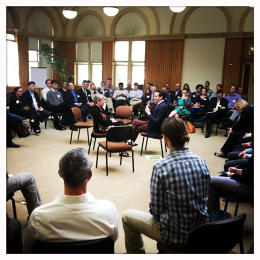
Last week, members of the State Department descended on Stanford University to host a daylong brainstorming session on how to contain all sorts of weapons of mass destruction, including nukes. The 150 people who showed up were a far more eclectic group than you’d find at a usual WMD confab. Wireless executives hobnobbed with criminal investigators. Analysts from microsatellite companies traded business cards with military officers. Data-mining experts rubbed elbows with some of the world’s top disarmament officials.

Keeping track of warheads used to be relatively straightforward. Only a few countries had them, and they tended to stay tucked inside giant missiles. If you knew where the missiles were, you knew where the nukes were. It was no cakewalk, but the United States felt fairly confident monitoring Soviet military movements from space.

Rose Gottemoeller (L) and Zvika Krieger (R)[Photo: courtesy of E.B. Boyd]

Now, however, it’s potentially much easier to build a radioactive bomb the size of a suitcase. Keeping track of all the “hot” stuff, that can be broken down into smaller pieces, is a fundamentally different puzzle than knowing how to spot big Russian trucks. The sophisticated containment system the world spent decades constructing isn’t suited to this new problem. That’s why some high-ranking officials—including Rose Gottemoeller, the State Department’s under secretary for arms control and international security—are embracing the notion that some of the best ideas on how to tackle the new challenge might come from people who’ve never heard of terms like “isotopics” or “dismantlement queue.” “If Amazon Prime can track billions of small objects,” Gottemoeller told the crowd at Stanford, “there’s no reason we can’t figure out how to better track WMDs.”

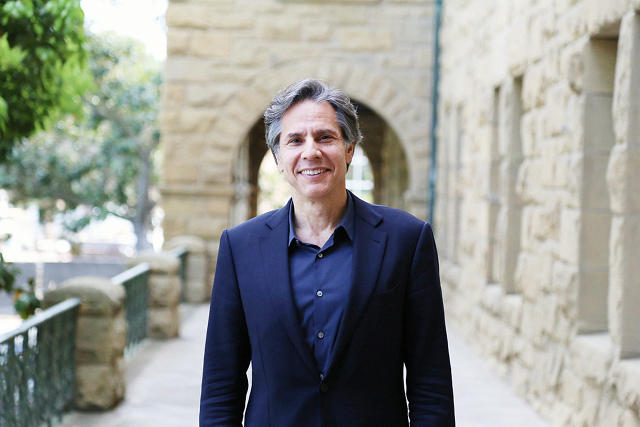
The workshop was the latest project in a larger innovation jag spearheaded by Deputy Secretary of State Antony Blinken. Floppy-haired, blues-guitar-loving Blinken stepped into his new role early last year as the second-in-command at the State Department. In addition to his formal duties, a deputy gets to champion a few pet projects. For Blinken, building bridges to the tech community has become one of those areas of focus. “I’ve spent 23 years in government,” he told me at a sunny campus café not far from the workshop. “More and more, it was becoming evident that many of the problems we were trying to solve were at the intersection of foreign policy and technology.” The dirty bomb issue is a prime example—it takes diplomacy to coordinate other governments in the fight against terrorism, and technology to track such hard-to-trace weapons.

Standing at a podium at Stanford, Blinken described how technological innovation is now as crucial to the State Department’s work as its traditional focus on economics and political affairs—even though the department isn’t exactly fluent in tech. As Blinken put it, sometimes it feels like “we need scientists and technologists in the room just to tell us whether we need scientists and technologists in the room.” That’s why Blinken has instituted an “Innovation Forum” at the State Department, which works on convening gatherings like the WMD workshop, and which he hopes will inspire self-starting, out-of-the-box-thinking, unconventional-solution-producing innovators in the tech community to dedicate some of their time and brainpower to tackling major international issues.

For example, in January, the State Department gathered a different group, also at Stanford, to explore ways to educate the hundreds of thousands of Syrian children now living in refugee camps. Without education, those children will have limited economic opportunities in the future—and young adults with limited prospects are especially vulnerable, as Blinken put it at that gathering, to “the siren call” of terrorism. Another meeting, in New York, explored FinTech. Historically, the United States and its allies controlled bad actors by cutting off their bank accounts using antiterrorism laws. But cryptocurrencies such as Bitcoin now let criminal networks make end runs around such controls. A third gathering in Washington sought new ways to monitor adherence to ceasefires, such as using smartphones and geolocation for crowdsourced reporting of violence.

Antony Blinken[Photo: courtesy of William Russo, State Department]

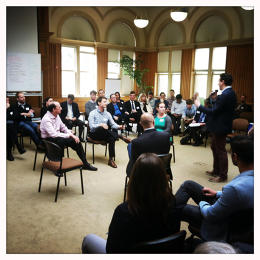
At the Stanford WMD conference, participants were broken into small groups, where they dove into energetic exchanges about how sensors, data, and social media might help officials track fissile material—and maybe even help identify, Minority Report-style, when someone might be planning an attack. One of the participants, Brian MacCarthy, who recently opened a strategic innovations office for Booz Allen Hamilton in Silicon Valley, listened to the discussions—and was impressed. Before he moved out West, he worked inside Washington, selling products and services to government agencies on behalf of a large IT provider. “I was in D.C. for 10 years,” he noted, “and I never could have gotten this kind of a conversation going.”

Blinken’s ideas fall in line with a larger push in Washington to build more bridges to the tech sector and leverage the industry’s creative, can-do spirit to improve the way government operates. Hillary Clinton was the first secretary of state to turn to the modern tech sector for help on the international front. The Pentagon opened an office in Silicon Valley last year, as did the Department of Homeland Security. And, as this publication explored in depth last summer, President Obama has made it a priority to get all-star tech natives to do tours of duty inside the halls of government.

Still, engineering a cultural transformation at the State Department isn’t easy. Washington, like any large, powerful institution, can be set in its ways. “Just the concept of trying new things is an uphill battle,” said State Department senior advisor for tech and innovation Zvika Krieger in a phone conversation after the WMD event. Krieger told me that, when he was planning one of the earlier workshops, he invited some key D.C. stakeholders to participate—but “they were very skeptical. Their point of view was, ‘We’ve never worked with tech before, and we’ve been fine without them.'”

Krieger himself doesn’t share that old-school orientation. He’s a thirtysomething former journalist and innovation specialist who once worked for Secretary of Defense Ashton Carter back when Carter was the number-two guy at the Pentagon. Krieger is taking an iterative approach to the workshops, designing successive events based on learnings from previous ones. “We’re prototyping how we approach Silicon Valley,” says Krieger, who always seems to have a merry twinkle in his eye. “We’re seeing which formats work and what issues we should engage on.”

The difference between traditional government approaches and Silicon Valley methods were visually palpable at the WMD event. Nuclear Security Summits, which take place biannually, are solemn meetings at which world leaders sit stiffly around enormous round tables (that, ironically, and most likely unintentionally, bear an unfortunate resemblance to the ominous war room in Dr. Strangelove). The large conference room at Stanford, by contrast, was strewn with Post-it notes and Sharpie markers, and chairs were pushed aside in favor of casual small-group discussions.

By the end of the day, the teams came up with a handful of ideas—for example, testing how effective crowdsourcing can be at identifying nuclear sites in visual data, or holding a competition to see how well various sensing technologies could identify the presence of dangerous types of radioactive material in a crowded area. The participants were clearly excited by the challenge. “I’ve been working on some pieces [of my research] for 20 to 30 years,” said Kent Langley, a professor at Singularity University and a data-science entrepreneur. One of his companies has developed a platform that crunches large amounts of data to predict the intentions of potential customers, so a company can better market to them. One of the workshop small groups, by contrast, discussed how data could be crunched to figure out a potential terrorist’s intentions. The workshop, Langley said, made him realize his work could help “save lives.” “Let’s do that!” he said.

This is exactly what the State Department is banking on. Blinken and Krieger know that single daylong sessions can hardly hope to produce immediately actionable solutions, but they want to spread the message that the government no longer feels a need to retain a monopoly on solving these problems. Blinken’s team hopes top minds in the Valley and other innovation hubs will be inspired to take a stab at these big, gnarly questions. Their plan might be working. Just weeks after the workshop on Syrian education, some participants forged ahead on their own and tinkered with some of the ideas born during the session, such as using mobile phones for language instruction, or distributing tablets preloaded with educational content in refugee camps and recruiting solar companies to provide the panels needed to power them.

This kind of scrappy, just-dive-in response from Valley denizens gives Krieger hope. “In D.C., we would have spent months battling different bureaucratic hurdles to get all of the different stakeholders to buy in,” he said, “and we would have had to find the money for it when so much of our money is apportioned years in advance.”

On the other hand, Blinken and Krieger have precious little time to make headway. Obama leaves office next January. Even if a Democrat wins the White House in the fall, it’s standard practice for political appointees, like Blinken, to step down, so that incoming secretaries can bring in their own teams. Blinken’s “minimal viable product,” then, is just to produce a credible proof of concept for his meeting-of-the-minds program. “My hope is that this becomes institutionalized by the time we leave,” he said. “And that whoever follows us wants to continue it.”

Photographs courtesy of E.B. Boyd, with the exception of the mushroom cloud (via Wikipedia) and the portrait of Antony Blinken (courtesy of William Russo, State Department)

Read More

The Burr-Feinstein Encryption Bill Is Probably D.O.A.

The encryption bill being floated by Senators Richard Burr and Dianne Feinstein already seems marked for failure because of a promised filibuster, a hostile House of Representatives, an eventual POTUS veto, and universal opposition from Silicon Valley and privacy groups.

The bill, which was leaked last Friday and circulated Wednesday, mandates that U.S. technology companies establish an encryption “backdoor” through which government agencies can access user data on the power of a warrant or court order.

The main problem with the bill, sources say, is that it touches only U.S.-based hardware and software companies, and so will do little to curb terrorism. The Internet, after all, isn’t confined by borders, so bad actors could easily abandon tech products with backdoors and move to ones with better security. Terrorist networks are already known to use apps Telegram or Signal, which are operated by companies outside the United States and use strong, open-source encryption.

The Burr-Feinstein bill will next be discussed and marked up in the Senate Intelligence Committee, which Senator Burr chairs and of which Feinstein is the ranking member. If the marked-up bill passes a vote in the committee it could be introduced on the Senate floor.

But Senator Ron Wyden (D-Oregon)—the second-ranking Democrat on the Intelligence Committee—has vowed to be waiting there with a filibuster if that happens. Wyden does not believe the problems with the bill can be fixed with markups, a spokesman said.

Even without a filibuster, Congressman Darrell Issa (R-Calif.) said the bill almost certainly lacks the votes for passage in the Senate. It’s even more unlikely that a companion bill would be introduced in the House, where passage is next to impossible.

The White House has already said that it won’t support the Burr-Feinstein bill in its current form.

At least one Republican member of Senate Intelligence Committee—Senator Dan Coats (R-Indiana)—came out in support of the bill in an interview with NPR Wednesday night.

Other than Coats, it was difficult to find members of Congress who are in support of the bill. A Coats spokesman said in an email note he knew of no others supporting it.

“The discussion draft was released just yesterday and staff is in the process of talking to stakeholders,” said a Feinstein spokesman. “I’m sure we’ll be in a position to discuss support for the bill down the road.”

It was far easier finding people in Washington to speak out against the bill.

“The bill goes to an inherent constitutional question of do we have a right to produce a product that commits no crime, or provide a service that commits no crime, and guarantees security, or do we have to presume that locks have to be insecure so that law enforcement can get to them?” Issa told Fast Company Thursday.

The question still remains as to whether it’s really possible to write a viable law that would both allow the government access to encrypted data without seriously weakening personal data security in a time when hackers are becoming more resourceful and aggressive.

“People are trying to find the middle ground between encryption and national security,” Congresswoman Zoe Lofgren told Fast Company Thursday. “If there is some middle ground that I don’t know about I would be happy to hear it, but if you create holes in the encryption you make security weaker.”

Both Issa and Lofgren sit on the House Judiciary Committee, which held a hearing on encryption where both Apple and the FBI testified.

Both Senators pointed to an editorial in the San Jose Mercury News titled “Feinstein still clueless on technology after all these years.”

The language of the bill indeed does expose a big disconnect between the thinking of the national security community and the tech community.

Apple, which has been at the center of the encryption debate, also chose not to comment. Apple and the FBI will testify in front of another Congressional committee—the House Energy and Commerce Committee—next Tuesday.

Several members of Congress have told Fast Company that the political winds are blowing away from carte blanche government surveillance and toward stronger encryption in a broad sense. Just yesterday members of the House Judiciary Committee voted overwhelmingly to increase the personal data security protections in the Email Privacy Act.

Read More